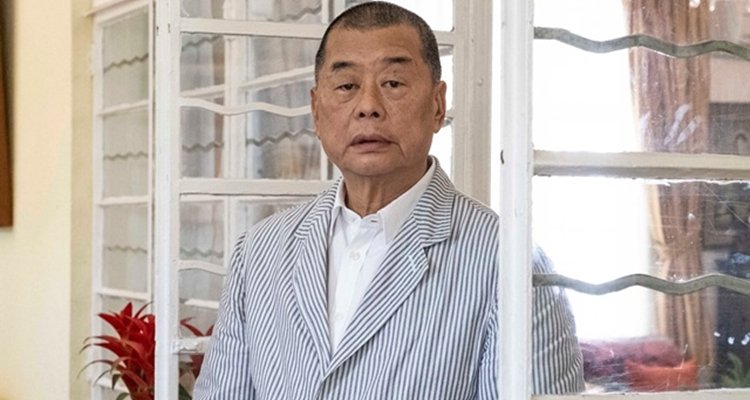
Here we go again: “Jimmy Lai, 78, has been held since December 2020 and is currently serving what his supporters describe as a politically motivated 20-year sentence under Hong Kong’s national security law” (Sri Lanka Guardian, April 20, 2026).
“What his supporters describe as”? The delimitation is superfluous and offensive.
It’s the Chinese Communist Party. The Party’s injustices in the matter of Jimmy Lai are as difficult to perceive as whether the cat is on the mat. Lai is not accused of bank robbery. The CCP went after him and is giving him what seems to be the longest sentence of any of those punished for leading widespread and years-long protests against the mainland’s tyranny because it regards Lai as one of the very top leaders of those protests. This resistance, stymied at least for now by the National Security Law of 2020, had been joined by tens of thousands of Hongkongers.
How can the reporter regard as doubtful such a mild and inescapable characterization of the arrest, conviction, and sentencing of Lai as “politically motivated” when we have the whole history of the CCP to look at, all the reporting of the last decade, all the public statements about Lai made by CCP officials and functionaries, including Hong Kong judges who laughably pretend to be impartial, and no evidence of any other motive save sadism?
“Collusion” and “sedition”
At least the author is willing to enclose the word “seditious” (though not the word “collusion”) in skeptical quotation marks in this summary: Lai “has spent more than 1,900 days in solitary confinement at Stanley Prison, a maximum-security facility on Hong Kong Island. His conviction includes charges such as collusion with foreign forces and publishing ‘seditious’ material through his now-closed pro-democracy newspaper Apple Daily.”
[The family’s] hope now rests partly on international diplomacy. They are watching closely ahead of a planned meeting between Donald Trump and Chinese President Xi Jinping, believing the case could be raised at the highest level. “I hope he raises it and tells President Xi it is not in his interest to keep my father locked up,” Sebastien Lai says, noting that there is bipartisan support for his father in the United States. British officials, including Prime Minister Keir Starmer, have also raised the case, though the family believes diplomatic efforts have often prioritised trade relations.
At the heart of their appeal are a series of letters written by Jimmy Lai from his prison cell. Published publicly for the first time, the correspondence reveals a man reflecting on faith, family, and suffering with a striking tone of spiritual resilience. “You are a real angel, so don’t worry about anything,” one letter reads to his daughter. “Through suffering I realize that living a life you won’t stake your life for is not worth living for.”
Born in Guangzhou in 1947, Lai fled mainland China as a child and smuggled himself into Hong Kong at the age of 12. He worked in a textile factory, lost part of a finger and hearing in one ear, and eventually built a business empire that made him a billionaire media mogul. His newspapers Apple Daily and Next Magazine became rare outspoken voices in support of Hong Kong’s pro-democracy movement, particularly after the 1989 Tiananmen Square crackdown, which he described as politically transformative.
That activism came at a cost. Over the years, Lai and his family were subject to intimidation, surveillance, and violent threats, including firebomb attacks on his home and a gruesome incident in which animal remains were left at his door.
The writer is sympathetic. After preserving himself from the necessity of making any independent assessment of what is happening here—including whether the diplomatic efforts of UK Prime Minister Keir Starmer have “often prioritised trade relations” at the expense of Lai and the UK’s own security—he conveys a few salient facts about the experiences of Jimmy Lai and his children.
It’s an article about family ties and travails, not injustice. The conclusion is that “as pressure builds and his letters circulate more widely, Jimmy Lai’s voice from prison is becoming harder to ignore.” This may even lead to a productive investigation about whether the children are right in supposing the imprisonment of their father to be as politically motivated as all the harassment that preceded it.