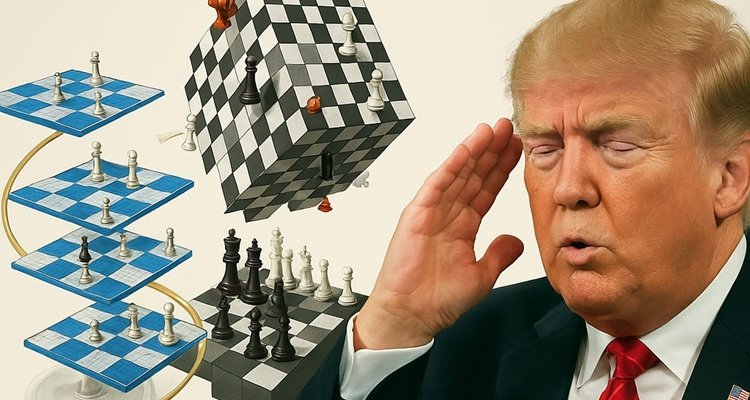
You would think that the challenge inherent in chess could provide a simple metaphor, as in “He is playing the situation like a grandmaster.” But some people don’t trust that a reference to chess—by itself—can suggest much difficulty. They have to add extra dimensions.
For example, “Trump’s 3D chess has many moving pieces.” Moving pieces too? Not good enough: “President Trump is playing four-dimensional chess.” Still not good enough: “Is Trump Playing 5D Chess?” Maybe so: “Trump Finally Reveals His 5D Chess Strategy.” But even that’s not good enough: “Trump playing 6D Chess | Trapped China in its own game.”
Order in chaos
When we set aside the silly headlines and chess references, we find some interesting analysis about the possible U.S. strategies being advanced by the current Iran war, behind what the press largely considers to be international chaos. This material ranges from the fairly direct to the intriguingly complex.
The thinking of former member of parliament Sir Jacob Rees-Mogg is linear. President Trump knows what he wants to do and the war will produce these effects: It will force countries to take energy security seriously change their environmentalist rules to enlarge supply; and after any settlement, Iran will become a major supplier of world oil, lowering energy costs.
GB News commentator Alex Armstrong says: “Look who’s got the upper hand all of a sudden. America is now controlling vast swaths of oil that [Red] China needs” just as Beijing is about to enter negotiations with the United States. Europe has also been made dependent on U.S. energy, and “Washington will dictate terms and use energy as leverage, not just economically but geopolitically.”
Another commentator, Jesús Enrique Rosas, recently noticed that “Hundreds of supertankers, the kind that carry two million barrels each, are currently racing toward the US Gulf Coast from every direction. Atlantic, Indian Ocean, around Africa, the scenic route.”
American oil exports are approaching record levels. Gulf Coast refineries are running at 95% capacity. Supertankers that were mid-ocean on their way to the Persian Gulf literally turned around and headed to Texas. That’s not a metaphor. Ship tracking data shows them doing U-turns in the Indian Ocean.
Meanwhile China, which was getting 45% of its oil imports through Hormuz and paying basement prices for sanctioned Iranian crude, is now competing with Japan and Europe for the same expensive American barrels. Chinese manufacturers are already raising prices 20% on goods headed to the US….
This is either the most elaborate coincidence in the history of geopolitics…or someone planned the sequence Venezuela ->
Iran -> profits!
Real Clear Defense summarizes a Foreign Affairs article this way: “The president conceives U.S. relations with both its adversaries and allies as inherently zero-sum. In contrast, during the Cold War, the overriding logic of containing the Soviet Union meant that the U.S. behaved as a benevolent superpower vis-à-vis its European and Asian allies…. The fundamental shift towards a superpower’s predatory behavior marks a break in the tradition of non-use…. Trump is…constructing a new set of traditions around the application of U.S. power, which are likely to last beyond his term in office.”
Great wall
Daniel Kishi, with The American Compass think tank, sees a strategy in which America is building “a great wall around China.”
This began before the Iranian war, although the war certainly contributes to the trend. Tariffs rerouted CCP trade through third countries and the shutdown of suppliers like Venezuela and Iran exacerbate Beijing’s need for front men and pass-throughs.
“Nine [U.S.] Agreements on Reciprocal Trade [have been] finalized with Malaysia, Cambodia, El Salvador, Guatemala, Argentina, Bangladesh, Taiwan, Indonesia, and Ecuador,” with more on the way. They “contain a set of commitments that amount to a China containment strategy.” Their provisions “all serve three strategic functions: blocking Chinese goods from reaching the U.S. market through third countries, requiring partners to align with U.S. restrictions on China, and penalizing partners who undermine the architecture…. The agreements also obligate partners to address the unfair practices of ‘companies owned or controlled by third countries,’ a formulation that describes the mechanics of Chinese state-backed overcapacity without naming it directly.”
James Thorne, strategist with Canadian wealth management company Wellington-Altus, ramps up the complexity:
Trump’s second term is not just another burst of tariff theatre; it is the opening move in a new great game over energy, artificial intelligence, and money. By neutralizing Iran and Venezuela, squeezing Cuba, binding Canada, and courting Russia, Washington is trying to re-anchor oil in U.S. dollars and push BRICS’ [trading bloc] monetary ambitions to the margins. Layered on top are digital rails—dollar-backed stablecoins, tokenized Treasuries, gold, and even a strategic bitcoin reserve—designed to harden, not retire, King Dollar. If it works, Bretton Woods 2.0 will arrive not as a conference, but as the unannounced sequel to a crisis-ridden decade, with the U.S. once again writing the rules….
Neutralizing Iran…is meant to rip out China’s forward base in the Gulf and tilt that Great Game back toward Washington. It is not only about disrupting a regional spoiler; it also means stress testing the Chinese missile, satellite, and surveillance stack now embedded in Tehran. For the strategists around Trump, this is the mid-game position in which the whispered “Here begins the Great Game” has already given way to a more confident, if unspoken, “and we intend to finish it.”
A doctrine
So we are back to a game, albeit other than chess. And who can disagree with Thorne’s conclusion?
“If this project succeeds even partially, the shift will not just be institutional and geopolitical; it will be profoundly psychological. A world that watches the U.S. run the economy hot, grow out of a debt scare, retool its industrial base with productive capital, lead in digital assets and AI, and reassert de facto control over global energy markets will not seem a fluke. It will seem a doctrine.” □
James Roth works for a major defense contractor in Virginia.