The notion that China won’t ship missiles to Iran because China dictator Xi Jinping has told U.S. President Donald Trump that China won’t do so is a little wobbly.
But maybe it’s true. Perhaps, as a show of good faith, China could let the U.S. borrow recently developed Chinese super-satellite technology so that the U.S. could use it to track vessels leaving China. Defence Security Asia reports on Chinese satellites that “Could Track Every U.S. Warship on Earth,” portending the “End of Naval Stealth” (April 14, 2026).
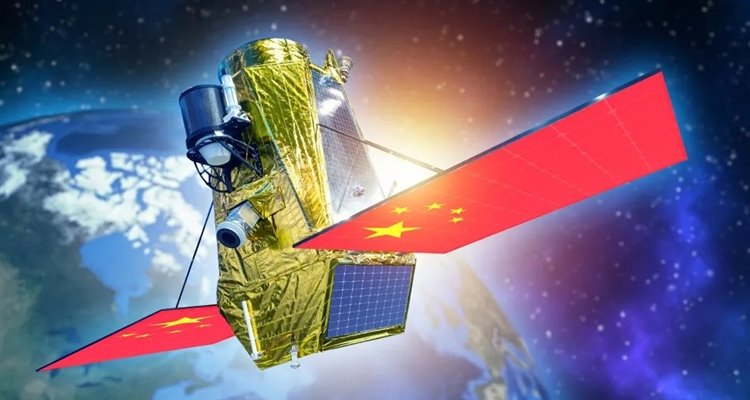
As the 340-metre Japanese tanker Towa Maru crossed rough seas near the Spratly Islands, a Chinese geosynchronous synthetic-aperture radar satellite maintained continuous contact from 35,800 kilometres above Earth despite cloud cover, darkness and severe ocean interference.
Lead researcher Hu Yuxin declared that the new processing architecture could isolate weak ship echoes from violent sea clutter at distances previously considered physically impractical, fundamentally overturning assumptions about high-orbit radar reconnaissance.
If fused with other Chinese intelligence networks, including over-the-horizon radars, underwater sensors, drones and long-range anti-ship missiles, the capability could dramatically compress warning times for U.S. naval commanders throughout the Indo-Pacific.
The demonstration is especially consequential because American carrier strike groups approaching Taiwan or the South China Sea could now be detected, tracked and targeted far earlier than previously assumed….
Military planners have long assumed that geosynchronous orbit was unsuitable for tracking moving ships because the radar signal weakens dramatically over such immense distances and becomes overwhelmed by wave reflections.
The Chinese demonstration challenges that assumption directly because the satellite not only detected the Towa Maru but maintained a stable tracking solution while the vessel manoeuvred through difficult weather.
Another good thing for China is that geosynchronous satellites are harder to track than low-orbit satellites.
All this is “strategically alarming because future Chinese satellites could watch entire naval formations continuously rather than merely identifying their last known positions.” That’s if all pans out as projected.
Hu Yuxin is affiliated with institutions like the University of Chinese Academy of Sciences and Xi’an Jiaotong University, which have participated in academic collaborations with American universities. But his own work and that of his known Chinese colleagues does not seem to have benefited from direct collaborations with U.S. academics.