Hard to disagree with this from The New York Times: “President Trump’s open willingness to hold up a $14 billion Taiwan arms package is a win for Beijing. Now China could be weighing how to keep the weapons on ice for as long as it can” (May 18, 2026).
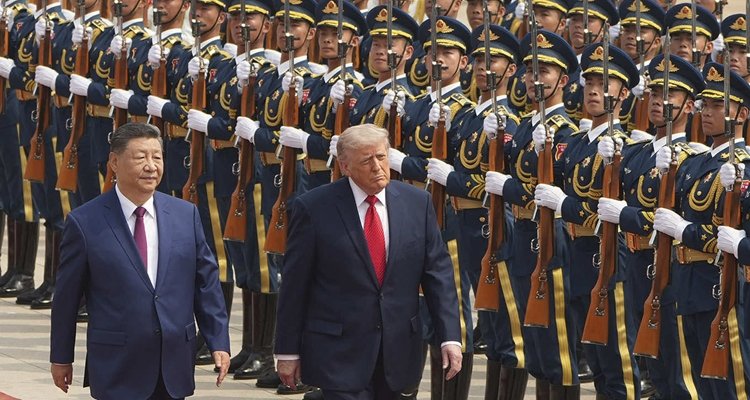
On Monday, China’s state media used Mr. Trump’s comments to send a message at home and to Taiwan: that the United States cannot be relied on to defend Taiwan, the island democracy that Beijing claims as its territory.
President Lai Ching-te of Taiwan, a frequent target of Beijing’s vitriol, and his Democratic Progressive Party can no longer rely on “unconditional indulgence” from the United States, said the Global Times, a Chinese newspaper, citing a Chinese researcher.
“Security cannot be bought with military purchases; if you become a pawn, you will only be squeezed dry,” said Col. Jiang Bin, a spokesman for China’s Ministry of National Defense, on Monday, referring to Taiwan.
The American president’s comments had been released over the weekend, after Mr. Trump left a summit with Mr. Xi in Beijing on Friday. He said he was keeping on hold a decision about a package of weapons to Taiwan worth around $14 billion, and described it as a “very good negotiating chip” that could be used with Beijing….
Beijing can gain some advantage simply if Mr. Trump puts off any approval for long enough, some analysts said.
“The question is whether the pending $14 billion sale is delayed for weeks, months, or longer,” said Craig Singleton, the China Program senior director at the Foundation for Defense of Democracies in Washington. “A prolonged hold, especially one shaped by Beijing’s objections, would raise much more serious concerns about the reliability of U.S. deterrence.”
I suppose that in line with Colonel Jiang Bin’s dictum that security cannot be bought with military purchases, we can expect that the People’s Republic of China will immediately destroy all of its military weapons. If you agree, contact me about a certain bridge I want to sell you.
Of course, it’s not military purchases alone that “buy” security. One must get the weapons—they have to be shipped if they are not where one is already. Then one must set up or store the weapons in various locations. One must also train people in how to use them. Many other policies and actions are also relevant. In any case, one can only increase security, never become absolutely secure, by doing these things. Not while an enemy you can’t get rid of continues to circle, growl, and menace.
Not a bargaining chip
Craig Singleton in The Washington Post:
Taiwan’s weapons shouldn’t be treated as leverage to be traded with Beijing. They are the means by which Washington helps ensure Chinese leader Xi Jinping never believes that trying to forcibly reclaim the island democracy of 23 million people can succeed at an acceptable cost.
Deterrence delayed is deterrence degraded. Taiwan needs missiles, air defenses, anti-drone systems, mobile launchers, training and munitions before a crisis begins. Once Chinese ships, aircraft and cyber units are moving, the window of opportunity to sufficiently arm Taiwan would shut almost instantly. The purpose of arming Taiwan now is to avoid ever needing that window….
Punishing Taiwan after it steps up sends the wrong message. It tells U.S. partners that even when they spend more, buy American and take their defense seriously, American support can still become conditional on the preferences of the very adversary threatening them.
It sends Beijing an even worse signal. If the strengthening of Taiwan’s defense can be slowed or suspended when Beijing objects, Xi has every reason to object louder….
Lawmakers should press the administration to approve the package, accelerate delivery timelines and explain any delay.
Less decorous than the Times or the Post is Mitchell Sobieski, writing in the Milwaukee Independent:
Such a systemic retreat [from previous diplomacy vis-à-vis the PRC] was most vividly illustrated by Trump’s direct betrayal of Taiwan, a democratic partner systematically degraded during the summit into a mere financial instrument. By publicly confirming that a critical fourteen-billion-dollar defensive arms package was being held in abeyance, explicitly conditioning its delivery on Beijing’s economic behavior, Trump effectively subverted the statutory mandates of the 1979 Taiwan Relations Act.
The unprecedented move replaced a firm legal commitment to democratic defense with an arbitrary, transactional bargaining chip. Furthermore, by publicly adopting Beijing’s preferred narrative and placing the blame for cross-strait tensions onto Taiwan’s democratically elected leadership, Trump neutralized the core psychological element of American deterrence, confirming the region’s deepest fear that Washington views the island as entirely expendable….
Foreign adversaries are no longer forced to outmaneuver American power. They merely have to exploit a short-sighted decision-making process that views vital geopolitical choke points as disposable personal assets….
The illusion of unyielding American resolve has been permanently shattered, replaced by an era of self-inflicted retreat that leaves a fractured international order to navigate the rapid, unchecked rise of authoritarian dominance in the Pacific.
Things may not be as bad as Sobieski supposes, and the policies of previous administrations toward the PRC and the ROC may not constitute quite the gold standard that the commentary seems to imply (see Nixon and Carter for starters). But Trump’s declarations about Taiwan are certainly a disaster, a wholly unnecessary one if the goal of the diplomacy, or whatever it was, in Beijing was simply to maintain stalemate in all the matters of contention with respect to which the U.S. has not already submitted to the Chinese Communist Party.
A time for flip-flopping
Rubio, or somebody, must take on the job of backing the president into a corner and screaming at him about the arms deals and the wrongness of stabbing the Republic of China in the back until he caves. Or, if that would be counterproductive, pummel him with ten compliments per second until he caves.
On the U.S. side, the previous weapons package and the forthcoming weapons package are being or will be held up only because of the White House’s foolish second and third thoughts. The best possible thing that could happen right now is another mercurial Trump pivot and formal release of the weapons to Taipei by 5 p.m. on May 21, 2026.
Also see:
Congress.gov: Taiwan Relations Act (1979)
“Declares it to be the policy of the United States to preserve and promote extensive, close, and friendly commercial, cultural, and other relations between the people of the United States and the people on Taiwan, as well as the people on the China mainland and all other people of the Western Pacific area. Declares that peace and stability in the area are in the political, security, and economic interests of the United States, and are matters of international concern. States that the United States decision to establish diplomatic relations with the People’s Republic of China rests upon the expectation that the future of Taiwan will be determined by peaceful means and that any effort to determine the future of Taiwan by other than peaceful means, including by boycotts or embargoes is considered a threat to the peace and security of the Western Pacific area and of grave concern to the United States. States that the United States shall provide Taiwan with arms of a defensive character and shall maintain the capacity of the United States to resist any resort to force or other forms of coercion that would jeopardize the security, or social or economic system, of the people of Taiwan.”