Would you walk up to a bully flailing away at his victim, who is doing his best to defend himself, and say, “Look, you both need to chill out.” What is this but giving aid and comfort to the bully?
My assumption that U.S. policy toward the Republic of China has emerged more or less unscathed from the set-piece diplomacy in Beijing has been overturned by later reporting on statements by President Trump.
Perhaps the assumption can still be regarded as true if we discount the mere words of the U.S. president, subtracting, let’s say, 100 percent from what he is saying about the People’s Republic of China in relation to the Republic of China and pondering only the residue. But this does not seem to be a promising analytical procedure.
Words
Trump: “I’ll make a determination [about whether to let multi-billion-dollar deals for arms to Taipei proceed] over the next fairly short period….
“President Xi and I talked about Taiwan. On Taiwan, he does not want to see a fight for independence because that would be a very strong confrontation.”
Taiwan is already independent from the People’s Republic of China. The PRC has never governed Taiwan.
“I’ll be making decisions,” Trump said. “But, you know, I think the last thing we need right now is a war that’s 9,500 miles away.”
Trump’s Republican administration in December authorized a record-setting $11 billion weapons package for Taipei, but it has yet to move forward. Lawmakers also approved a $14 billion arms sale to Taiwan in January, but the sale cannot advance until Trump formally sends it to Congress. China opposes such sales and has suggested that Washington’s relationship with the self-governing island is the key factor in U.S.-China relations.
Trump said Xi also reiterated China’s strong opposition to Taiwan’s independence. “I heard him out,” Trump said. “I didn’t make a comment.”
Trump’s consultation with Xi about arms sales to Taiwan may violate the so-called Six Assurances, a set of nonbinding U.S. policy principles formulated in 1982 under President Ronald Reagan that have helped guide the U.S. relationship with Taipei, according to analysts.
The second of the Six Assurances states that the U.S. “did not agree to consult with the People’s Republic of China on arms sales to Taiwan.”
Trump said the issue of the 1982 assurances came up in the talks with Xi.
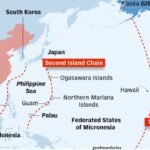
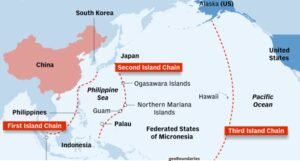
Trump: “When you look at the odds, China is a very, very powerful, big country. [Taiwan is] a very small island. Think of it; it’s 59 miles away. We’re 9,500 miles away. That’s a little bit of a difficult problem.”
Trump, on whether he would be moving forward with the arms deal: “No, I’m holding that in abeyance, and it depends on China. It depends. It’s a very good negotiating chip for us, frankly. It’s a lot of weapons….
“Taiwan would be very smart to cool it a little bit. China would be very smart to cool it a little bit.”
Realities
One can’t ignore the words because some of the words, insofar as reflecting present policy and intentions, must have an immediate destructive effect on the ability of Taiwan to defend itself at its location zero miles away from itself.
The president’s implication that it would be a piece of cake for the mainland to gobble up Taiwan in a military assault is belied by the fact that it hasn’t done so. On this site, James Roth has explained some of the reasons that conquering the island would not be a piece of cake.
Whatever its ability to resist an attack right now, stronger ability to defend itself would make Taiwan even harder to conquer, not easier, and would make war less likely, not more likely.
In the run-up to the summit, Trump seemed to be deferring completion of arms deals with Taipei in order to avoid annoying the dictator until the colloquies had concluded. This rationale was already misguided. But the important thing, we were given to understand, was that the summit Go Well. Now, though, President Trump is talking about keeping the arms to Taipei on ice indefinitely as a bargaining chip.
In hopes that Beijing will do what? Xi is not Sadat.
And what does advice to Taipei to “cool it” mean? That it should do less to protect itself and do more to appease Beijing and should pretend that the Chinese Communist Party is not a constant threat in the myriad ways that it is?
Some deals cannot be made. Trump’s disingenuousness and delay only help Beijing and only hurt Taipei. The former is not going to change any cardinal aspect of its policy toward the latter unless and until the regime changes in Beijing or Beijing invades. If Beijing invades before Trump leaves office, his saying at that point “Omigod, I was wrong, let’s get those arms shipped to Taiwan ASAP” will not be very comforting to the Taiwanese.
Also see:
StoptheCCP.org: “Red China Cannot Conquer Taiwan at Hypersonic Speed”
StoptheCCP.org: “How Not to Better Defend Taiwan”
StoptheCCP.org: “Three Ways Red China Might Not Grab the Republic of China”
StoptheCCP.org: “What War Between Beijing and Taipei Would Really Mean”