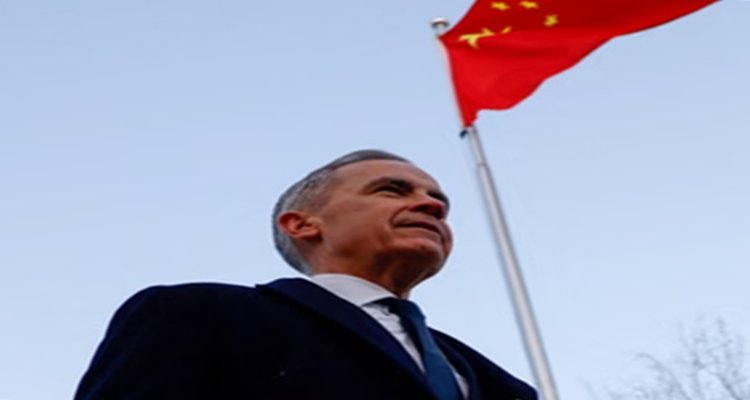
In January, Canadian Prime Minister Mark Carney and Xi Jinping announced “a new Canada–[Red] China strategic partnership” composed of “five pillars: energy, economic and trade cooperation, public safety and security[!], multilateralism, and culture and people-to-people ties.”
This week, a few pieces of the safety and security pillar crumbled away when former Mountie William Majcher was acquitted of “engaging in preparatory acts to commit an offence.” It appears that Canadian laws prevented Chinese authorities “from directly contacting a Vancouver-based millionaire wanted for financial crimes in [communist] China.” Majcher was accused of being a go-between.
“The Crown had argued that [incriminating] emails were proof Majcher was attempting to force Sun to comply with the wishes of Chinese authorities.” The judge said that the “requisite specific intent” was missing. Asked if the trial was political, Majcher’s lawyer, Ian Donaldson, said: “I think there are many who believe that there was a small ‘p’ political agenda, that China, many years ago, was thought to be the enemy. Today, of course, with irony, America is thought to be the enemy, and China is our friend. From my perspective, that has nothing to do with what happened today.”
The trial had uncovered that “at least 25 Canadian residents were targeted by Chinese police under an anti-corruption program, which doubled as a tool of transnational repression. [An] affidavit shows that the Chinese nationals may have been forced to return to their homeland against their will to face punishment for alleged financial crimes. Some of them would have faced life imprisonment, or even a death sentence.”
Respective laws
The trial also drew attention to a memorandum of understanding “on cooperation in combating crimes” between the Royal Canadian Mounted Police and the Ministry of Public Security of the People’s Republic of China. In a joint statement (not necessarily also in the MOU), the two sides “committed to strengthening law enforcement cooperation to combat corruption and transnational crimes, including telecommunication and cyber fraud and illegal synthetic drugs in accordance with their respective laws.’ ”
Jenny Kwan, member of parliament for Vancouver East, said on X that she was “calling on Mark Carney govt to stop hiding RCMP–MPS MOU signed in Beijing. Reports that RCMP needs Beijing’s ‘permission’ to show this MOU to Canadians [indicate] a threat to our sovereignty.”
Per CTV News, Kwan has written “that it is ‘troubling’ that the federal government has ‘declined to proactively disclose the police co-operation agreement, despite its significant implications for public safety, civil liberties, diaspora communities and national sovereignty.’ ”
Other critics also agree that
the federal government should disclose the text of the MOU, given the evidence presented at Majcher’s trial, which shows Chinese police acted outside of Canadian laws, as well as threatened and harassed permanent residents in Canada. Lansdon Chan, an advocacy officer with Hong Kong Watch, says the expansion of official engagement with China’s police is alarming, given what was revealed at the Majcher trial.
“The least the government can do is disclose fully what is in the agreement for transparency and public confidence,” said Chan. “The Hong Kong community does not have confidence they will be protected if they speak out against China.”
One example of Chinese police violating human rights that was cited in the Majcher trial involved a former Chinese Supreme People’s Court Judge who moved to Canada in 2014.
Xie Weidong criticized Beijing’s justice system and was accused of corruption. To pressure Xie to return home, the MPS imprisoned his sister and kidnapped his son from an underground garage in China. Beijing also sent agents to Toronto to threaten and harass Xie, according to an RCMP affidavit.
In 2024, the Canadian parliament passed the Foreign Influence Transparency and Accountability Act, designed to curb foreign interference and directing creation of a foreign agent registry. That registry has yet to be created. As part of the Act, a “foreign influence transparency commissioner” has been appointed.
The United States
The United States has a similar bill, H.R.1819, the Foreign Influence Transparency Act (no Accountability in this case). Introduced in 2023, it is currently “Referred to the Committee on the Judiciary, and in addition to the Committee on Education and the Workforce, for a period to be subsequently determined by the Speaker, in each case for consideration of such provisions as fall within the jurisdiction of the committee concerned.” Whatever that means.
The draft American law aims to address “foreign influence in higher education and in certain other academic, religious, and artistic pursuits” in part by limiting an existing exemption from requirements to register as a foreign agent for persons who are “engaging in activities in furtherance of religious, scholastic, academic, or scientific pursuits or of the fine arts.” The Act would require that the exemption be available to persons engaging in such activities “only if those activities do not promote the political agenda of a foreign government.”
This is obviously not broad enough, and the exemption language looks like it’s there to appease hardliners. Who’s going to examine the activities for political agendas and who, accused of promoting the political agenda of a foreign government, would refrain from going to court to resist?
And the stale odor of 2023 indicates that our Congress is not terribly interested in this legislation anyway. □
James Roth works for a major defense contractor in Virginia.