The Washington Post reports that “Scientists say U.S. will suffer if White House bars science with China” (August 11, 2026).
If the headline is accurate, what many scientists believe will happen under a proposed OMB rule is not quite accurate: what would be prohibited is government funding of “U.S. science collaboration with China.” According to the Federal Register, the proposed rule “does not prohibit recipients from engaging in foreign collaborations using non-Federal funds.” However, since so much scientific research is funded by the federal government, the perception is close enough.
In April, the independent U.S. government board overseeing $9 billion in federal science funding prepared to issue a stark warning in its biennial report to the president and Congress: China has surpassed the United States as the world’s top investor and producer of science and engineering research and development.
For years, the National Science Board backed efforts to shield U.S. research funds from enabling academic theft, while maintaining that scientific engagement with China is essential to understanding and competing with an increasingly formidable rival.
Days before the report was to be released, President Donald Trump dismissed all 22 board members and proposed a dramatically different course: sever virtually all federally funded research collaborations involving China.
The proposed Office of Management and Budget rule, set to take effect in December [originally October 1, 2026], would mark one of the biggest overhauls of U.S. science funding in decades, giving political appointees greater authority over grant awards previously guided by scientific peer review and requiring they “advance the President’s policy priorities.”
It would also effectively expand the 2011 Wolf Amendment, which bars scientists from using NASA funding for bilateral collaborations with China, to all federal agencies and scientists receiving federal funds, marking the largest break in U.S.-China scientific engagement in decades.
The Post says that 88 percent of 50,000 public comments on the proposed rule—a sample of almost half a million comments—are negative. Many of these comments come from “scientists and top U.S. science bodies.”
A fired NSB member says: “At a time when we know that our main competitor has a stronger hand, you want to stay in the game. Or else we will just be more and more in the dark as China pulls farther and farther ahead.”
How did we get here?
Does China’s decades of intellectual property theft and collaborations with Western researchers have any bearing on how it has pulled “farther and farther ahead,” if it has?
The Post seems to relay little recognition by many opponents of the funding ban of why the collaborations have been a problem: the benefits for the Chinese Communist Party. These benefits include facilitation of AI-abetted mass surveillance and predictive policing, biometric surveillance, mass censorship, military intelligence and targeting, cyberattacks, drones, hypersonics, nuclear and other weaponry, satellite technology, propulsion, robotics, computer science.
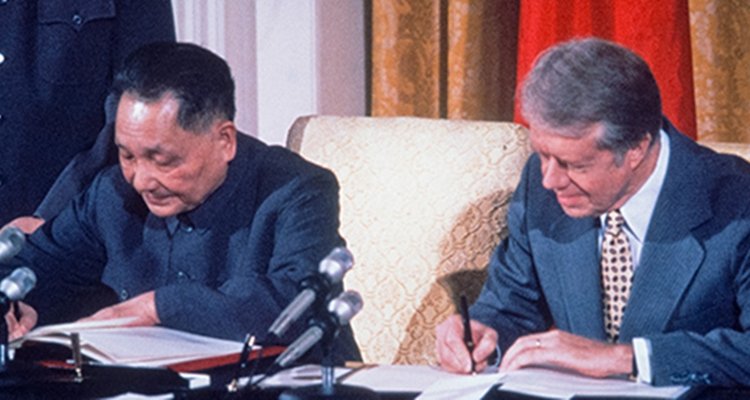
Critics of the CCP-facilitating collaborations note that the rise of Red China as a “scientific superpower” has been made possible not only by “massive investment from Beijing” but also by “systematic theft of U.S. research and intellectual property, as well as decades of failure to confront the security risks of scientific ties with China.” Such ties were formalized during the Carter years.
The Post notes that in 2025, a report issued by the Select Committee on the CCP, following up on an earlier report, “found thousands of U.S. research papers involved co-authors affiliated with Chinese defense-linked organizations working in fields including artificial intelligence, hypersonics and nuclear physics.”
If we want to prevent U.S. researchers from working to enhance the CCP’s domestic and international threats, the U.S. government cannot keep paying for collaborations that enhance those threats.
Compromise?
Some opponents of the impending rule say that it has a point but is too broad. They suggest that there must be a way to distinguish potentially harmful collaborations with PRC researchers from obviously innocuous ones. But it’s hardly obvious that making and enforcing this distinction would be practicable. Seemingly benign findings may be indirectly rather than directly and obviously useful to the PRC and its military.
We must keep in mind that under the totalitarian regime’s official policy of military-civil fusion, the Party “is acquiring the intellectual property, key research, and technological advances of the world’s citizens, researchers, scholars, and private industry in order to advance the CCP’s military aims. The CCP is systematically reorganizing the Chinese science and technology enterprise to ensure that new innovations simultaneously advance economic and military development.”
Also see:
Select Committee on the CCP: Fox in the Henhouse: The U.S. Department of Defense Research and Engineering’s Failure to Protect Taxpayer-Funded Research (2025)
Select Committee on the CCP: CCP on the Quad: How American Taxpayers and Universities Fund the CCP’s Advanced Military and Technological Research (2024)