Earlier this month Red China purged another Politburo member, this one accused of bribery while at China Aerospace Science and Technology Corp. He was one of 33 senior communists recently expelled from the Party.
The ongoing purges have hit Beijing’s military especially hard, with Reuters speculating that “The extensive replacements of military brass mean that [Red] China maintains its current defense posture, continuing weapons tests and increasingly complex exercises. But question marks linger over the impact of the purges on [its] ability to wage war….”
This is the nub of the matter. If Beijing were going to reform its armed forces for the sake of more effectively waging war in the Pacific, it would first need to fill the vacant commands and stop creating more gaps through continued purges. Then again, it may be that purging is the only kind of military “reform” that a regime this brittle and unstable can manage. Beijing may never get to the next step of undertaking actual military reforms.
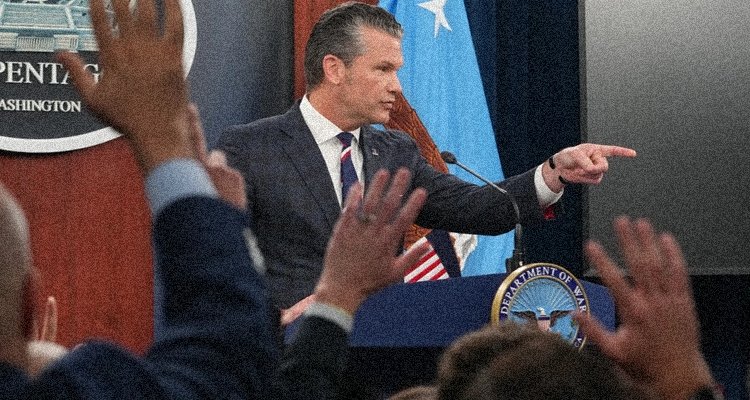
The communist-purge headlines appeared while Washington was in a tizzy over the possible (and, later, failed) impeachment of Secretary of War Pete Hegseth, motivated in part by his own purging of Obama-installed and Biden-installed generals and his reduction of the number of flag officers on active duty.
Hegseth is that very rare thing in America’s federal government, a military reformer. And what to reform is such a broad question that each reformer brings in a different agenda.
Earlier agendas
Under Presidents Nixon and Ford, Secretary of Defense James Schlesinger concerned himself with ending reliance on mutually assured destruction (deterrence) and restoring the balance between conventional and nuclear forces, among other projects. Schlesinger reformed at a very high level. He died last year.
Over a decade after the Ford presidency, Senator Barry Goldwater and Representative Bill Nichols authored the eponymous Goldwater-Nichols Act in response to conspicuous military failures. It was notable in reforming the authority of the Joint Chiefs of Staff, improving communications within DoD, and forcing upon the services a collaboration now called “jointness.” Jointness replacing the previous disjointedness, as it were.
We reformers had high hopes for Donald Rumsfeld during his second tour as Secretary of Defense.
As a piece from July 2001 noted, “Rumsfeld has a mandate from the President to challenge Pentagon orthodoxy and transform the military into an information-age force. [George W.] Bush declared…on the campaign trail that ‘As President, I will begin an immediate, comprehensive review of our military—the structure of its forces, the state of its strategy, the priorities of its procurement—conducted by a leadership team under the Secretary of Defense.’ He said that he would give his defense secretary ‘a broad mandate—to challenge the status quo and envision a new architecture of American defense for decades to come.’ ”
NBC put it put it this way, “Two years before American troops invaded Iraq, Defense Secretary Donald Rumsfeld declared a personal war against the U.S. military’s Cold War mentality and Pentagon bureaucracy. Rumsfeld put forward a vision for a top-to-bottom transformation in the way the military fights and how the Pentagon conducts its business.”
Very encouraging.
However, the generals and admirals were unwilling to be warred against. “In the months before the terrorist attacks,” History Network reports, “Rumsfeld’s efforts to modernize the military met formidable resistance from military brass themselves. The Pentagon joined forces with its political allies in Congress and elsewhere in Washington to undermine Rumsfeld’s plans.”
In his book Rumsfeld, Andrew Cockburn records Rumsfeld’s observation that the Pentagon was an “adversary that poses a serious threat to the security of the United States.”
And then came the war. And suddenly the reforms became all about force structures, unit sizes and military doctrines. The underlying problems remained.
In his memoir Duty, Rumsfeld successor Robert Gates lays out clearly how the Pentagon must be managed. “Very specific objectives, with tight deadlines and in-person reports to the secretary himself provide the only way to get people focused and to ensure they are performing.” And this is just to achieve a reasonable level of business as usual. Gates was a skilled administrator, not a reformer.
Pete Hegseth
Hegseth faces a more difficult struggle in the kind of reform he wants to implement, that which is the “moral” (in Napoleon’s sense of the word). He is very concerned with fighting spirit, and he is very down on the military’s countervailing, pervasive administrative ethos.
Gates notes in his book that, for instance, the rotation of senior officers through the Middle East war zones was entirely based on personnel requirements rather than on fighting qualities. Moreover, commanders were not permitted to pick their subordinates—this was another personnel matter.
A member of the staff of Iraq commander George Casey once told your author that Casey would often spend days laboring over a single PowerPoint presentation. Perhaps this is another example of the persistence of peacetime values and norms in wartime that Gates observed.
Publicity about Hegseth’s reforms has boosted recruitment. He expresses his goals plainly: “From this moment forward, the only mission of the newly restored Department of War is this: warfighting, preparing for war and preparing to win, unrelenting and uncompromising in that pursuit.”
This is the hardest kind of reform to implement. The incentive structures that brought us DEI, free trans surgeries for military members, and a host of evils—those incentives are still there, latent. The danger is that they will rise to the surface at the next change of administration.
Hegseth’s challenge is to make his changes and then to make them stick. □
James Roth works for a major defense contractor in Virginia.