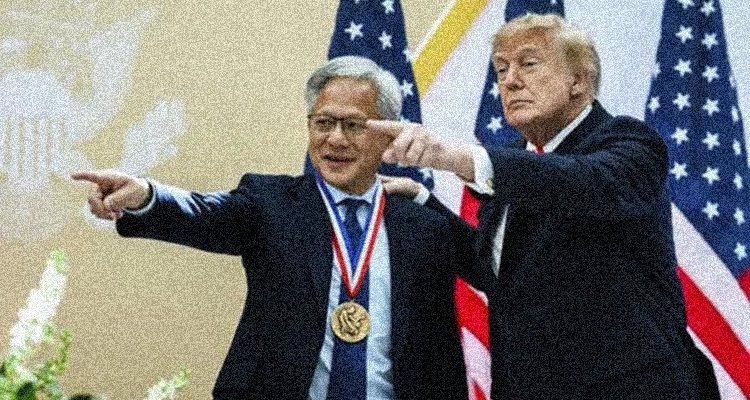
President Trump downplays the significance of any alert he may have been given about Nvidia CEO Jensen Huang’s liaison with a Chinese spy prior to the time that newspaper readers have been hearing about it, the last couple of weeks.
No, maybe, yeah
This is from a Monday, November 9, 2026 Q&A with the press:
Reporter: “Just to follow up on the—when were you first told of these potential issues with Mr. Huang? You didn’t answer that question.”
Trump: “Well, I’ve been hearing about it, and I’ve been reading a little bit about it over a period of time, but not too long ago.”
Later:
Reporter: “And sticking with Jensen Huang, when you went to China earlier this year in May, did you know about these alleged ties with the Chinese spy then, or—”
Trump: “No, I didn’t hear about it then. But a lot of people have heard about it, and Jensen totally denies that [i.e, Jensen Huang denies that he had any idea the person he was having an affair with was a spy].”
Later, the same or another reporter:
Reporter: “I wanted you to put a finer point on what exactly you were made aware of the intelligence around Jensen Huang.”
Trump: “Oh, I’d have to check, but this has been going on—”
Reporter: “But there are reports that Secretary Rubio put an intelligence memo out last year. Did you read that memo?”
Trump: “Well, I’d certainly check with the intelligence people. It could have been mentioned. Certainly, it didn’t make much of an impact on me. Yeah.”
No, maybe, yeah—somewhere in that vicinity. If it was mentioned, no impact. Or little impact.
“It could have been mentioned”—that the CEO of top U.S. chip company Nvidia, who has been lobbying for permission to send more of its most powerful microchips to China and therefore to the CCP, and who has been downplaying concerns about security, is having an affair with a spy for the CCP—just might possibly have been mentioned, in a memo or briefing or whatever—but if so, didn’t make (much of) an impact.
Low-impact security briefings
No impact? If you are the president of the United States and somebody says, “Oh by the way, the CEO of top microchip maker Nvidia, the guy trying to get as many export restrictions as possible removed on marketing of its advanced microchips to the People’s Republic of China—is in a relationship with someone who is reporting to Beijing,” wouldn’t there be at least enough of impact for you to say “Huh? Tell me more!”?
The president is saying that either no one in fact reported to him on the Jensen-Huang-affair-with-a-spy-for-CCP problem or that he was indeed told but in such a vanishingly marginal way that the importance of the problem didn’t quite register.
The New York Times has suggested that upon learning about the Jensen Huang liaison with a spy for the CCP “roughly a year ago,” President Trump did nothing about it for fear of “disrupting Nvidia’s chip sales…and of further complicating the trading relationship with China.” This is an inference, bolstered by the impressions of unnamed insiders. It may be wrong. Seems plausible though.
What we know for sure is that “a lot of people have heard about” Nvidia CEO Jensen Huang’s affair with a spy for the CCP—now.
Also see:
The New York Times: “The Woman in the Middle of Nvidia’s Spy Scandal” (November 10, 2026)
“For Ms. Huang, there was reason to celebrate. Backed by wealthy investors in Shanghai, she had just restructured a company that would soon buy billions of dollars in Nvidia artificial intelligence chips. The U.S. government had barred Chinese companies from buying the advanced chips, but Ms. Huang had sidestepped this prohibition by creating a firm, Megaspeed, through a Singaporean shell company.
“Her close relationship with Nvidia’s leader also appeared to smooth the way. Four days after the ownership change Megaspeed was named a Nvidia cloud partner, giving it access to the coveted components.”
The New York Times: “Nvidia Chief Seen as Target of Chinese Spy Plot” (October 29, 2026)
“According to tech investors familiar with the company, Ms. Huang and her associates bragged about her connections to Mr. Huang and used it to raise funds and promote their fast-expanding network of businesses, which has invested alongside the Chinese government in data centers around China.”