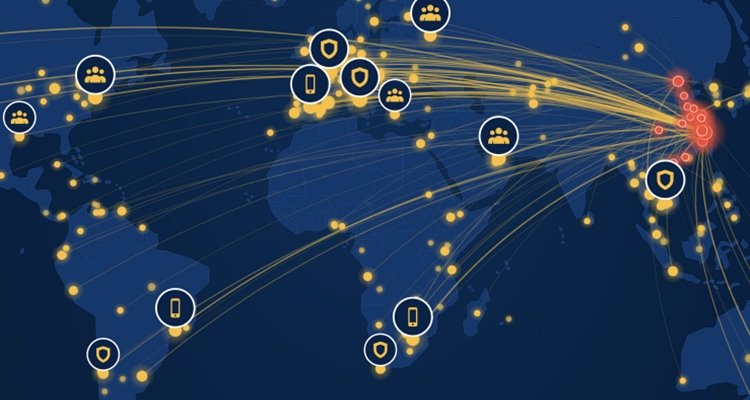
A new Safeguard Defenders report updates the organization’s research on the Chinese Communist Party’s efforts to control Chinese nationals residing overseas. As the title suggests, a major focus is method: “A Formula for Repression: China’s Global Grid for Community Control.” The grids that parcel up communities to help the CCP control Chinese living in China are also the model for overseas control.
In 2022, Safeguard Defenders published two reports on the activities of over a hundred CCP “police stations” in more than fifty countries. The research had a modest impact. Many governments denounced the illegally operating stations. Some investigated them and made some arrests. “Beijing responded by claiming they had closed.” Not so. The network of stations is expanding (November 2026).
Today, more than ten police forces from five Chinese provinces are engaged in the work of a global network of Chinese Communist Party operatives abroad. The police involvement is only the beginning, and these are not isolated initiatives by a few local governments in China.
Since late 2024, five new national policies instruct authorities across China to expand designated liaison activities abroad. The core aim is to export the domestic system of grid management to control the diaspora.
In China, the Party divides every city, town and village into grids, each square representing a few hundred households, and each with a grid manager who reports upward. The manager has ten tasks, nine of which have to do with surveillance and control. There is a file on every resident. Anything seen as a threat to Party rule is escalated to a hub where enforcement stands ready to act.
Internationally, this system of mass surveillance, control and suppression is projected through a global grid of united front affiliated organizations or designated liaisons. They are run by the Party’s “bridge and bond” to the diaspora: the Overseas Chinese Federation.
These Party liaisons provide the infrastructure other Chinese authorities—police, prosecutors, courts, justice bureaus and others— simply plug into. Or, as the Party calls it: through which they “extend their tentacles”.
CCP officials have protested that the stations merely provide services to Chinese nationals. But everything they say about the stations and the tentacles in available records—that is, everything outside of statements denouncing the work of Safeguard Defenders—indicates otherwise.
Also, “even services come with conditions….”
Geese and chessboard
Chapters of the report explore what the Party wants, who the overseas Chinese are, how grid-based management works in general and how it works abroad.
“The overarching goal: a diaspora run ‘as one chessboard from top to bottom’ that ‘flies in formation like wild geese, at the same frequency.’… This report finds that more Chinese jurisdictions are running police-overseas-Chinese mechanisms today than we found in 2022.”
Most of the organizational mechanisms for policing Chinese overseas via overseas police stations (or whatever these instruments of transnational repression may be called) are in China. “However, the associations that host a liaison point and the person designated to run it are based abroad, and they are where an effective response needs to start.”
Thirty-two pages of the Safeguard Defenders report consist of maps and charts listing overseas control work within provinces or municipalities of the People’s Republic of China and relating these PRC loci of “Overseas Chinese Federations” to the liaison centers overseas. An endless web of remote and local control, or attempted control, is outlined.
It’s all sourced in the CCP’s own documents. The footnotes are another big chunk of the report.
The “services”
“At home, the Party’s tool for watching and managing a population is the grid: a few hundred households, one grid worker and ten tasks. Only one of the ten is services, and even services come with conditions…..
“From 2014 on, the Party systematically extended that machinery abroad. Overseas Chinese Federation liaison points that had existed for years—often for purposes of trade and talent recruitment—were now told to perform additional functions. Police, prosecutors, courts and justice bureaus followed, the rulebooks caught up, and by 2026 ‘full coverage’ was policy. Our count, based on the authorities’ own records, is nearly 1,250 formally designated liaison points in at least 91 countries: 73 by the end of 2015, the rest in the ten years since.”