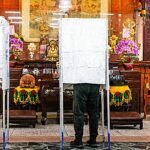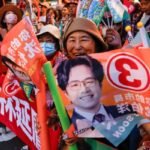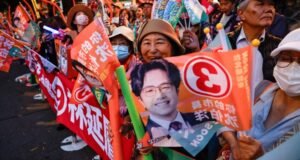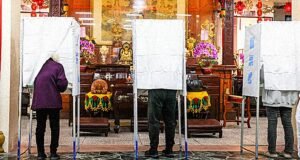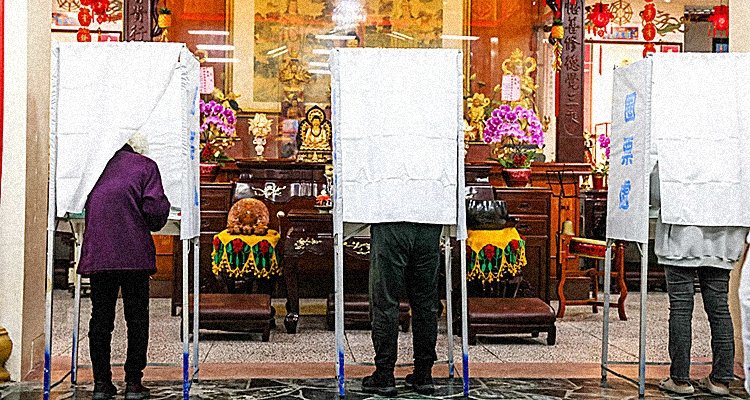
The Taipei Times reports that although the Kuomintang retained the mayoralty of Tapei in Saturday’s local elections, the ruling Democratic Progressive Party gained ground in the ROC overall (November 29, 2026).
Yesterday’s nine-in-one local elections reshaped Taiwan’s political landscape, with the Democratic Progressive Party (DPP) wresting control of five cities and counties from the Chinese Nationalist Party (KMT), according to results available at press time….
At press time, the DPP had ended the KMT’s control of Taichung and Chiayi City, as well as Hsinchu, Changhua and Yilan counties, in yesterday’s elections….
As of press time last night, the Yilan and Hualien county commissioner races remained too close to call, with both camps awaiting final confirmation from their respective election commissions before declaring victory.
Among the major losses for the KMT yesterday was Taichung, one of Taiwan’s six special municipalities, where its candidate, Deputy Legislative Speaker Johnny Chiang, was defeated by DPP Legislator Ho Hsin-chun….
In the closely watched Taipei mayoral race, incumbent Mayor Chiang Wan-an of the KMT fended off a strong challenge from DPP Legislator Puma Shen to win a second term.
These local elections are “nine-in-one” because they refer to elections for nice types of offices that have been conducted simultaneously since 2014. The nine are listed by Taiwan.md as “special municipality mayors, special municipality councilors, county/city mayors, county/city councilors, township/city mayors, township/city citizen representatives, mountain indigenous district chiefs, district representatives, and village chiefs—all with four-year terms.” Basically, mayors, councilors, and representatives.
The Taipei Times also notes that several legislative by-elections will be required to fill seats being given up by lawmakers who have just been elected to local executive positions.
“In previous election cycles, several lawmakers resigned before running for local executive posts…. Such resignations were seen as a show of confidence in their electoral prospects. However, this year, none of the lawmakers resigned ahead of the election, underscoring the uncertainty and competitiveness of the races.”
DPP versus KMT
The DPP is the political party more in favor of resisting the Chinese Communist Party’s efforts to subsume Taiwan.
The KMT is the political party more in favor of accommodating the Chinese Communist Party’s efforts to subsume Taiwan. Some members may say that by appeasing the CCP they can avoid this outcome. Others explicitly advocate eventual unification with the mainland, to take place maybe by the end of the 2030s. They either do or do not believe that under a proposed “one country, two system” post-unification setup, the CCP would allow the second system governing Taiwan to remain intact.
A smaller political party, the Taiwan People’s Party or TPP, has allied itself with the KMT in the Legislative Yuan, the national legislature, to form a working majority that has often resisted DPP efforts to strengthen the country’s ability to defend itself. In January 2028, all 113 seats of the Legislative Yuan will be decided in elections that also determine who will be the Republic of China’s next president.