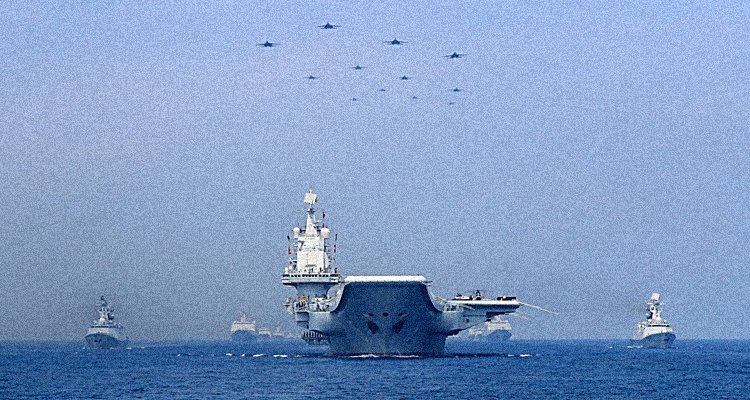
This just in: in 2032, the People’s Republic of China fails to quickly defeat Taiwan and so becomes “trapped in a war of attrition.” Brian Kerg reports for the Atlantic Council as either a time traveler or a practitioner of what the Council calls “fictional intelligence” (“FicInt”) (November 23, 2026).
These joint firepower strikes—the vaunted first attack of China’s war on Taiwan—were meant to smash Taiwan’s defenses, incapacitate its military force, and shatter the Taiwanese will to fight. While these salvoes were terrifying and impressive, they failed to achieve China’s objectives.
Some of the attacks got through, crashing into ports, airfields, and military bases, and sending plumes of flame and smoke into the sky. From Taipei in the north to Kaohsiung in the south, Taiwan was mercilessly hit again and again. While sources of Taiwanese military power were China’s target, many civilians were also slaughtered by the attack. World leaders initially waited to see whether Taiwan could withstand the onslaught or…would quickly fold as many analysts had predicted.
But the T-Dome, Taiwan’s multi-layered air- and missile-defense system, proved unexpectedly effective. While it faced performance difficulties when it first became operational in 2027, two years after its announcement in 2025, the reliability of many of its autonomous systems matured rapidly. As China’s incursions into Taiwan’s airspace and aggressive maritime harassment grew more frequent and hostile year after year, Taiwan’s presidents and commanders became more comfortable putting greater faith in the T-Dome’s permission to autonomously engage targets it identified as hostile.
With the help of artificial intelligence, the T-Dome intercepts “90 percent of Chinese munitions in the first barrage.” The ROC’s bases and command posts prove to be robust. Its air force maintains command and control underground as engineers repair damaged “airfields, roads, and bases with alacrity.”
Striking back
Taipei’s counterattack is also surprisingly successful thanks to the “superior quality and reliability of Taiwan’s munitions” and “China’s years-long strategic emphasis on offensive rather than defensive capabilities.” The U.S., Japan and others help by providing “exquisite intelligence” and “non-kinetic cyber and space capabilities” that increase the hit rate.
All this boosts Taiwanese morale. Clearly, Taiwan is not helpless, and the PRC is not an “unstoppable juggernaut.”
The war drags on. It looks as if the Taiwanese “are prepared to fight for years if necessary to preserve the democracy and way of life they built after ending martial law in 1987.”
Now what?
“Beijing now faces a dilemma. Backing down could deal a fatal blow to the credibility of the Chinese Communist Party, while pressing on would mean doubling down on sunk costs and putting the government’s dream of national rejuvenation further out of reach. Caught in a trap of its own making, China has looked abroad to Russia and North Korea for other solutions, while the Central Military Commission has begun to consider limited nuclear strikes to turn the tide in China’s favor.”
Author Kerg follows up his scenario spinning by distilling lessons for the people of 2026.
For example: “Regardless of when, why, and how China may start the fight, the result would likely be a protracted war with Taiwan.” “Even successful strikes rarely deliver knockout blows.” “When nations are attacked, cohesion surges, even among politically divided states.” “Third parties are not easily intimidated into total non-participation in wars that impact them.”