Will the Chinese Communist Party follow through on what Xi Jinping verbally agreed to in his October 30 meeting with Donald Trump? Lei of Lei’s Real Talk offers reasons to be more optimistic about this and other things than I was in a recent post. She ties the meeting to her recent speculations about Xi’s political fate.
A glum dictator
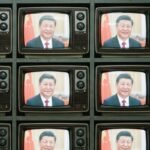
Lei argues that Xi, who looked weary and downcast during the proceedings, was essentially following marching orders; that although nominally still in charge of the CCP and the military, retaining all his major positions in the wake of the Fourth Plenum, he has in fact lost a power struggle that has been going on behind the scenes. She believes that this is why the meeting with Trump was so short: lasting not hours with a fair amount of wrangling but less than an hour of real talk if you subtract preliminaries and time spent translating. The affair was a scripted defeat.
Xi is backing down from severe threats like super-restrictive export controls on critical minerals because, in Lei’s view, he is no longer making the calls. Those who are making the calls don’t want any more massive shocks to the Chinese economy and fear the prospect of further unrest such as was provoked by the high U.S. tariffs imposed in April 2025 and, earlier, by the CCP’s extreme pandemic-control lockdown measures. Trump had threatened to reimpose super-high tariffs in retaliation against Xi’s threat to virtually shut down China’s exports of rare earths, the mining and especially refining of which is currently dominated by China.
Lei agrees that the CCP chronically lies and cheats but says that the Party is more likely to keep its agreements when its back is against the wall. She also believes that Xi’s failure to raise the issue of Taiwan during the meeting is significant.
In the past, Beijing always tied US-China trade deals to Taiwan, pushing Washington to move from not supporting independence to opposing independence. But this time, Xi Jinping let it go.
So, who won? If you add everything up, Trump’s modest tariff cut and partial export pause in exchange for China’s five major economic concessions and two strategic ones, the answer seems pretty clear. The clearest signs of this reversal are Beijing’s abandonment of the rare-earth card and the Taiwan card. Those are the two most significant ones, because they were both long viewed as China’s toughest bargaining chips, especially Taiwan….
Can Beijing be trusted to honor the deal? Well, there are two key points for us to consider. One is that this deal is only valid for one year. It must be renewed annually, meaning that both sides will review how well each has delivered…. If Xi Jinping fails to comply, the trade war can restart immediately….
If you look at CCP’s behavioral pattern, they only honor agreements when they’re in crisis mode. When I say “they,” [I mean] CCP leaders.
When they feel weak or cornered, they cooperate. But when they feel strong and confident, they break promises. Right now, for Washington, this deal is important, but not existential. But for Beijing and CCP or Xi Jinping, it is a matter of survival.
The regime is in a crisis mode. So, if talks collapsed, China would be cut off from the new global trade order. It will be a death blow to its economy, to its already struggling economy. So, faced with a choice between wolf warrior defiance and strategic surrender, Beijing clearly chose the latter.
Xi was so morose during the proceedings because he was surrendering under pressure, Lei concludes.
Entities
All food for thought, though I think that Lei pays too little attention to the implausibility of some of the concessions on the Chinese side and the severity of some of the concessions on the U.S. side—especially willingness to defer for a year closure of the loophole that enables Chinese companies on the U.S. Department of Commerce’s “Entity List” to sidestep U.S. restrictions by using subsidiaries. If this loophole ends up being preserved year after year, why even have an Entity List?
Also see:
BIS.gov: Entity List FAQ
“The Affiliates Rule will automatically subject foreign entities that are at least 50 percent owned by one or more parties on the Entity List, Military End-User List, or Specially Designated National designated under programs listed in § 744.8(a)(1), or non-listed parties subject to Affiliates Rule restrictions, to the licensing requirement and license review policy of their listed parent(s).” This text is from a Commerce Department document last updated on September 29, 2025, i.e., a month before the one-year deferment verbally agreed to at the October 30, 2025 Trump-Xi meeting in South Korea.