We must adjust a few words of what Congressman John Moolenaar, who chairs the House Select Committee on the Chinese Communist Party, had to say about President Trump’s swing through Asia and his meeting with Xi in South Korea (Select Committee, October 30):
“In a successful trip to Asia, President Trump turbocharged America’s efforts to counter Chinese aggression on rare earths and secured critical minerals agreements with our allies that will benefit America for years to come. China’s rare earth controls are a loaded gun pointed at our economy, and we must neutralize the threat by ending supply chain dependencies on China before it is too late. President Trump’s meeting with Xi Jinping also brought hopeful progress for our farmers and the fight against fentanyl, but the ultimate measure of success will be whether China upholds its promises or lies and cheats as it usually does.”
Hope springs eternal
The statement is fine until the part about how Trumps meeting with Xi brought something called “hopeful progress” on a couple of the issues on the agenda. Moolenaar then warns that we can’t know yet whether the words uttered during the meeting represent any progress because, as we know, the Chinese Communist Party and Xi Jinping tend to lie and cheat rather than keep promises. Perhaps Moolenaar meant to refer to “what we hope will prove to be progress.”
Naomi Lim’s report for the Washington Examiner is also skeptical (October 31, 2025).
Trump’s readout for the pair’s “amazing,” roughly 100-minute meeting on Wednesday in South Korea on the sidelines of this year’s Asia-Pacific Economic Cooperation leaders summit is at odds with Xi’s more muted counterpart capturing how the two countries, to a large extent, agreed to postpone many of their disagreements for 12 months.
We find a lot of dubious trade-offs in what was informally agreed to at the meeting. Lim notes that Trump and Xi
agreed to a year-long pause of Chinese export controls, which, from this month, included products with even 0.1% of rare earth minerals produced or manufactured in China….
Trump agreed to pause, again for a year, the implementation of a new rule his administration announced last month that would expand the Commerce Department’s “entity-list” export restrictions to any entity that was at least 50% owned by one or more entities on the department’s list of possible national security risk entities.
Is this because U.S. security doesn’t matter anymore?
Trump similarly agreed to a year-long pause in the USTR’s Section 301 investigation, under the Trade Act, of China’s maritime, logistics, and shipbuilding industries.
“Xi demonstrated that China is able to effectively threaten global rare earth supply chains to extort changes in U.S. policy,” [Ryan Fedasiuk of the American Enterprise Institute] said.
“The United States ended up rolling back the ‘Affiliates Rule’—an important measure announced by the Commerce Department in September to close loopholes in its export blacklist,” Fedasiuk said. “This was a major loss for U.S. national security hawks, and could weaken Trump’s efforts to contain growing Chinese technological power.”…
Fedasiuk is thinking clearly, mostly, but what an odd way to frame the shameful retreat on the affiliates rule: as a major loss for national security hawks as opposed to the national security of the whole country.
On Air Force One, Trump admitted to reporters that, “We didn’t really discuss the oil,” only “working together to see if we can get that war finished.”
China may resume buying soybeans from the United States. President Trump is confident, telling U.S. farmers to buy new tractors and and make other investments on the basis of the preliminary announcement alone. China may also buy Alaskan oil and gas. The Trump administration still seems to be okay with letting Nvidia sell all but its very latest and best chips to the PRC’s CCP-controlled firms. Meanwhile, China has at least for now ordered the country’s big tech firms “to halt testing and orders of Nvidia’s AI semiconductor chips.”
The U.S. will reduce tariffs on the People’s Republic of China as compensation for Trump’s expectation that Xi’s government will become much more cooperative in stemming the flow of fentanyl precursors to the United States. Indeed, according to the Xinhua, a PRC news agency, Xi may well also cooperate on “combating illegal immigration and telecom fraud, anti-money laundering, artificial intelligence, and responding to infectious diseases.” These vague assurances about something or other don’t seem to be eminently reliable.
All this sounds like a net loss for the U.S. side, not really the 12-out-of-10 level, “amazing,” “truly great” results that Trump has been trumpeting.
If the agreements hold, they are probably the best that could have been hoped for, National Review’s editors suggest. “An essentially unenforceable agreement that will keep the sword of Damocles forged out of rare earths merely dangling over America’s head for another twelve months beats more unpleasant alternatives.” NR wants Trump to lead an Operation Warp Speed to end American vulnerability on the rare-earth front.
Jimmy Lai, Gui Minhai
A White House official reportedly confirmed that President Trump did, as promised, press Xi for the release of Jimmy Lai during the meeting. Lai’s fate was more in the news prior to the meeting than it apparently has been after the meeting.
Jimmy Lai is the prominent Hong Kong publisher and pro-democracy activist who has been languishing in a Hong Kong prison since 2020. He was recently subjected to a punishing months-long show trial the verdict of which has yet to be announced. The CCP often doesn’t bother with even the simulation of a trial; the point here is to make an example of Lai. The party-state won’t willingly release him, and none of the possibly impending U.S.-PRC deals seems to be contingent on his release.
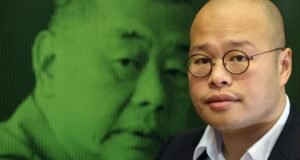
The People’s Republic of China also wrongly detains many others, both Chinese nationals and westerners. One of the latter is Swedish publisher Gui Minhai, kidnapped in Thailand ten years ago.
“If China censors and refuses to allow independent journalism within its borders,” writes Thibaut Bruttin, “Europe should also close its market to Chinese media—especially those controlled by the CCP. As Xi himself has declared, the role of media outlets is only to ‘serve the Party.’…
“The Chinese regime must be pressured to immediately release Gui Minhai, and the EU must make it clear that refusal will carry serious political consequences for bilateral relations. Any economic collaboration should be strictly conditioned on his release. This is not a dream but a reality—something that can be achieved, as demonstrated by the release of Australian journalist Cheng Lei just two years ago.”
Also see: