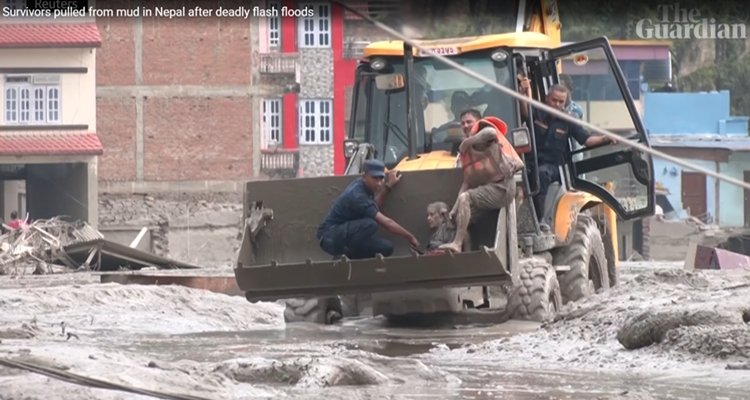
In the wake of the recent catastrophic Nepal-Tibet flash flood, the CCP has continued to dam information about Tibet. So although we can surmise, we don’t really know what the disaster has cost Tibetans. We can, though, get some idea of the losses suffered in Nepal—a better idea than many people within the People’s Republic of China (The Guardian, August 28, 2026).
In Nepal, journalists rushed to get as close to the disaster zone as possible to interview survivors and rescue workers. Villagers provided minute-by-minute accounts of what happened when the floods, the exact cause of which is still being studied by scientists, tore through their homes.
In China, state media carried several broadcasts about the floods and dispatched their own journalists to the area, but reports focused on the rescue efforts rather than the scale of the devastation. In one broadcast from a relief centre in Tibet, the journalist did not speak to any of the people sitting behind him.
Tibet, brought under Chinese control in the 1950s, is the most sensitive and tightly controlled region in the country. Sporadic protests, including self-immolations, by Tibetans calling for more autonomy and religious freedom have been cracked down on by the authorities. International journalists cannot visit Tibet apart from on tightly choreographed government tours. Many Tibetans are not allowed passports and have very limited contact with the outside world. Tibetans can be punished for speaking to journalists. Human rights groups have for years criticised Beijing’s policies on Tibetan language and culture, which activists say are under attack.
That makes independent assessments of how the flash floods have affected the Tibetan side of the border difficult.
Drawing similar conclusions, The BBC reports that Chinese state media have “showed rescue teams wandering in a wasteland of mud and rock while calling out to anyone trapped. But there is little detail beyond that. There are no accounts from survivors in Tibet, and almost no user-generated footage showing the deadly moments or their aftermath. We are yet to hear from anxious families of those missing. Trying to contact people there is near-impossible during regular times.”
We may get some independent assessments, though, as brave Tibetan reporters find ways to communication information to publications like Bitter Winter and groups like the International Campaign for Tibet.
Mumbai’s CNBC-TV18 reports that according to ICT, “China is covering up the scale of the impact of flash floods in Tibet’s Kyirong County, where the disaster struck before surging downstream into Nepal, by keeping a tight rein on information from the region.
“The group has raised concerns over whether local Tibetans are receiving necessary aid, particularly as the threat of further flooding looms. Information about the situation in Tibet remains sparse compared with the videos and accounts emerging from Nepal, which have dominated social media and news coverage around the world.”
Alive and thriving
What does the Chinese government gain by preventing Tibetans from speaking to journalists and by “tightly choreographing” what journalists who visit Tibet may see and hear?
Journalist-tourists who gamely iterate CCP propaganda get showcased in outlets like the Global Times, where they explain how wonderful everything is in Tibet and how terribly misunderstood the place is.
One “geopolitical analyst, columnist, blogger, podcaster, and writer based out of Bangalore, India” attests: “Every aspect of Tibetan culture is alive and thriving—the language, food, dress, music, dance, cultural norms, architecture and religion…. The people certainly have the freedom and liberty to embrace their traditions…. The boarding schools are excellent and pragmatic instruments in educating remote and underprivileged Tibetans.”
Thus, the proof being offered that the CCP does nothing to repress Tibetans or wipe out Tibetan culture is the fact that Tibetan culture has not yet been wiped out.
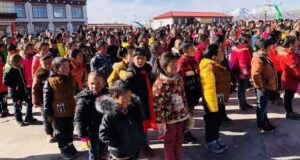
Not mentioned: that Tibetans can’t come and go as they please, often being prohibited from holding passports; that the children are taken from their families by force to be sent to the “excellent and pragmatic” boarding schools, a major function of which is to instill CCP propaganda; that China has been closing and demolishing Tibetan schools and temples without regard to the wishes of Tibetans; that speaking the Tibetan tongue and teaching it are discouraged in the lauded boarding schools.
Also see:
The New York Times: “How China is Erasing Tibetan Culture, One Child at a Time”
“Student life is heavy with political indoctrination. Schools, for instance, celebrate what China calls ‘Serfs’ Emancipation Day,’ referring to the anniversary of the Communist Party’s full takeover of Tibet in 1959, after a failed Tibetan uprising and a Chinese crackdown that forced the Dalai Lama into exile.”