When we hear about these things, we tend to hear about them at third remove and some time later. The CCP is not issuing videos and celebratory press releases that would contradict the various fictions it tells the world about merry Tibet. The Party also often tries to prevent Tibetans from communicating freely with people outside of Tibet.
The Tibetan Centre for Human Rights and Democracy says that according to the latest information it has received, “Chinese authorities have forcibly closed at least three private Tibetan schools in the Golok (Chinese: Guoluo) region of Amdo over the past three months” (October 19, 2026).
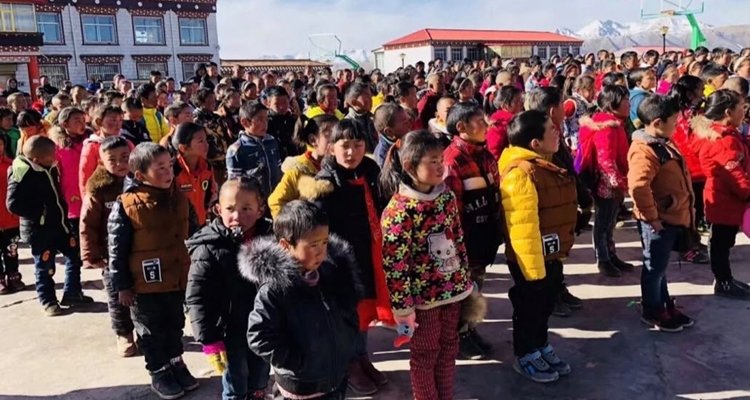
The schools are the Golok Tadrak Orphan School [students of which are shown above], the Ra-Gya Jigme Gyaltsen Grassland (Tsathang) Girls’ School, and a community-funded village school in Jasag village. Authorities ordered the closures between August and September 2026, depriving Tibetan children of educational institutions that placed their language, culture, and community traditions at the centre of learning.
The latest closures follow years of mounting pressure on independent and privately run Tibetan schools and reinforce concerns that Chinese authorities are systematically eliminating educational alternatives outside the state-controlled school system. TCHRD warned of this trend in its 2022 thematic report, “Tibetan Language and Education Rights Under Xi Jinping,” which documented the growing vulnerability of private, community-funded, and monastic-affiliated schools to government restrictions….
The reported closure comes amid changes to China’s national language legislation. On 27 December 2025, the Standing Committee of the National People’s Congress adopted revisions to the Law on the Standard Spoken and Written Chinese Language, originally enacted in 2000. The revised law took effect on 1 January 2026. Among other changes, it removed a provision allowing exceptions to the general requirement that standard Chinese be used as the basic language of instruction in schools.
Rather than supporting meaningful bilingual education, restrictions on Tibetan-medium instruction leave families with fewer opportunities to ensure that their children develop literacy and academic skills in their mother tongue.
The Golok Tadrak Orphan School, shut down on September 2, had been founded by Tawu Lobsang Palden and his wife to provide “care and education to more than 300 orphans and children from disadvantaged or broken families.”
Ra-Gya Jigme Gyaltsen Grassland Girls’ School, shut down on August 27, established by the Tibetan monk Jigme Gyaltsen, “aimed to expand educational opportunities for girls from nomadic communities.”
Self-sufficient
Also in August, the CCP shut down a primary school in Ra-Gya township funded by the people of Jasag village because, according to local sources, officials had ordered the school to stop teaching the Tibetan language and use only Chinese. “When the school refused to abandon Tibetan-language instruction, authorities reportedly ordered its immediate closure and directed students to attend government-run boarding schools.”
The Party’s cultural-ideological reasons for shutting down these and other Tibetan schools are unambiguous. But the fact that at least the third of these three forcibly closed schools was, according to the Centre, funded by local residents—the Jasag village school wasn’t spending party-state funds—underscores the repressive and cruel nature of these closings.
Also see:
TCHRD: “Sucked Our Marrow: Tibetan Language and Education Rights Under Xi Jinping” (2022)