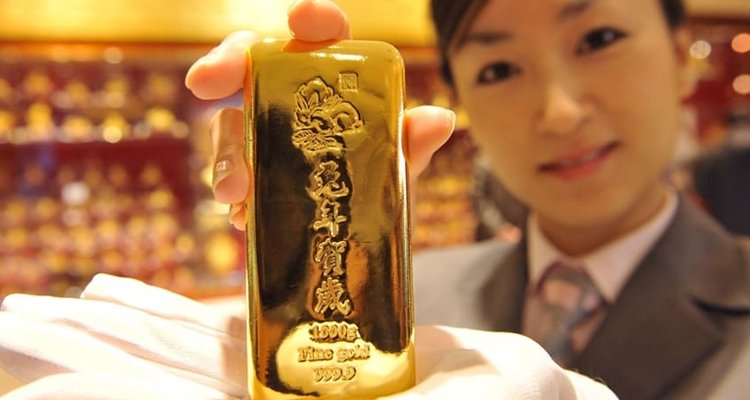
The new headlines about Red China’s gold buying are not really new. In mid-2026, we read that “China Bought the Most Gold Since 2023 in July” and about “Why Beijing has been buying large amounts of gold for past 20 months.”
Last year we saw such headlines as “Why Is [Red] China Quietly Stockpiling Gold Reserves?” and “Why [Red] China Is Buying So Much Gold.” The year before, more of the same.
One funny thing (among many) is that the reported buy figures tend to be based on Beijing’s official numbers, officially released through official channels; and these seem to be consistently understated.
For example, a recent report notes that “China gold buying has surged well beyond what official figures indicate, according to new estimates from Goldman Sachs. The People’s Bank of China reported 15 tonnes acquired in June, but London OTC [over the counter] market data suggests actual buying reached 40 tonnes. May figures show a similar gap, with 48 tonnes purchased through OTC channels versus 10 tonnes officially disclosed.”
A riddle
This gold riddle has several pieces: why so much? why so secretive? where does all of the PRC’s own gold-mining production go?
Analysts offer different answers.
A new report by S&P Global attributes buying in large part to the CCP’s “Gold Road” initiative. This involves Beijing’s establishing gold vaults abroad to allow trade and settlement in either renminbi or gold. No word on how many vaults are planned and whether the gold filling the vaults will come from the central bank or another source.
Another view is that the People’s Bank of China (PCOB) is diversifying the reserves it holds, adding gold while selling dollars. What are you going to replace dollar holdings with, euros?
This explanation morphs into something pretty vague: “China’s continued gold purchases are seen as part of its long-term economic and financial strategy. The country wants to strengthen its economy and increase its influence in the global financial system.”
It’s unclear how buying gold and then storing it at the PCOB strengthens the economy or how it increases Beijing’s influence in the global financial system, especially since Beijing keeps much less gold than any “normal” state. We learn that in the current cycle of a PCOB buying surge, “Global central banks accelerated buying in the second quarter, purchasing a record 289 tonnes—a 62 per cent increase from a year prior. Poland’s central bank was the biggest buyer in the three-month period, accumulating 51 tonnes of gold, and the People’s Bank of China ranked second with a purchase of 33 tonnes. South Korea’s central bank also said that it would increase gold’s share of its foreign reserves.”
Gold buying has been a general trend in central banking, and, going by its official reports, Red China badly lags the rest of the world. Thus, “China’s overall foreign reserves are at $3.6 trillion out of which gold contributes around 7% which is much lower than the global average of 22%. In comparison, gold accounts for 75% of France’s reserves, 68% of the Netherlands’, 44% of Turkey’s, 37% of Russia’s, and 21% of Poland’s.”
In this news report too, we encounter the mysterious remark that, according to analysts, “for China to overtake the U.S. as the world’s top economy in the coming decades, it must accumulate more than 8,000 tonnes.”
Outlier
Under the international Basel III Accords, gold in the vault counts as the equivalent in cash money. Under central-bank logic, vaulting gold or cash should have the same effect, whatever that is. How a central bank’s locking up more cash or gold would enable an economy to “overtake” a competing economy is a puzzle. The single potential upside to gold accumulation appears to be improving the PCOB’s credit-risk profile.
In terms of official gold holdings, Red China is inferior and an outlier. It wants to be a peer. It wants to be “normal.” So it builds its gold reserves.
It does not reveal the full extent of its holdings for fear that the world would revalue the renminbi upwards. This would be an export-economy killer. If and when the CCP wants to strengthen the value of its currency, it can increase reports of gold purchases and holdings. For now, this seems unlikely.
One of the more interesting speculations about China’s gold buying involves the launch of a gold-backed central bank digital currency (CBDC) for use at home or abroad. At home, gold backing would sweeten the bitter pill of a central-bank digitized currency used for surveillance and control. Abroad, a gold-backed CBDC could inspire confidence in renminbi transactions. Perhaps these will come in the future. Gold will provide options. □
James Roth works for a major defense contractor in Virginia.
Also see:
StoptheCCP.org: “What Is China Going to Do With the Gold?”