Diplomats and presidents who want to win over the officials of autocratic governments, e.g., the government of the People’s Republic of China, often kid themselves about what’s possible. One of their favorite counterproductive strategies is “quiet diplomacy.”
As summarized by Miles Yu, its tenets are something along these lines: “Do not embarrass Beijing. Allow its leaders to ‘save face.’ Trust private assurances. Above all, keep talking behind closed doors.” Yu calls this approach a “dangerous delusion” (The Washington Times, August 31, 2026).
The record of quiet diplomacy should have discredited it long ago. Beijing made solemn promises regarding World Trade Organization obligations and market access, the South China Sea’s non-militarization, Hong Kong’s autonomy, human rights, intellectual property, cyber activities, international norms and more.
Again and again, the promises were broken, evaded or reinterpreted once Beijing secured what it wanted. Again and again, Washington received another private assurance—and Beijing pocketed another public advantage.
Quiet diplomacy survived because it has created its own constituency: a professional class of China brokers whose influence depends on the proposition that Beijing remains one discreet conversation away from moderation….
Thus emerges one of the strangest features of the U.S.-China relationship: Americans explaining to other Americans why the Chinese Communist Party must not be offended….
This ecosystem has also produced the blame-America-first China expert, for whom Chinese aggression can usually be traced to something Washington did to make Beijing insecure….
Quiet diplomacy also frightens America’s friends. When an American leader disappears behind closed doors with a CCP general secretary, Taiwan, Japan, South Korea, the Philippines, Australia and others naturally wonder what Washington might concede at their expense. Even when no concession occurs, secrecy breeds uncertainty, and uncertainty among allies is itself a strategic victory for Beijing.
Truth and transparency make things harder for the CCP regime, argues Yu. “Sunlight…raises the price of lying, reassures allies and denies Beijing the ability to tell different stories to different audiences.”
I’m not sure about the last. But more open and unambiguous diplomacy would at least make telling the different stories harder.
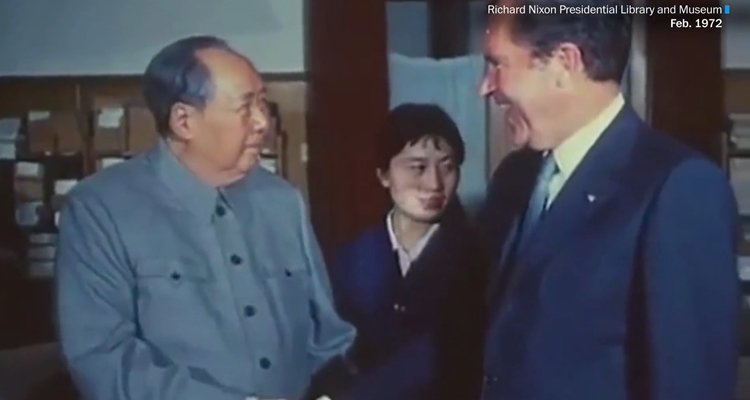
Nixon goes to China
Yu’s commentary is fine except for a passage in which he says that the U.S. habit of self-deception about China started with Nixon and Kissinger.
I’m not getting at the fact that journalists and others had been snowing us about Mao and the communists long before the 1970s. (Mao is “noted for his insistence upon accuracy of detail,” wrote Edgar Snow in 1936.) What really mars the piece is Yu’s assertion that Nixon and Kissinger “achieved an important strategic breakthrough” in China. If we could revise this to say “floundered their way into an epochal strategic disaster” in China, the analysis would be almost perfect.
Nixon and Kissinger “helped establish a style of personalized, secretive diplomacy in which Beijing enjoyed extraordinary control over the setting, interpretation and information,” writes the author.
“Ambiguity mattered. What did ‘China’ mean? What did Washington promise Beijing regarding Taiwan? What constituted sovereignty?….No American president should conduct consequential diplomacy with a CCP leader behind closed doors in a controlled-information environment without capable American interpreters, note takers, experts and a precise institutional record. The fate of nations should never depend on whether an American leader believes he has established a special relationship with the man across the table.”
Nothing in this evaluation warrants saluting the talks as a strategic “breakthrough.” Or is the mere fact that Nixon, Kissinger, Mao, and Zhou got together at all to be regarded as the “breakthrough,” something inspiringly creditworthy in itself no matter how the diplomacy was conducted and no matter how destructive the consequences proved to be?
Wow, Nixon went to China. What if he hadn’t?
Also see:
National Security Archive: “Nixon’s Trip to China: Records now Completely Declassified, Including Kissinger Intelligence Briefing and Assurances on Taiwan” (December 11, 2003)
“Kissinger later claimed that Zhou ‘spent very little of our time on’ Taiwan, but actually Nixon and Kissinger went to some length to mollify his concerns about the possibility of Taiwanese independence and prospective Japanese influence over Taiwan. After years of declassification requests and appeals, the National Security Archive publishes here for the first time the intelligence briefing to the Chinese and the complete texts of Nixon’s conversations with Zhou, including the assurances on Taiwan.”
National Security Archive: “Taiwan is a part of China” (February 22, 1972)
Nixon: “Dr. Kissinger when he was here stated our agreement to five principles. I completely endorse these principles, and the Prime Minister can count on that no matter what we say on other subjects. Principle One. There is one China, and Taiwan is a part of [Red] China. There will be no more statements made—if I can control our bureaucracy—to the effect that the status of Taiwan is undetermined. Second, we have not and will not support any Taiwan independence movement….
“Let me in complete candor tell the Prime Minister what my problem is, from a political standpoint…. The left wants this trip to fail, not because of Taiwan but because of the Soviet Union. And the right, for deeply principled ideological reasons, believes that no concessions at all should be made regarding Taiwan….
“Our problem is to be clever enough to find language which will meet your need yet does not stir up the animals so much that they gang up on Taiwan [gang up in support of Taiwan] and thereby torpedo our initiative. That is our goal.
“I will simply sum up by saying I do not want to be forced when I return to the United States, in a press conference or by Congressional leaders, to make a strong basically pro-Taiwan statement because of what has been said here. This is because it will make it very difficult to deliver on the policy which I have already determined I shall follow.”