“Army installations are the foundation of Army readiness. To protect our people, mission and assets, commanders have been authorized the ability to damage, destroy, seize or disable unauthorized unmanned aircraft.”
So said the U.S. Army Materiel Command Public Affairs office in June of 2022. In light of subsequent events, this announcement seems premature.
Subsequent events
In January and into February 2023, commanders nationwide were playing idle spectator during the overflights of Red China’s spy balloon.
In January 2024, a drone attacked a Jordanian base and killed three U.S. servicemen. “The Pentagon has not outlined any new moves to bolster defenses against the drone threat in the region,” one report said.
In October 2024, the commander of Langley Air Force Base watched waves of drones up to 20 feet long “and capable of speeds over 100 mph” fly over his base for 17 nights in a row, doing nothing to counteract them.
In November 2024, drones flew unchallenged over the Picatinny Arsenal, a U.S. Army research site. There were 11 of them.
In 2025, General Gregory Guillot said that there were “350 detections reported last year [2024] on military installations.” Guillot defends North American airspace.
On June 6, 2025, the White House announced the creation of a “Federal Task Force to Restore American Airspace Sovereignty.” So someone recognized a problem. Is this like a blue-ribbon panel?
New policy
In December 2025, the Department of War issued a new policy: “U.S. installation commanders will be allowed to take action against drones flying near their bases even if they are flying beyond the perimeter.” A fact sheet on the new policy was published in February 2026.
And yet the next month, beginning March 9, 2026, Barksdale Air Force Base, home for U.S. B-52s, “experienced several unauthorized drone incursions that varied in duration and number of drones.” Personnel were ordered to “shelter in place.” That means hide. Cower. ABC News reported that the overflights lasted for nearly a week. No action was taken.
Also in March 2026, drones were spotted over Fort McNair in Washington DC, where the secretaries of War and State live. No answers given to the inquiring press.
In a CBS news interview, General Guillot was asked: “As it stands today, could you detect a swarm of drones flying over or flying into the airspace at Langley? Could you detect that today?”
“At low altitude, probably not with your standard FAA or surveillance radars,” was his answer.
Reporter Bill Whitaker noted that any defensive efforts might well be complicated by bureaucracy. “When the drones flew outside the perimeter of Langley Air Force Base, other agencies had jurisdiction: the Coast Guard, FAA, FBI, and local police. There was no one agency in charge.”
Red tape comes first, defense second.
The website DroneLife explains that under current federal law, “only a handful of federal agencies—the departments of Defense, Energy, Justice and Homeland Security—can take measures to interfere with the flight of drones, and then only under very restrictive circumstances.”
More new policies
Efforts to address the drone problem have been in the works for years. But according to a Center for New American Security report released last September, the military’s efforts have been “hindered by insufficient scale and urgency.”
“Local, state and federal officials are increasingly calling for changes to current federal law regarding the ability of facility owners to detect and mitigate unwanted drone incursions,” says DroneLife. “Lawmakers are also demanding that state, local, tribal and territorial law enforcement agencies be granted new authority to interrupt the flight of or even bring down errant drones that pose a threat to critical infrastructure sites or other significant potential targets.”
Business Insider notes that although the Department of War “has issued multiple counter-UAS [drone] policies—rules governing how the military can detect, disrupt, or disable uncrewed aerial systems—those directives are not standardized, leaving some base leaders unaware that their installations qualify as ‘covered assets.’ ”
The term “covered assets” apparently refers to bases that are sensitive enough to be allowed to fight back against incursions.
This means that in addition to being internally restricted by the Department of War, the departments of Energy, Justice, and Homeland Security might also have to be consulted regarding whether “covered” status is in effect or not. Another consideration also came up in the CBS interview, the “safety issue for the American public. Firing missiles in our homeland is not taken lightly.”
This January, the Department of War’s Inspector General issued a report, “Management Advisory: Immediate Attention Required to Protect DoD Covered Assets Against Unmanned Aircraft Systems.” As you see from the title, this report finds fault with base commanders for not following the (inadequate and restrictive) rules that are in place.
Lesson not learned
Meanwhile, Air Force Colonel Cody Moore says that today, in 2026, the Air Force is training base commanders to help them “understand their specific authorities, how they should work with local law enforcement—because outside of the gate, they’re a big piece of that too—and then also how to communicate that within the Air Force and with NORAD and NORTHCOM and all of the other civilian agencies that are a part of this.”
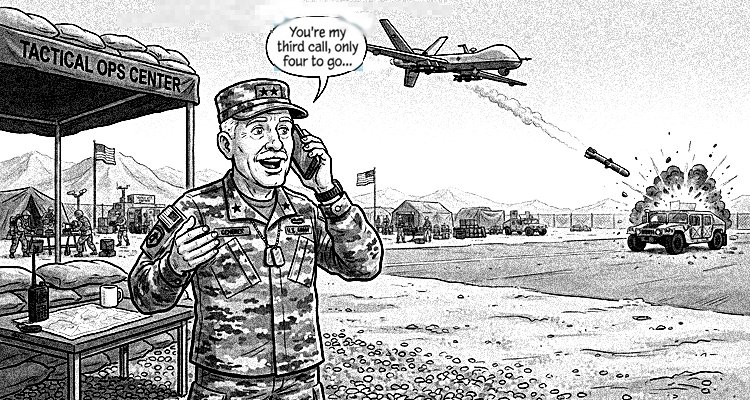
They are training the base commanders to initiate a full inter-agency staff action in the time it takes for a drone to fly over their bases.
So nobody has learned anything since 2022.
The general who has spent decades nurturing his or her career in a micromanagement culture that tolerates zero mistakes is not going to pull the trigger on a drone over which multiple departments claim jurisdiction and burning pieces of which might fall on government property, on sheltering airmen—and, beyond the fence, on happy children, praying nuns, precious pets or expensive private property.
As it stands now, base defense ain’t gonna happen. Convene panels, issue directives, pass laws. The absurdity will continue. □
James Roth works for a major defense contractor in Virginia.