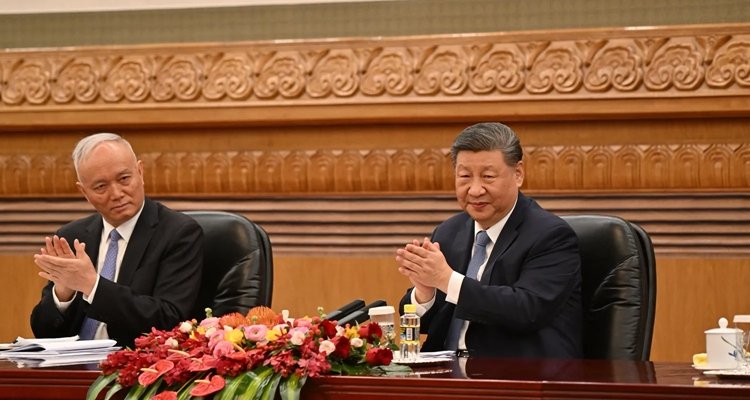
Mr. Cai Qi recently assumed the presidency of the Central Party School of the Chinese Communist Party, as if he did not have enough on his plate.
Among the positions that keeps him busy, per Vision Times: “membership in the Politburo Standing Committee of the Chinese Communist Party, first-ranked secretary of the Secretariat of the Chinese Communist Party, director of the CCP General Office, vice chairman of the Central National Security Commission, secretary of the Central and State Organs Working Committee, head of the Central Party Building Leading Group, and director of the Central Cyberspace Affairs Commission.”
A superstar
Those may not be all of his titles, but we’ve made a good start, at least. We don’t need a trained Sinologist to read these tea leaves. He’s a communist superstar.
Back in 2022, Reuters noticed Cai (shown above, left) being promoted four times in the four years ending in 2017, a fact which “ ‘suggests his importance to Xi Jinping,’ said Cheng Li, an expert on Chinese politics at the Brookings Institution.”
The work hasn’t always been easy. In 2017, he was, among other things, head of Beijing’s communist party, and in that capacity he ordered the removal of storefront signs, the banning of coal heat, and the mass eviction of low-income nonresidents from the city. Having been criticized in the state press, no less, he eventually staged a meeting with some nonresidents (“migrants”) and “urged employers to hold themselves more accountable for workers’ well-being, including [by] offering decent food, accommodation and skills training.”
So after taking away workers’ jobs, he urged employers to hold themselves more accountable.
A more recent setback-that-should-have-been involved the 2024 arrest of two Britons passing secrets to Red China, secrets alleged by prosecutors to have been “funneled through multiple intermediaries” to Cai Qi. Britain’s Independent calls Cai the “senior Beijing official at the heart of the [communist] China spy scandal.” Former Prince Andrew met with Cai “at least three times” in 2017 and 2018. “But,” says ITV, “there is no suggestion the Duke of York knew of or was involved in any espionage.”
This story generated bad publicity for Cai and Red China and churned out headlines for some time. So why would Xi Jinping shower so many offices on politically damaged goods?
Analyst Wang Youqun gives three reasons. The first is the dearth of people whom Xi trusts. The second is that Cai is a “hardline enforcer” and a great flatterer. The third is that Cai is now positioned to shape attendance at next year’s 21stParty Congress, laying the groundwork for approvals desired by Xi.
Buried in his clutch of positions, and woefully underreported, is the reality of Cai’s ever tighter grasp of personnel matters. As Wang infers, Cai has the authority he needs to shape attendance at a meeting that will give Xi even more time in office. Xi is depending on Cai to deliver Xi loyalists.
Power politics
What’s wrong with this picture?
The most basic consideration involves all the titles Cai holds. He cannot possibly do all the work required and so must have his people, yes, his people, to help him. His entourage must be enormous. Imagine all that staff in prestigious, powerful offices beholden to Cai.
Stalin used his mastery of Soviet personnel levers to build a Stalinist faction in the party and purge his Old Bolshevik comrades. The logic of power politics does not fade with time.
Cai holds the levers of personnel. So Cai is in a very powerful position. And with each new personnel decision, his position grows stronger.
This accumulation of offices has led to speculation about Cai’s rank. The Economist writes that “Cai Qi may be the second-most powerful person in China.”
Deng Yuwen in Foreign Policy disagrees. “Cai is indeed one of the people closest to Xi in Chinese politics today. But proximity to supreme power is not the same as being close to holding it. Cai is of course important, but he is not China’s de facto second-in-command. Such a figure, under a leader as paranoid about sharing power as Xi, doesn’t really exist.”
If all the bestowed titles are empty, then Xi is safe; he is not sharing real power. But empty titles will not provide the personnel needed for a successful 21stParty Congress next year. To get that Congress, Xi had to have delegated real power.
Xi can look after his interests by monitoring Cai’s candidate recommendations, appointments, promotions. But if personnel management is truly in Cai’s hands, not even “a leader as paranoid about sharing power as Xi” will be entirely safe. □
James Roth works for a major defense contractor in Virginia.