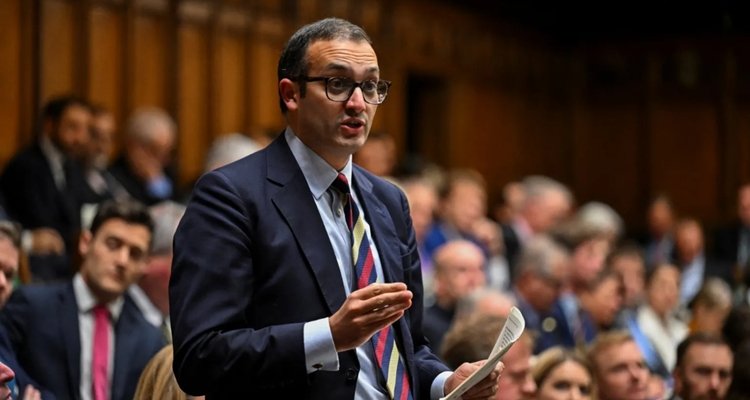
After summarizing a lot of lamentable British engagement with China, Neil Shastri-Hurst hastens to add that “Engagement where it is in Britain’s interests should continue.”
The Conservative Member of Parliament (shown above) then affirms the advisability of avoiding “unnecessary confrontation.”
Security and obligations
Next, we learn that engagement should not, however, come “at the expense of our national security or, worse, our obligations to those who have placed their trust in this country.”
These considerations are not mutually exclusive. Compromising the national security of Great Britain also comes at the expense of Hongkongers “who have placed their trust in this country.” To allow agents of the Chinese Communist Party to harass Hongkongers living in the UK is to allow national security to be compromised.
In the last couple of years, has the UK government engaged with the PRC in any way but at the expense of national security and/or obligations to expatriate victims of mainland China?
MP Shastri-Hurst writes (ConservativeHome, July 21, 2026):
China is not simply another major trading partner. It is a revisionist power that seeks to reshape the international order in ways fundamentally at odds with Britain’s interests and values. Its actions in the South China Sea, its intimidation of Taiwan, its industrial-scale cyber operations, and its repression in Hong Kong are not isolated issues. They form part of a strategy to expand Beijing’s influence while weakening the resolve of liberal democracies.
Hong Kong activists and other Chinese dissidents living in Britain have repeatedly warned about intimidation and harassment on UK soil. We have already seen allegations of unofficial Chinese “police stations”, reports of bounties placed on pro-democracy campaigners overseas, and attempts to silence critics well beyond China’s borders.
When individuals who have sought refuge in Britain fear they could be monitored, intimidated, or targeted because of the actions of a foreign state, this ceases to be a diplomatic issue. It becomes a matter of national security….
Offering a visa is only part of that commitment. We must also ensure those who have come here are able to live free from intimidation by the regime they left behind.
That means taking seriously credible concerns about foreign interference. It means ensuring our intelligence agencies and police have the powers and resources necessary to investigate transnational repression. It means protecting democratic campaigners, journalists, and community leaders who continue to speak out for freedom in Hong Kong.
Above all, it means recognising that our China policy cannot be based upon wishful thinking.
Agreed. The British government should not compromise Britain’s actual interests when conducting foreign policy and should not betray Hongkongers who have escaped to Britain. Therefore, Downing Street should end all engagement with China, which it seems to treat as synonymous with surrender to China.
Also see:
Reuters: “UK approval for China’s mega embassy in London challenged in court by locals” (July 14, 2026)
“The decision was taken with a view to improving ties with Beijing despite British and U.S. politicians warning that it could be used as a base for spying. Britain’s intelligence agencies said any threat could be mitigated.
“Local residents argue that officials failed to take into account the risk that the new embassy could curtail protests or be used to monitor and intimidate Chinese dissidents.”