A person’s claim that when he once upon a time acted like a thug, he did so because he had been fooled by the thug running the show goes only so far.
Part three of a Le Monde series about “Mao’s Fraught Legacy” talks about the Cultural Revolution that Mao Zedong incited in 1966 “to restore his challenged legitimacy. The leader of the Chinese Communist Party relied on young people, unleashing a wave of violence to suppress all opposition. Some Red Guards later said they felt manipulated.”
Mao was manipulative?
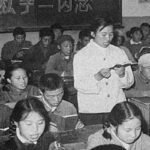
Sixty years later, Ding Xueliang still feels bitter when he speaks about his past as a Red Guard. In 1966, he was one of the youngest in his region to be swept up in the arbitrary frenzy of the Cultural Revolution….. He was not yet 13 years old when that Maoist madness erupted, and he was suddenly appointed propaganda leader of one of the most radical factions in the city of Xuancheng in his home province of Anhui, in the East.
He only later realized how Mao Zedong had exploited his naïveté to serve his own desire for power. “We, the Red Guards, were deceived,” said the 73-year-old man in a café in Hong Kong, where he was an emeritus professor at the Hong Kong University of Science and Technology, six decades after the start of the Cultural Revolution and 50 years after Mao’s death.
Most of the Le Monde article is behind a paywall. But a 1988 profile on Ding Xueliang in The Harvard Crimson reports:
In the Red Guard, the youth corps of Mao’s mid-1960s purge against revisionism in the Communist Party, Xueliang led a cadre of Communist youth in marches and rallies around China and worked his way up the ranks of the group’s propaganda wing until its decline in 1969….
Xueliang entered the Red Guard after two years of junior high school in 1966. “I had no experience with political activities; but at that time we were convinced by Communist party propaganda that the Cultural Revolution would determine the fate of the party, the nation, the people, and everything we respected and valued,” he explained….
He did more than spread slogans:
Xueliang took part in a three-day demonstration attended by nearly 30,000 students to force the provincial governor of Hofei to confess corruption….
Along with 6000 Red Guard members, Xueliang later helped to wrest the city of Ching Yang from the control of almost 100,000 peasants. The Guard’s three-day fast in that cold March prompted the central government to force local authorities to appease the students and expel peasants from the city.
Armed violence increased among Guard members as the Cultural Revolution progressed, and the youth stole weapons from the state army, Xueliang said, adding that when he was caught taking three handguns from an army unit, the soldiers gave him one gun “for encouragement.”
Many Red Guards thrashed people for being “class enemies”; subjected them to public humiliation and painful struggle sessions; tortured them into confessing imaginary crimes; looted and destroyed furniture, art, books in campaigns against pre-communist or noncommunist culture; arbitrarily detained people and forced them to work in degrading conditions; invaded homes and took over schools, factories, government offices.
Often enough, the Red Guards killed their victims, either on purpose or “accidentally.”
Let’s stipulate that the Red Guards were deceived and that they were young. These facts didn’t turn them into robots from which all volitional capacity and self-responsibility had been stripped. If a Red Guard committed crimes because someone was in effect holding a gun to his head, that’s one thing, a circumstance that may mitigate his guilt when it cannot entirely absolve him. If he committed the crimes voluntarily, that’s another. Many of the Red Guards zealously threw themselves into their work, and for more than a day or two.