Some scholars wonder, “Why Did China Experiment with and then Abandon Village Elections?” People are noticing that good old Chinese village “democracy” is not what it used to be before Xi Jinping.
Wonder not. When asking about organizations and change in a communist system, always refer first to the answer “party power.” Red China is a Leninist state: the Party supervises the government. When some part of the government gets a little frisky, the Party rides in.
“In the 1980s, when the CCP abandoned the collectivization and central planning that were the hallmarks of the Mao Zedong era, it left a power vacuum in China’s 700,000 administrative villages,” writes Ben Hillman. “Under Mao, all important political and economic decisions in rural China were made by ‘People’s Communes’…. These bodies became defunct as China shifted toward a market economy.”
In 1987, Mao’s successors decided that elected village councils and leaders could shoulder some of the work of the former people’s communes. The elected did not even need to be communists. And by 2002, the Party began to admit “capitalists” (local entrepreneurs) to Party membership.
It takes a village
The village level is and was the only level in Red China permitted to vote for a government. But the heyday of village “democracy” was not necessarily a great time.
“How meaningful are elections?” wonders Richard Levy, writing in 2010. “Many village elections are pro forma. In some cases, there is no real competition and the results are known by all in advance. In others, the elections are ‘managed.’ ”
Researcher Tamara Jacka, surveying four villages in Yunnan province, discovered that in these villages “neither cadres nor villagers used the word ‘represent’ to characterize the role of members of village government. Furthermore, villagers could not explain what villager representatives do or what ‘representative’ in the title ‘villager representative’ means.”
In 2010, Graeme Smith observed that “ongoing reforms and processes” were already “causing township governments to become ‘hollow ‘shells,’ and [there were] effects of ‘hollowing out’ on township government leaders, staff and rural residents.”
A brief timeline of the voting anomaly would include:
1987 National People’s Congress passes the provisional Organic Law on Village Committees.
1988 Article 2 makes village committees a “mass organization of self-government.”
2012 Xi Jinping becomes general secretary of the communist party.
2016 The Ministry of Public Security cracks down on rural “black and evil forces.”
2018 The “Strategic Plan for Rural Revitalization 2018–2022” makes party-building the key to rural revitalization.
2018-2019 The regime launches its “Campaign to Sweep Away Black and Eliminate Evil” (local corruption).
2020 Elected village leaders are classified as “public agents” under state supervision, akin to civil servants.
Since 2012, “Under Xi, the party has used a multipronged strategy of political directives, legal maneuvers, organizational reform, and political and law-enforcement campaigns to reestablish party dominance over village affairs.”
Nor is law enforcement kidding around. The communist press reports that “In the first nine months of this year [2024], 77,000 current or former village heads and Party chiefs have been investigated in China, an increase of 31,000 compared to last year.”
The same press elaborates on the amount of local supervision applied by, for example, Guizhou province, where new regulations ensure that “village heads…perform their duties with integrity.” The report stresses that “matters concerning village-level asset management must be deliberated by the village Party organization, and reported to the township Party committee for the record. [The new rules require] strict implementation of the annual inspection system for rural collective assets and a regular reporting system.”
So we have closely supervised elected leaders. There is not much village democracy there. But the news gets worse.
Taking the village
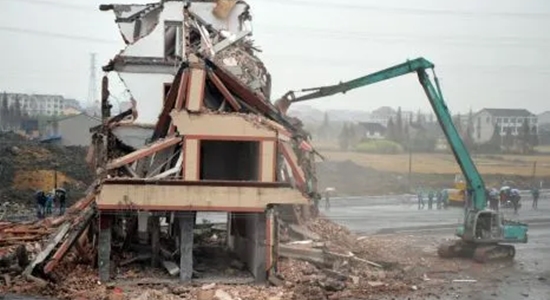
Beijing is eradicating whole villages. NPR reports that “Thousands of villagers in Shandong…have already been rendered effectively homeless since local governments began forcibly clearing away houses last year [2019]. The ongoing mass demolition and consolidation of villages scattered across China has become so common that residents colloquially refer to the initiative as ‘pulling’ villages out from the ground, much like one would pull out a rotten tooth or a weed…. The provincial government slated thousands of villages to be demolished and consolidated by the end of this year.”
In many cases, farmers are given apartments or small houses to replace their larger farm houses.
Worse in some ways is the current program to replace village names in Xinjiang (what we used to call Chinese Turkestan). Human Rights Watch tallied 3,600 village names changed between 2009 and 2023 by the regime from historic ones to silly propaganda words. “The top three most common replacement village names are ‘Happiness,’ ‘Unity,’ and ‘Harmony.’ ”
Last year your village elected some “representatives.” They were arrested or placed under close supervision. This year, your village was destroyed on orders of the province.
At least no one renamed it Happiness before it was bulldozed. There is no happiness in a communist village “democracy.” □
James Roth works for a major defense contractor in Virginia.