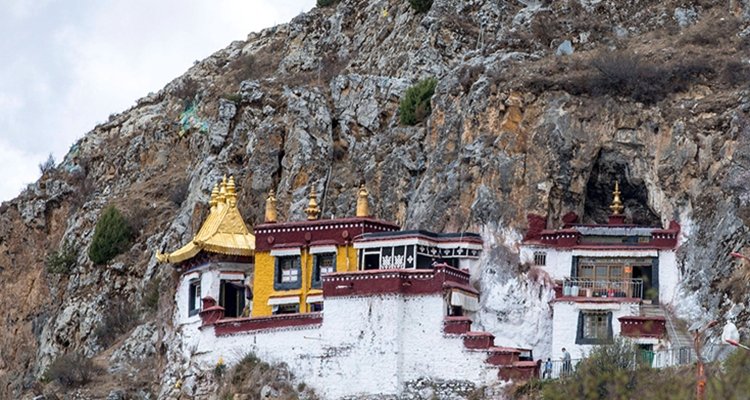
China has demoted a CCP official in charge of Drakkar County in Tibet for dereliction of duty. He hesitated to do his part to implement the latest crackdown on religious practice in the PRC’s “autonomous” Tibetan region (Phayul, August 3, 2026).
Chinese authorities recently ordered the implementation of stringent measures across five counties in Tsolho (Hainan) Tibetan Autonomous Prefecture—Serchen, Trika, Drakkar, Mangra, and Ba—requiring local authorities to prohibit the public from observing Nyungne, a traditional Buddhist fasting retreat, while intensifying restrictions on religious activities. The directives also called for dismantling of prayer flags and prayer banners, as well as the mandatory display of the Chinese national flag at the entrance of every household.
However, Druk Bum Gyal, who served concurrently as Communist Party Secretary and county chief of Drakkar County, reportedly refrained from implementing the directives immediately. According to the report, he argued that abruptly enforcing the policies could provoke an unpredictable public reaction, saying the measures should instead be introduced gradually.
His reluctance to carry out the campaign reportedly prompted higher authorities to remove him from his leadership positions. He was subsequently transferred to a lower-ranking post.
Is Druk Bum Gyal a hero for wanting to slow the tyranny down? If the reporting is accurate, he would have been willing to tolerate all of the vicious policies that he was loathe to impose all at once. Nevertheless, Tibetans are “praising him for resisting the immediate implementation of measures viewed as hostile to Tibetan religious traditions.” They would have welcomed any reprieve.
Collaboration in India?
On the same day, Phayul reported that in anticipation of a visit by Xi Jinping to New Delhi next month, Beijing is urging the Indian government “to restrict media access for Tibetan exile and Falun Gong-affiliated news organisations.”
“China’s concerns extend to several Tibetan media organisations operating from Dharamshala, the headquarters of the exile Tibetan government, officially known as the Central Tibetan Administration. These include Phayul, Radio Free Asia’s Tibetan Service, Tibet Times, Tibet Express, Tibet Radio, and Voice of Tibet (VoT), all of which have consistently reported on the human rights situation inside Tibet and the Chinese government’s regressive policies implemented in Tibet.”
So far, it is unknown whether India will comply with this request.
Collaboration in Nepal
Meanwhile, the government of Nepal has canceled “the 17th Seminar of the International Association for Tibetan Studies, an internationally renowned academic conference that was scheduled to take place in Kathmandu from August 23 to 29, 2026…. The cancellation follows sustained diplomatic pressure from the Chinese Embassy in Kathmandu.”
The Chinese Communist Party had a backup plan: swamp the conference.
“As diplomatic pressure from Beijing intensified, exile Tibetan scholars and researchers increasingly found themselves sidelined from the event. In contrast, Chinese state-affiliated institutions, including the China Tibetology Research Center, had registered a delegation of nearly 100 participants, a move that observers viewed as an effort to shape academic discourse on Tibet during the conference.”
The sponsors of the seminar, a Kathmandu University department and Rangjung Yeshe Institute, might have, in theory, rejected the applications of the CCP delegates and refused to sideline the Tibetans. But whether such a course was ever feasible is now a moot question.