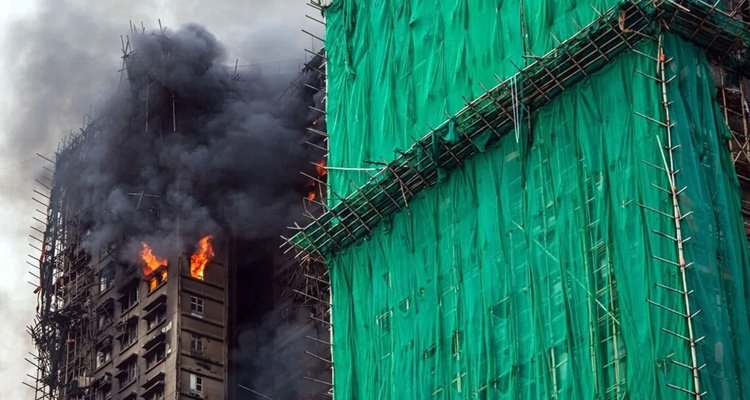
The Hong Kong government doesn’t want Hongkongers to know how many people died in the fires that raged through seven towers of Hong Kong’s Wang Fuk Court apartment complex on November 26, 2025. The official “count” is reportedly 159 or so dead and 31 missing.
Lei of Lei’s Real Talk has done some back-of-envelope calculations using reasonable assumptions and relevant data. Some of her observations (December 6, 2025):
“One massive fire, seven towers, 31 floors each…. Residents on the upper floors had almost no change to escape. And even if they did, they had very little time to do so.”
According to the Hong Kong government’s 2021 census, “the Wang Fuk Court residential complexes [consisting of eight towers] housed 4,643 residents. And that’s averaging 580 people per tower.” (Lei later concludes that 4,643 is likely an underestimate.)
“The overall at-home rate was about 58%.” This percentage is based on numbers of elderly residents, most of whom were home; working residents, maybe a fifth of whom were home; and children, many of whom had recently returned from school; and similar estimates.
“Roughly 2,366 people were at home or they were in the buildings at the time. But…you also have renovation workers, caregivers, nannies, delivery workers, social workers, and visitors. So people estimate another 250 individuals were inside.” So, “roughly 2,600 people” were trapped inside the seven towers at the time of the fire.
“Because the estate was under long-term construction, residents’ windows were sealed shut.”
The fire alarms did not work.
The fire did not start at one point and then spread. “The fire started in different buildings simultaneously.” No matter how the fires started, though, “within minutes…all seven buildings were engulfed. The only vertical escape routes were filled with thick smoke.”
Likely mortality rate
Judging by the mortality rates of other major fires, the mortality rate of the Wang Fuk Court fire was probably between 25 percent and 50 percent of the residents who were at home at the time. The mortality rate in this case is probably on the higher end (or even higher), because Wang Fuk Court was affected by “systemic failures at every level,” including nonfunctioning alarms and “buildings wrapped in fuel-like scaffolding nets.”
In light of all these considerations, “the real number [of deaths] should be closer to the upper end, around 1,300 deaths. And this is still conservative in my opinion, because this is assuming that half of the 2,600 people trapped in the buildings survived the fire. Judging by the intensity of the fire…I think that’s highly optimistic.”
The government’s “quote-unquote ‘care team’…official care team…threw away tons of donated supplies…. They explained that they had to throw them away because no one needed them…. [The most] likely reason is there weren’t enough survivors left to use them.”
“There were about 5,000 people who basically lost their homes. Yet only about 2,000 residents went to the government’s shelter after the fire. Where did the other 3,000 people go or 2,000 plus people go? Did they all move in with the relatives and friends? When Hong Kong has the most cramped housing in the world, some might, but not 2,000 people. I don’t think so…. The simplest explanation is, many of them perished.”
Residents of the towers reportedly held 7,600 insurance policies. “I assume some people probably have double life insurance policies. Some people don’t have any. But that indicates the number of occupants in that community is higher than the census data.”
Also: “In the days after the fire, thousands of missing person posts appeared online. People were looking for their loved ones. They’re real people looking for missing family members or friends. These cannot be fake…. So how could you have thousands of people looking, thousands of posts looking for missing people when you only have 100 to 200 people missing?”
Impossible
What it all adds up to is that although we don’t really know how many residents of Wang Fuk Court died, the very low official estimate of deaths is “physically, statistically, historically, and logically impossible.”
Hongkongers have seen no officially released list of those who died. Such lists after catastrophic events are standard in many parts of the world. “But in Hong Kong, nothing. No one knows who survived and who perished in the fire. Just like mainland China.”
This is probably the kind of thing that the Hong Kong government doesn’t want foreign news reporters to talk about.
What are we make of all this? Only that the CCP-destroyed Hong Kong that we knew before the blaze is the same as the CCP-destroyed Hong Kong that we are witnessing now. But maybe some Hongkongers are now more willing to oppose the regime.