Foreign observers of how the Thai government operates don’t believe that Zhang Xinyan is being held because she overstayed her visa. But some Thai journalists seem to believe this—even though she was stopped while boarding a plane for Canada (UCA News, July 13, 2026).
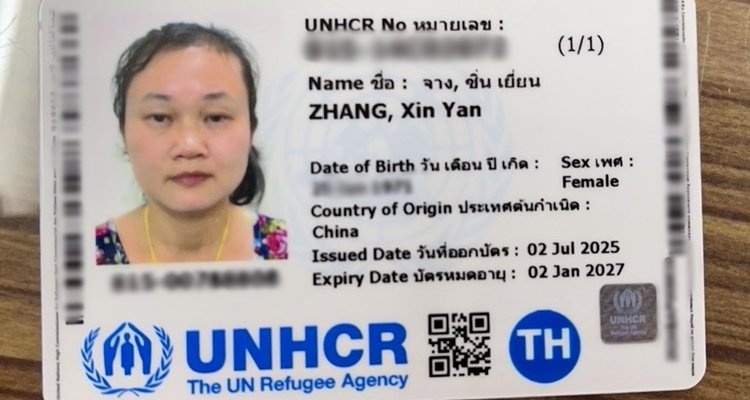
Thai media backed the claims, adding it was believed she was taken to Thonburi Court where she was to be charged with overstaying her Thai visa. The 56-year-old’s UNHCR refugee card, which was posted online, showed an expiration date of Jan. 2, 2027….
“It’s beyond outrageous that Thailand is playing Beijing’s game by holding Zhang Xinyan and threatening to send her back to China, where she will face arrest, persecution, and torture,” said Phil Robertson, Director, Asia Human Rights and Labour Advocates.
“She is a UNHCR-recognized refugee who has already been cleared for resettlement to Canada, and the Thais should let her depart to Canada as planned.” [The UNHCR is the United Nations High Commissioner for Refugees.]
Thailand sparked an international incident in February last year when it bowed to years of Chinese pressure and secretly deported 40 Muslim Uyghurs.
All had been granted asylum in Canada and the United States. They were deported despite reassurances by the Thai government that this would not happen, issued just one month earlier. A year later, the 40 had vanished….
Zhang is also a pro-democracy activist and a member of the Hong Kong Parliament group in exile, which held illegal global elections for the territory last year. If sent back, she could become the first person deported, charged under Hong Kong’s national security law, and imprisoned.
Zhang hasn’t been deported to the People’s Republic of China, yet. But the risk is not marginal. If the Thai government did not detain her in order to send her back to the PRC, why detain her at all? Had the plane headed for Canada taken off with Zhang on it, this would have been the end of any “overstaying visa” problem.
On X, Sing Chow asks: “If Thailand is not a party to the 1951 Refugee Convention or its 1967 Protocol, and lacks a comprehensive refugee protection system, why does the UNHCR continue to conduct so much of its refugee protection and resettlement work there?…If even a UN-recognized refugee cannot be guaranteed basic safety, what does this refugee card truly represent?”
The criticism is not quite fair. For one thing, issuing the card is a source of public pressure on a government, even one that has not agreed to implement a “comprehensive refugee protection system.” Reports indicate that despite many problems, the UNHCR and other organizations have had some success in helping refugees in Thailand to resettle.
Also, when leaving China in 2014, Zhang had to go somewhere, and perhaps had little choice about where to go. In 2016, Zhang was granted refugee status by the UNHCR, and she has been able to make her home in Thailand for years. But in July 2025, she was one of 15 Hongkongers for which the Hong Kong authorities issued arrest warrants.
According to a wanted notice posted by the Hong Kong police, she is accused along with others of participating in “the election of [a] ‘referendum’ in order to form a body of power named ‘The Hong Kong Parliament’, with a view to achieving ‘self-determination’ and subverting the State power…. A reward of two hundred thousand Hong Kong dollars ($200,000-HK) is being offered by Police to any member of the public who can provide information on the related person or case.”
Also see:
The Globe and Mail: “Hong Kong activists in Canada, U.S. and U.K. announce plans to form exile parliament” (July 27, 2022)