It is final and binding in the judgment of the Philippines or the Permanent Court of Arbitration in The Hague operating under the UN Convention of the Law of the Sea, but “null and void” in the assertion of the People’s Republic of China.
The Philippine government recently held a forum in recognition of the tenth anniversary of an arbitral ruling of the Permanent Court (United Daily, July 11, 2026).
In 2013, based on the United Nations Convention on the Law of the Sea, the Philippines submitted a request for arbitration to the Permanent Court of Arbitration in The Hague. On July 12, 2016, the tribunal ruled that China’s “nine-dash line” historic rights claim had no legal basis, and confirmed that the South China Sea features claimed by China did not generate an exclusive economic zone.
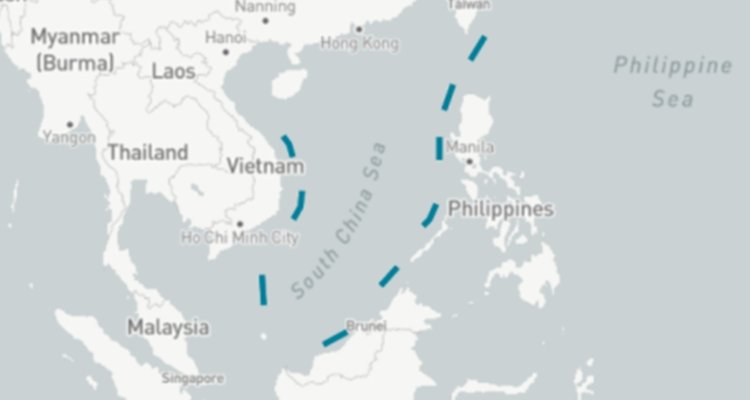
The nine-dash line is the Chinese government’s line on maps indicating the scope of its arbitrary and devouring claim over the South China Sea. Since 2016, the PRC has repudiated the Permanent Court’s ruling not only verbally but by its actions in that Sea: spraying vessels with water cannons, blocking and ramming vessels, boarding vessels with knives and spears, using military-grade lasers to cause temporary blindness, harassing fishermen, harassing soldiers on resupply missions.
[Philippine Solicitor General Darlene Marie Berberabe] noted that if China’s claim were recognized, most of the Philippines’ EEZ resources would be encompassed within it.
She said the arbitral award clearly confirms that the Philippines is entitled by law to the exclusive rights to explore, develop, conserve, and manage marine resources, the seabed, and subsoil resources within its exclusive economic zone….
[Berberabe] said that since 2022, the Philippine government has continually publicized the harassment of Philippine ships and fishermen by Chinese vessels in the West Philippine Sea and has informed the international community of these incidents.
In 2024, the Marcos administration further reorganized the National Coast Watch Council into the National Maritime Council to unify the coordination of West Philippine Sea affairs and strengthen the safeguarding of maritime rights.
The Philippine Coast Guard, armed forces, and various agencies have been conducting patrols, mapping the region, submitting diplomatic protests, and in general “maintaining a presence in the West Philippine Sea to safeguard the country’s maritime rights in practice.”
Up to now
The Rappler news site has published a timeline of PRC harassment of Philippine vessels that occurred from 2011 to 2016. A more comprehensive timeline in Wikipedia lists incidents or claims going back to the third century BC. Around 2011, the chronicle becomes annual, in many individual years showing numerous incidents of PRC harassment of U.S., Vietnamese, Philippine and other vessels.
The mere fact that a country criticizes or refuses to follow an international ruling doesn’t tell us anything by itself. Much of what the United Nations says or tries to impose deserves to be criticized or ignored. But the 2016 arbitral ruling about Philippine and related water rights issued by the Permanent Court of Arbitration in The Hague under the 1982 UN Convention of the Law of the Sea (UNCLOS)—a Convention that the PRC signed and ratified—is reasonable enough. It amounts to telling the non-land-locked nations of the region that they must not crowd each other. But the CCP doesn’t want to be restrained by such considerations, so calls the ruling “illegal, null and void, and nonbinding.”
Whether a disagreement over water boundaries is reasonable is one question. Another is how a country handles boundary disputes in its relations with other countries. Several countries in the vicinity of the South China Sea—the Republic of China, Vietnam, the Philippines, Malaysia, Brunei, Indonesia—disagree with other countries about boundaries. But they do not routinely block and ram, wield water cannons and lasers against, and otherwise harass and harm the vessels and people of other countries.
Also see:
PCA Cases: “The South China Sea Arbitration Award of 12 July 2016” (PDF)
“The Tribunal concludes that, as between the Philippines and China, China’s claims to historic rights, or other sovereign rights or jurisdiction, with respect to the maritime areas of the South China Sea encompassed by the relevant part of the ‘nine-dash line’ are contrary to the Convention [the United Nations Convention on the Law of the Sea (1982)] and without lawful effect to the extent that they exceed the geographic and substantive limits of China’s maritime entitlements under the Convention.”
Taiwan Talks: “South China Sea Ruling at 10: Why the Philippines Is Still Winning”
Ray Powell, SeaLight Foundation: The Philippines “used the provisions of the United Nations Convention on the Law of the Sea to have an arbitration process. China signed up to the UNCLOS in 1996. It was subject to the arbitration process. It simply recognized it was in a weak position and so it declined to participate, and it’s used that [refusal] to participate as its rationale for saying [the arbitral ruling] doesn’t apply to us. But that is not what the law says.”
Rappler: “Timeline: The Philippines-China maritime dispute”
Wikipedia: “Timeline of the South China Sea dispute”
StoptheCCP.org: “The Spratly Agenda”