Can you reconcile the following two statements? “Washington’s decision not to renew Executive Order 13936 was not a concession to Beijing or a gesture tied to renewed U.S.–China trade talks…. Trade talks simply offered a convenient moment to retire an instrument that no longer served U.S. strategic interests.”
These sentences are in the same introductory paragraph and are separated by only one other sentence (Australian Institute of International Affairs, August 11, 2026).
Was not a gesture tied to trade talks, not a concession. Trade talks simply offered a convenient moment to let the order lapse. Why and how did the trade talks offer this convenient moment?
Largely symbolic
Could it be that although author C.F. Legrand regards the sanctions against particular Hong Kong and mainland officials as having by now collapsed into being “largely symbolic,” i.e., meaningless and ineffective (in her view), the Chinese Communist Party regards the symbolism of U.S. opposition to its tyranny as meaningful and important and in fact welcomed the supposedly meaningless concession that Legrand knows for a fact the U.S. side did not make?
The Chinese Communist Party imposes and attempts to impose its will in Hong Kong and around the world by military and violent means and by inundatory deployment of symbols like flags, art, and the words of its rote propaganda.
Here is Legrand’s middle sentence in the first paragraph: “After six years of Hong Kong’s eroding autonomy, rising compliance costs for American financial institutions, and growing integration with mainland China, the order had become largely symbolic.” Legrand also writes: “However, it was unlikely from the start that sanctions would force Beijing to change course. Beijing views Hong Kong’s governance, security architecture, and political order as nonnegotiable parts of its own national sovereignty.”
Clearly (?) then, China’s evil treatment of Hongkongers, being an immovable rock, ought not to have ever been opposed by so weak a means as largely symbolic sanctions. Especially since, according to Legrand, the symbolic opposition represented by the sanctions both had no effect at all after first being imposed in 2020 and, by 2026, had become “largely symbolic,” which I take to mean “ineffective” (since Legrand suggests that symbolic U.S. opposition has no effect on the Chinese Communist Party and perhaps not on any one of its officials and perhaps does not hearten the Party’s domestic foes either).
Per Legrand, then, the nonexistent effect of the U.S. sanctions imposed against the Hong Kong government in 2020 had, by 2026, no longer exerted any of even the original nonexistent effect.
The nine
The lapse of Executive Order 13936 does not restore the status quo ante. We are talking only about the dropping of U.S. sanctions against nine officials (seven Hong Kong officials, two mainland officials) who had been sanctioned under the terms of the executive order and who are not also named in other U.S. lists of sanctions. The United States still regards Hong Kong as no longer autonomous and no longer entitled to a privileged trade status that had been based on its former, now destroyed autonomy.
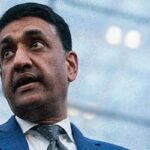
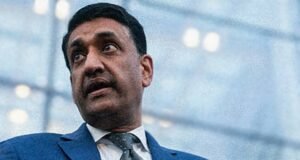
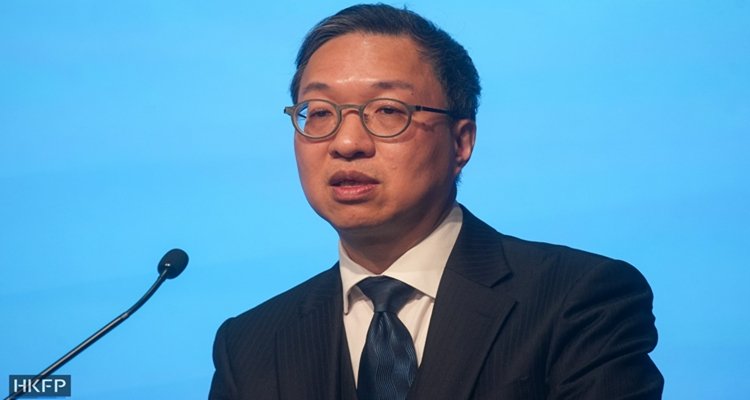
The nine officials who are no longer subject to U.S. sanctions are Paul Lam Ting-kwok, Secretary for Justice (shown above); Dong Jingwei, director of Beijing’s national security office in Hong Kong; Raymond Siu Chak-yee, former Commissioner of Police; Sonny Au Chi-kwong, Secretary-General of the Committee for Safeguarding National Security; Dick Wong Chung-chun, Assistant Commissioner of Police (National Security); Margaret Chiu Wing-lan, former Assistant Commissioner of Police (National Security); Stephen Lo Wai-chung, former Commissioner of Police; Qiu Hong, former Deputy Director of the Central Government Liaison Office in Hong Kong; Yang Jianping, former Deputy Director of the Central Government Liaison Office in Hong Kong.
Thirty-nine other Hong Kong and mainland officials are still subject to U.S. sanctions.
What does Legrand think of the sanctions that are still intact? Just “largely symbolic”? Meaningless? Ineffective? Should be dropped? Or what? What about the fact that U.S. continues to treat Hong Kong as no longer autonomous?
Importantly
C.F. Legrand writes: “Importantly, the expiration does not signal a broader U.S. retreat. Washington adjusted one instrument but kept its overall Hong Kong policy intact. Although nine individuals were removed from the sanctions list, its broader legal framework remains unchanged…. The 2026 report [the ‘2026 Hong Kong Policy Act Report’] again found Hong Kong insufficiently autonomous, meaning its preferential treatment cannot be restored. Hong Kong’s status will not return to its pre-2019 position.”
What seems to be implied by this part of Legrand’s commentary is that it’s a good thing that the U.S. has not also dropped the remaining sanctions and that the U.S. has not restored the preferential treatment of Hong Kong. If so, why isn’t it a bad thing that a thug like Paul Lam is no longer on any U.S. sanctions list?
Also see:
The Hill: “The US owes the people of Hong Kong an explanation”