Let’s assume the best. That the whole thing is just a blind.
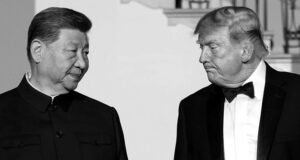
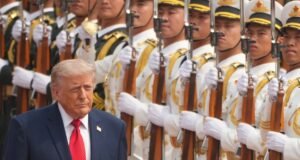
That U.S. President Trump’s gushing over Chinese dictator Xi Jinping and waffling about Taiwan are intended only to soothingly keep Xi from doing anything drastic—in addition to all the other drastic things he is doing—until the United States can extract itself from the PRC’s critical-mineral supply chain grip, finish the war in Iran, pull a rabbit out of the hat in Ukraine, build lots of ships and planes and missiles, and do one or two dozen other things to shore up the American position after decades of delusional thinking about the People’s Republic that Donald Trump is merely simulating in the only way he knows how, over the top.
A few assumptions may be erroneous. One, that the brutal totalitarian dictator is susceptible to the hypnotic sway of Trumpian flattery. Two, that Xi’s foiled successor(s) or supplanter(s), whichever person or group might have managed to take over if Trump hadn’t done so much to shore up Xi’s recently rattled domestic position, would have been worse than Xi. Three, that all the hailing and feting of Xi Jinping has no cost on the world stage, including the cost of discouraging the friends of the U.S. and the foes of the Xi regime.
This from Peter Hartcher is blunt: “Trump’s grovelling emboldens China and imperils the Asia Pacific” (The Sydney Morning Herald, September 29, 2026).
China’s leader, Xi Jinping, is achieving what the celebrated ancient Chinese strategist Sun Tzu declared to be “supreme excellence” in warfare.
That is, he’s “breaking the enemy’s resistance without fighting”. Donald Trump is delivering advantages of historic consequence to China—free….
Much of the commentary is that Xi’s three days of summitry with Trump was “all symbolism, no substance”. In reality, it was a triumph for the Chinese Communist Party and its leader in both symbolism and in substance.
Among many effusions of fatuity during the recent summit meetings and tours that Hartcher relentlessly records:
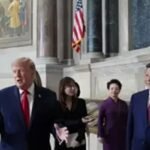
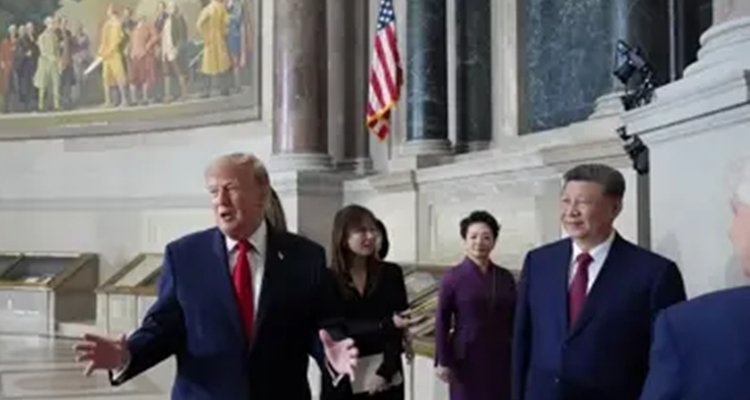
Trump took Xi on a personally guided visit to the National Archives to show him the original US Declaration of Independence. As the leaders left, Trump told reporters: “We’re just comparing. Ours goes 250 years, which is great, and we’re proud of it. But theirs goes 6000 years.”
This is part of a Trump pattern of parroting Chinese Communist Party propaganda. The US republic is indeed 250 years old; the People’s Republic of China is a mere 76 years old. The CCP spruiks [promotes] 6000 years of Chinese culture to create the impression of permanence and legitimacy for its modern dictatorship. The corresponding age for the US president would be to lay claim to the history of Western civilisation.
Kurt Campbell points out another example from Xi’s visit. Both presidents claimed that the US and China were united as allies against Japan in World War II. [Trump: “Look at the greatness that we had together fighting in World War II….Just as our people worked together to win that war, President Xi and I will continue working together to forge a better future for both of our nations.”]
But the US actually allied with the Republic of China, ruled by the nationalist Kuomintang, the system that the Communist insurgency drove out of mainland China in 1949. The Republic of China relocated on the island of Taiwan.
A Taiwan academic, Chen Fang-yu, of Taipei’s Soochow University, told a weekend conference: “We’re facing the Chinese communists’ enormous propaganda resources and their continuous attempts…to brainwash” the US public.
With help from Donald Trump.
Nobukatsu Kanehara, former Japanese diplomat, says that if war erupts over Taiwan, “the South China Sea and East China Sea would be blocked…. We have to understand the huge consequences.”
A PRC conquest of Taiwan would, Hartcher summarizes, help Beijing “to establish itself as the hegemon over the maritime arteries that carry about one-third of global trade.”
Kanehara: “Xi has to believe that there will be a big war that he cannot win.”
Also see:
StoptheCCP.org: “Beijing’s Parade of Distortion”
“It’s clear that the communists were a stumbling block in the defeat of Japan.”