China is clinging to its magnets. Bloomberg reports (“Trump pledge of quick China magnet flows has yet to materialize,” June 20, 2025):
Almost 10 days since President Donald Trump declared a “done” trade deal with Beijing, US companies remain largely in the dark on when they’ll receive crucial magnets from China—and whether Washington, in turn, will allow a host of other exports to resume….
China’s system is improving but remains cumbersome, they said, contrary to Trump’s assurances rare earths would flow “up front” after a June 11 accord struck in London.
The delays are holding an array of American industries hostage to the rocky US-China relationship, as some firms wait for magnets and others face restrictions selling to China. That friction risks derailing a fragile tariff truce clinched [sic] by Washington and Beijing in Geneva last month, and triggering fresh rounds of retaliation….
In response to China’s sluggishness on magnets, Trump last month restricted US firms from exporting chip software, jet engines and a key ingredient to make plastic to China until President Xi Jinping restores rare earth exports. Companies subject to Washington’s curbs have halted billions of dollars in planned shipments as they wait for players in unrelated sectors to secure permits from Beijing, which could take weeks or even months to process, given the current pace….
Access to rare earths is an issue “that is going to continue to metastasize until there is resolution,” said Adam Johnson, chief executive officer of Principal Mineral, which invests in US mineral supply chains for industrial defense. “This is just a spigot that can be turned on and off by China.”…
Beijing still hasn’t officially spelled out the deal’s requirements, nor has Xi publicly signaled his endorsement of it—a step Trump said was necessary.
The Chinese Communist Party knows that the U.S. president, Donald Trump, likes to make deals. Perhaps it would give the United States any deal it likes and however many deals it likes. Maybe the Chinese government would even agree to an infinity of favorable deals, very good deals, the best deals ever.
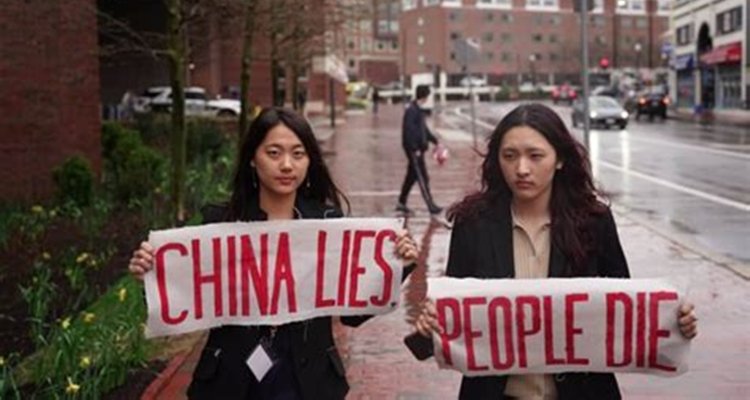
History of lies
Whether China would abide by the terms of the deals is a different question, the answer to which is suggested by an article pointing out that “Chinese leaders have a long history of strategic deception” (The Hill, June 19, 2025).
In September 2015, Chinese Dictator Xi Jinping “made an unambiguous commitment [to President Obama]: China had ‘no intention to militarize’ the artificial islands it was building in the South China Sea.” Xi lied: “within three years, satellite imagery revealed military-grade airstrips stretching across previously submerged reefs.”
This should not have been a shocker. Nor should Obama have believed Xi to begin with. China’s diplomatic deceptions are not an aberration but part of a consistent and deliberate pattern that the authors trace to the 1940s, when Mao lied to U.S. diplomats about the nature of the communists; they said that they were just “moderate ‘agrarian reformers’ seeking democratic change.”
Later:
During President Richard Nixon’s landmark visit, Mao and Zhou downplayed their revolutionary ideology and the ongoing brutality of the Cultural Revolution, strategically masking their domestic repression to secure diplomatic recognition and economic benefits. China also signed the Sino-U.K. Joint Declaration on Hong Kong in 1984, promising to keep the status quo for 50 years—before violating that agreement when the Communist Party cracked down on protests in 2019.
By the late 1980s, China had learned that Americans suffer from political amnesia. By offering the appearance of cooperation and reform today, they could make Americans forget the deceptions of yesterday.
More lies came during the pandemic.
The authors relate only a few major examples of the “strategic deception,” but the record of it is continuous.
“The Chinese Communist Party has mastered what might be called the ‘liar’s dividend’: violating commitments often carries fewer costs than honoring them, especially when enforcement mechanisms are weak and other parties have short memories….
“After seven decades of strategic commitment-breaking, perhaps the most dangerous illusion is the belief that the next Chinese promise will somehow be different. As American representatives negotiate trade with Beijing, they would do well to secure not just the ‘best’ trade deal for the U.S., but one that accounts for the possibility of deception.”