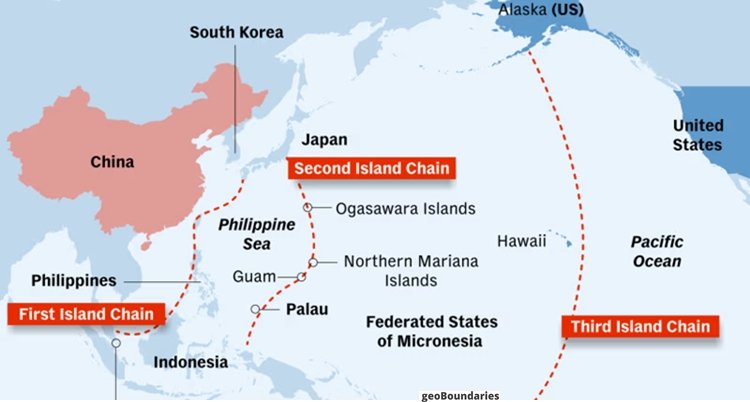
Since Eisenhower’s presidency, the island chain strategy has been the basic concept of how to contain Red China.
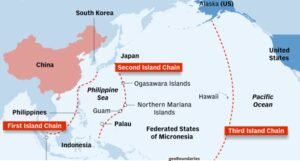
The idea is that U.S. forces based in the first island chain (Japan, Taiwan, the Philippines, Borneo) would operate against the PLA Navy while forces in the second island chain (Ogasawara Islands, Northern Mariana Islands, Guam, Palau) support those in the first. The third island chain stretching from Alaska through Hawaii and New Zealand represents a last line that could constrict a Red navy’s Pacific operations with land-based or supported forces. After the third line, the PLA Navy would have maximum freedom of movement in the Pacific.
Allies and geography
When he took office, Secretary of War Pete Hegseth stressed the defensive character of the first line: “We don’t want to see a conflict at all…. But we’re going to be postured forward and leaning forward as much as necessary to ensure [a conflict] doesn’t happen.”
The first island chain strategy depends on U.S. forces basing on foreign territory and getting the support of host countries. Our strongest allies, and the term has to be used with care, are Australia and New Zealand; and they are not even near the first chain. They would be our most supportive and permissive hosts, but the strength of their support cannot offset geography.
The nations actually in the first chain, consistently and thoughtlessly referred to as our “allies,” are only half-allies at best…with the U.S. pledged to come to their aid in a crunch but not vice versa.
A U.S. war with Red China would, for them, be a war of choice fraught with domestic political consequences as well as all the carnage of war. They would be weak powers electing to fight a superpower on behalf of a third party. How likely is that? And the current war in Iran suggests to all that their American bases, as well as their own assets, could be the targets of Red China in the same way that Saudi Arabia, Kuwait, Bahrain, etc., have been the targets of Iran.
To generalize, the “alliances” with these small powers consists of basing agreements, military sales, and periodic joint training. The good news is that someone in government finally noticed the problem and commissioned a report. In 2024, Rand published a study that asked all the right questions.
The questions
“Do existing security agreements enable the United States to obtain the type of access it requires from each ally?”
No. Absolutely not.
“Do the United States and its allies share similar interpretations of their respective agreements to minimize any potential friction of implementation?”
Probably not. We will find out the hard way.
“Should the United States seek to bring in a new capability into an ally’s territory, what is the process that needs to be followed?”
To be determined. If it were easy, the capabilities would be there already.
“How much do nonlegal factors (i.e., political considerations and public opinion) affect U.S. basing and access in each host country?”
Domestic politics seems the major consideration. This is a dangerous variable.
“What is the process for the United States to invoke its security treaty with each of the respective allies? Does invoking said treaty ensure ease of access?”
It will be difficult to use the treaty partner’s bases in some war about a third party, such as the Republic of China. See recent experiences with Spain, Saudi Arabia and Italy.
“Do the challenges to basing and access change depending on whether it is peacetime?”
Absolutely. They are already overly restrictive and politically sensitive.
Two words for this report: Bravo Rand. Read it for yourself to get a fair picture of these “alliances” and their foundation of eggshells.
In July, the Modern War Institute published a piece saying that “RAND’s recent work on fighting from allied territory is a useful corrective. Another RAND study delivers the larger point more bluntly: Some allied and partner decisions on access could determine the outcome of a conflict with China.”
This month, Responsible Statecraft published an editorial concluding that “the outcome of the U.S. war in Iran reveals clearly that the current U.S. first island chain presence is not sustainable or survivable.” Retreat to the second island chain, it recommends: “reduce and consolidate [U.S.] military presence, including both personnel and assets, into bases in Guam, Palau, Micronesia, Tinian, and others, leaving at most a small number of rotational forces in Japan and the Philippines.”
A bluff?
Answers to the challenge of keeping the first island chain defense have started appearing, but how realistic are they?
U.S. Naval Institute: “Each nation faces unique diplomatic and political challenges that complicate U.S. efforts to maintain forward presence. By knotting and splicing the frayed strands of each alliance, the United States can turn the rope of shared security into the chain it needs to be.”
In its present form, the first island strategy rests on so many contingencies as to be a bluff, one that needs to be replaced with bona fide alliance treaties.
Who’s working on that? □
James Roth works for a major defense contractor in Virginia.