Australia’s Lowy Institute has issued its annual Asia Power Index report, which finds that “The gap between American and [Communist] Chinese military capabilities is smaller than it ever has been.”
The report’s conclusions are grounded in numerical scores which seem to be ratings assigned by panels of experts. Each expert does a gut check and comes up with a number for the assigned topic. Then the numbers are averaged to produce a score.
The index, then, is not so much a precise measurement of reality as an expression of expert sentiment—nothing wrong with that. And the topics do contain useful data, occasionally used to justify ratings.
For instance, “In budgetary terms, the US still enjoys a comfortable lead over China, spending nearly three times as much on its military. However, Beijing’s appears to get more bang for its buck. Its new and potent Type 55 cruisers cost between US$850 to US$920 million compared to US$2.7 billion for an Arleigh Burke-class destroyer, the workhorse of America’s navy. Add to that the fact that the PLA’s budget has grown by nearly 1000% from 2000 to 2026, and we can see that China is spending its money more effectively than the US, and spending more and more of it.”
Defense networks
There is also the matter of “defense networks.” This is a much better term than “alliances” to describe treaty arrangements between regional states, although Lowy still uses “alliances” as well.
“In 2026, the United States’s Defense Networks score fell 4.2 points to 77.3—its lowest since the Index began—driven by a reduction in both the joint exercises and defense dialogues it held with allies and non-allied partners in the region. The decline began in late 2023, as events in the Middle East drew Washington’s attention away from Asia. This initially raised doubts about the durability of the hub-and-spoke alliance system, but stronger cooperation between the spokes has since emerged.”
The report is saying that Asian bilateral defense cooperation is growing, an outcome to be expected and desired, one would think.
“The Philippines has been particularly active, signing visiting forces agreements with several countries and a Reciprocal Access Agreement with Japan. It has also signed agreements with Australia to jointly develop defense infrastructure in the Philippines, and with South Korea to buy a dozen fighter jets. Australia, too, signed an agreement with Japan to purchase Mogami-class frigates as part of its naval modernization, in what is Japan’s largest defense export since the Second World War. These agreements reflect a long-term political investment in regional defense networks.”
Then there are the joint exercises.
“In 2022, Australia held 5 military exercises with Japan and 4 with the Philippines, without the United States. By 2025, these had more than doubled, to 13 and 11 respectively. Over the same period, Japan’s exercises with the Philippines increased from 7 to 12, and with Thailand from 2 to 6. Notably, through the application of the RAA, Japan deployed combat-capable ground forces to the Philippines for the first time since the Second World War as part of the Philippines-hosted Exercise Balikatan in early 2026.”
This is all good news.
Diplomacy
The experts also deemed that “US Diplomatic Influence fell by 6 points to 76.7 this year, marking the fourth straight year of decline and the largest single margin of loss in this measure since the Asia Power Index began in 2018.”
And take a look at this metric: “US voting alignment at the UN with other countries in the Index also fell sharply (36.6 points), reflecting Washington’s unilateralism and its tendency to vote alone on UN resolutions.”
One forgets that anyone might still consider the UN important.
Washington’s “withdrawal from the UN Economic and Social Commission for Asia and the Pacific in 2026, a year after leaving the UN Human Rights Council, further eroded its multilateral influence. [Red] China, by comparison, participates in more regional summits and organizations than all other countries in the Index.” Yes, the CCP maximizes its use of the UN. Duly noted.
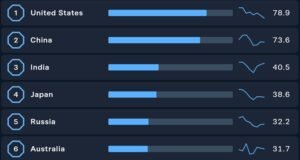
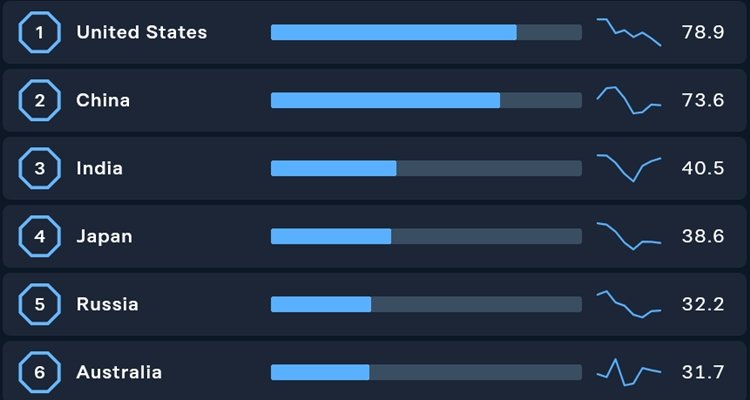
The gist of the report is its charting of comparative power (see here). The experts rate the U.S. as tops with 78.9 out of 100, followed by Red China at 73.6. (Some of the rankings are shown above.)
India and Japan are a distant third and fourth. Russia, Australia and South Korea are in a virtual three-way tie for fifth. Surprising are the similar scores for New Zealand, the Republic of China (Taiwan) and the Philippines, ranking from 13th to 15th.
Also surprising to see Nepal and Mongolia ranked at all.
Japan
In other news this week, the Japanese government told its military contractors that there would be some belt-tightening. “Each company was handed its own estimate for equipment and facility orders, at half of its original projection or 50% to 80% below it.”
Cuts of 50% or more, wow. Although the headline states it even more dramatically: “Japan Quietly Tells Arms Makers to Brace for Order Cuts of up to 80%.”
That could make Lowy’s 2027 report even more interesting than this year’s. □
James Roth works for a major defense contractor in Virginia.