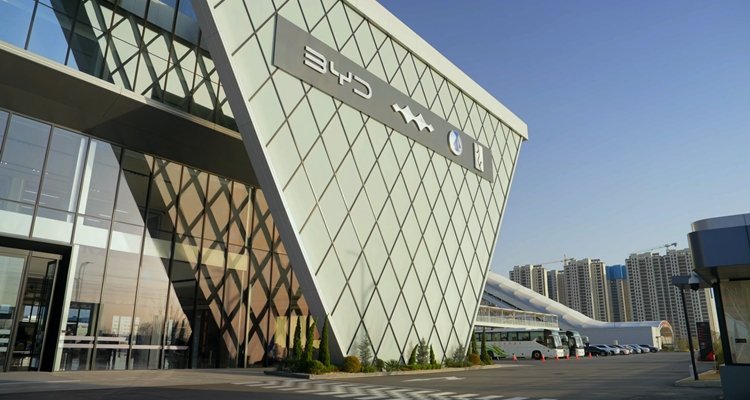
The BBC wrote a headline recently saying that “U.S. adds BYD to list of firms with alleged Chinese military ties.”
Alleged. This word “alleged” is misused in all kinds of reporting.
A more accurate headline would read, “U.S. exposes BYD’s military ties, adds firm to list of military companies.”
Read the report
To get it right, all the BBC had to do was read the report they were telling us about.
On June 8, the Pentagon issued that report, “Entities Identified as Chinese Military Companies Operating in the United States in Accordance with Section 1260H of the William M. (Mac) Thornberry National Defense Authorization Act for Fiscal Year 2021.” (Note that it’s the Act which is dated 2021; the content is fresh.)
For short, the 1260H List.
The Act defines “military companies.” The list compiles firms that meet the law’s definition.
We open the report, scroll down to the entry for BYD, and read that “BYD is directly and indirectly affiliated with SASAC [Beijing’s State-owned Assets Supervision and Administration Commission] and is indirectly affiliated with MIIT (Section 1260H(g)(2)(B)(i)(I)). BYD is a military-civil fusion contributor to the Chinese defense industrial base because it is affiliated with MIIT [Ministry of Industry and Information Technology] and because it resides in or is affiliated with a military-civil fusion enterprise zone (Sections 1260H(g)(3)(B)(i) and (g)(3)(E)).”
So the report plainly states that “BYD is a military-civil fusion contributor to the Chinese defense industrial base because it is affiliated with MIIT and because it resides in or is affiliated with a military-civil fusion enterprise zone.”
Accusation: contributor to the defense industrial base. Substantiation: affiliations.
The Justia Legal Dictionary says that the term “alleged” is “used when something is said to be true but has not been confirmed or substantiated.” Merriam-Webster defines “allege” as “to assert without proof or before proving.”
So we are not dealing with allegations but with what has been confirmed and substantiated. Every entity on the Pentagon’s new list has gotten the same treatment: accusation and substantiation.
Could be worse
This is not a sanctions list, however. As Reuters reports, “under recent U.S. law the Defense Department [Department of War] will be prohibited starting later this month from contracting directly with companies on the list, and from buying their products or services via third parties beginning in 2027.”
In an alert to its clients, the WilmerHale law firm lists some additional restrictions, noting that several other recent provisions “impose restrictions that are triggered by, or tied to, a 1260H designation, including restrictions on the procurement of additive manufacturing machines, AI applications or contracts with a company if it is (or its parents or subsidiaries are) party to a contract with an entity that engages in ‘lobbying activities’ for Section 1260H companies. This provision effectively creates a de facto blacklist of lobbyists based on the lobbyists’ work for such entities.”
In sum: lobbyists for military companies are restricted in the same way as their clients.
Meanwhile, “The companies can petition for removal” and they can sue to be removed. They will come off the list automatically if they relocate out of the U.S.
How harsh is that? Not so harsh.
Listed firms had a few things to say. From Reuters:
Chipmaker YMTC has determined that its being listed is “likely driven by anticompetitive motive rather than national security concerns.”
Carmaker BYD says that it will pursue “feasible administrative and legal means” to oppose the listing.
According to e-commerce giant Alibaba, “Alibaba is not a Chinese military company nor part of any military-civil fusion strategy. We will take all available legal action against attempts to misrepresent our company.”
Law firm Morgan Lewis warns that these military-company designations will lead to future trouble for the designees.
“Inclusion on the list also indicates that the US government may be contemplating additional restrictions on activities with these companies, including those imposed by other agencies, such as the US Department of the Treasury’s Office of Foreign Assets Control and the US Department of Commerce Bureau of Industry and Security. US companies will need to prepare to comply with new prohibitions that may be imposed by other US regulators. US companies may also need to consider potential Chinese law risks, which can result if a US company takes adverse actions against a listed entity.”
Real allegations
Politico reports that Red China’s Commerce Ministry “is threatening ‘forceful countermeasures’ unless the Defense Department [Department of War] walks back its latest listing of alleged Chinese military companies.” The ministry says that the U.S. has “disregarded the overall interests of bilateral economic and trade relations, continuously generalized the concept of national security, and abused state power to unjustifiably suppress Chinese enterprises.”
Washington disregarded, generalized, unjustifiably suppressed. Now those are some allegations indeed. □
James Roth works for a major defense contractor in Virginia.