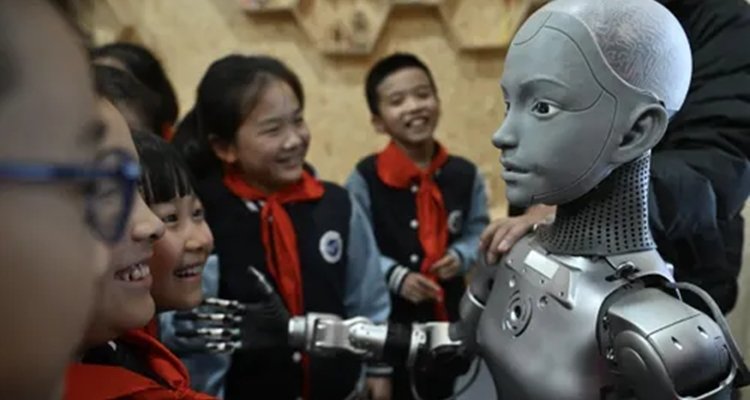
The market for humanoid robots has now gotten a lift from the public interest in artificial intelligence.
Per Associated Press, “Robots have long been seen as a bad bet for Silicon Valley investors—too complicated, capital-intensive and ‘boring, honestly,’ says venture capitalist Modar Alaoui. Alaoui, founder of the Humanoids Summit, gathered more than 2,000 people [in December], including top robotics engineers from Disney, Google and dozens of startups, to showcase their technology and debate what it will take to accelerate a nascent industry.”
So, there is this thing called the humanoid robot industry, and the United States and Red China lead it. Morgan Stanley values it at $5 trillion…potentially…off in the future, one assumes. Because in the U.S., manufacturers are struggling to find markets for these gadgets. Meanwhile, in Red China, 140 firms are making them even though the market is soft enough that the government is a leading buyer.
Das Robots
Humanoid robots are designed to perform human work. If enough do so successfully, you would have categories of work in which humans are displaced. In a workers’ paradise, this is strange, especially since under the old Soviet communism and current Chinese communism, there was and is no social safety net to speak of.
Red China’s state assistance is currently “ring-fenced around strict definitions of extreme hardship or minimum living allowances,” according to China Daily. In May, i.e., just last month, the Standing Committee of the National People’s Congress passed the Social Assistance Law, which is to take effect July 1.
“It targets individuals who are unable to work, have no income and lack caregivers, or whose legal caregivers cannot provide care, including the elderly, children and people with disabilities. It specifies that assistance will include basic living necessities, essential nursing services, medical care and burial services.”
This comes after years of dabbling with piecemeal interim legislation.
Think about communism without welfare and a dog-eat-dog economy awaiting its infusion of robot workers to displace real workers. In Marxist theory (which its Chinese practitioners seem rarely to invoke), perhaps this is the path to “post-scarcity anarchism,” days of plenty after the state has withered away. In the early 1970s, author Murray Bookchin explored post-scarcity anarchism in a book in which he foresaw technology liberating workers from scarcity and toil.
But this cannot be what the Party leaders have in mind. No current communist dictators can want anarchism, Marx or not. Besides which, communism creates scarcity.
Workers displaced by humanoid robots will need a vibrant labor market if they are going to regain work, and/or savings, and/or financial support. All of which communism seems reluctant or unable to provide.
Earlier this month we learned that “Wuhan-based GigaAI recently deployed the first batch of 100 SeeLight S1 humanoid robots for household testing…. The trial is being positioned as China’s first large-scale real-home test of a general-purpose humanoid robot designed for domestic use.”
Turning home chores over to robots takes us a little closer to Marx and Bookchin. But the makers will have to overcome the prices and limited dexterity of these machines.
Ethics for robots
For manufacturers of the humanoids, the big money will be in sales to business.
One series of headlines last month may have put a slight damper on such sales. They told the viral story of a factory robot attacking humans. Fortunately, the humans subdued the robot in the best style of the 60s comic-book hero Magnus, Robot Fighter.
These robots depend on AI, of course. What is AI up to? One headline warns: “AI willing to let humans die, blackmail to avoid shutdown, report finds.” Another: “Disturbing Signs of AI Threatening People Spark Concern.”
The AI needs ethics training, perhaps. This was one of the subjects of a funny 1965 novel by Michael Frayn called The Tin Men, in which scientists work on ethics programming for robots. The program works if a robot is willing to sacrifice itself for others. A robot and a dog would be put on a raft that ends up sinking from their weight, at which point the robot is supposed to jump off to save the dog. It never does.
Several years later, Philip K. Dick published We Can Build You, an amusing novel about builders of humanoid robots. The robots are first deployed in live-fire reenactments of the Civil War. Later, developers use them to populate houses they want to sell and to portray “ideal neighbors.” No jobs lost! No workers displaced!
If the makers of Red China’s humanoid robots want to avoid big trouble, they’ll finish Frayn’s ethical programming and find uses as harmless as those imagined by Dick. □
James Roth works for a major defense contractor in Virginia.