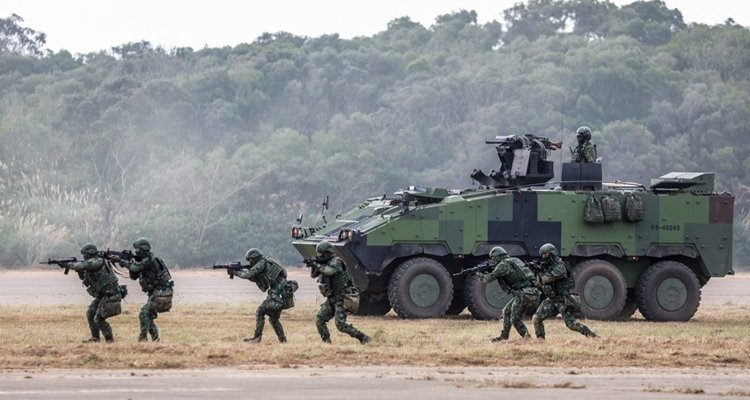
The Lai government had been pushing for about $40 billion USD in extra defense spending, in part in order to pay for U.S. weapons and domestic production of drones. But confronted with opposition from opposition parties that, together, wield a legislative majority, the government settled for a package of $25 billion USD, better than the Kuomintang’s lowball offer of $12 billion USD (Reuters, May 8, 2026).
The ruling Democratic Progressive Party expressed regret that the opposition had ignored repeated explanations by the defence ministry, not only limiting Taiwan’s defence capabilities but potentially creating security gaps.
“This is not merely a discount on the dollar amount—it is a discount on Taiwan’s comprehensive defence system, and a discount on Taiwan’s declaration to the world of its commitment to self-defence,” party spokesperson Lee Kun-cheng said in a statement.
Cheng Li-wun, chairwoman of the largest opposition party, the Kuomintang (KMT), told reporters the spending passed was exclusively for buying U.S. weapons.
“Taiwan’s national security must stand firmly on two legs. One is a sufficiently strong defence capability, and the other is the unceasing effort and determination to pursue cross-strait peace,” added Cheng, who visited China last month and met President Xi Jinping….
In December, Washington announced an $11 billion arms sales package for Taiwan, the largest ever.
A second package worth around $14 billion could be announced once U.S. President Donald Trump gets back from next week’s trip to China, Reuters has previously reported.
Agence France-Presse reports:
The special funds would be spread out over eight years and would be in addition to normal defence spending that is included in the government’s annual budget.
Lawmaker Chen Kuan-ting, who belongs to Lai’s Democratic Progressive Party, accused KMT leaders of “trying to disarm Taiwan” by excluding domestic procurement from the budget.
“If we restrict ourselves only to US arms purchases, then if one day Taiwan is encircled, Taiwan is blockaded, how are we going to maintain our ammunition supply and how are we going to sustain our combat capacity?” Chen said.
KMT lawmaker Hsu Chiao-hsin said the party supported “reasonable defence buildup and arms procurement”, but could not “accept lumping together arms sales, commercial purchases, and commissioned production”.
The New York Times reports:
Centrist Nationalist politicians appear to have pressed the party to come around to a more generous proposal. They warned that the party’s resistance to expanded military spending might hurt their hopes in local elections late this year, said Dennis Lu-Chung Weng, an associate professor at Sam Houston State University in Texas who is advising a potential Nationalist presidential candidate in 2028.
“That created real political pressure on the party,” he said.
Still, the governing Democratic Progressive Party was dissatisfied with the outcome of negotiations, because it left out spending for domestically made drones and other weapons. All 51 Democratic Progressive lawmakers abstained from the vote.
President Lai Ching-te: “Any gap [in ROC defenses] will compromise the integrity of the overall defensive system.”
A local analyst, Wen-Ti Sung, suggests that the KMT performed a successful balancing act by showing “just enough commitment to US-Taiwan security cooperation” to “silence doubters” within the KMT as well as in Washington, but not so much commitment as to “ruffle feathers in Beijing.”
Beijing’s feathers are in a state of continuous ruffle.
The best defense
All the Republic of China can do is defend itself as best it can from all ongoing and future threats issuing from the People’s Republic of China. There is no pursuing a “cross-strait peace” with an enemy determined to cow or coerce you into submission no matter what—as the People’s Republic has emphasized by word and deed over and over.
The “two legs” business is evidence that KMT Chairwoman Cheng and like-minded colleagues are less concerned about the potential for corruption in the larger defense package favored by the government than about the urgency, in their view, of appeasing the Chinese Communist Party.
Echoing CCP talking points and doing what she can to weaken Taiwan’s defenses may enable Cheng Li-wun to secure meetings with Xi Jinping and smiles, handshakes, positive-sounding words about China’s “rejuvenation” (which by the CCP’s definition requires subjugating Taiwan to its totalitarian rule).
None of this, though, can secure “peace” except in the form of surrender, which would be the end of the Republic of China and its national security. But Cheng must know all this.