Between the death of Mao Zedong in 1976 and the rise of Xi Jinping in 2012, the worst aspects of Mao’s rule of the People’s Republic of China—for example, the state’s murders of so many people during the consolidation of power, the Great Famine, and the Cultural Revolution—abated.
But despite the lower rate of state murder and the introduction or reintroduction of some (heavily regulated) market elements, making it easier for people to at least survive, the totalitarian nature of PRC rule did not fade away. Any question about whether the successors to Mao would allow persistent calls for political liberalization and other dissent was settled by the crackdown on pro-democracy demonstrators in Tiananmen Square and elsewhere in 1989.
Some things, though, did get better in China after Mao. And in recent years, some of the things that had gotten better have gotten worse.
You can experience the worst of what’s worse as a Tibetan, a Uyghur, a practitioner of Falun Gong, a Christian, a Buddhist—anyone whose ethnicity, culture, religion or other group affiliation has long attracted the special attention and hostility of the Chinese Communist Party.
Many Chinese don’t belong to any of these especially persecuted groups. They don’t normally have to worry that the party-state might demolish their house of worship, might jail them for studying the Koran, might murder them in order to harvest their organs, or might abduct their children in order to destroy memory of language and culture.
No escape
The citizen or subject of the PRC who escapes special persecution is assaulted in many other ways, though. He is censored, surveilled, and drowned in stultifying propaganda, and if he says or does anything regarded as too out of line in the street or online can easily find himself in a police station or a jail cell.
One of the evidences of what The Atlantic calls the country’s current “neo-totalitarian” political environment is the crackdown on fun and on any deviation from an increasingly constricted norm (“Life Has Gotten Surreal in China,” August 26, 2025).
Blind boxes [the contents of which customers can see only after buying] are but one cultural trend to incur the party’s ire. In recent years, Chinese authorities have gone after video games and K-pop, comedy clubs and Halloween parties, gay and lesbian activists and women’s-rights advocates, tech entrepreneurs and financial advisers. The incessant crackdowns, and the campaigns of censorship or censoriousness, suggest that the Chinese regime is intent on not just eliminating opposition, but also micromanaging its people’s lifestyles, consumption, and beliefs….
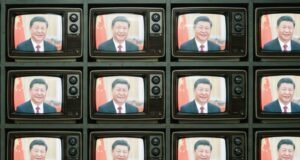
Disappearing inconvenient truths has always been a feature of Communist rule in China…. But Xi has lately taken his efforts to convince people that they live in a socialist utopia to a new extreme….
In October, residents of Shanghai who ventured out in Halloween costumes got a rude surprise: Police hauled them off the streets. Unsanctioned Halloween celebrations were apparently now off-limits. The authorities didn’t offer an explanation. Were they afraid that a reveler would criticize the regime with a satirical disguise, or dress up in a manner offensive to socialist morality? That a Halloween party might morph into a protest? In a politically charged society, nearly anything could appear to be a threat.
Students in the central city of Zhengzhou began taking nighttime bike rides to nearby Kaifeng. Late last year, the outings became a phenomenon as more and more riders joined them; sometimes the cyclists sang the country’s national anthem as they peddled. At first, officials encouraged these jaunts. But then the crowds swelled to the tens of thousands, and the security state got jittery. In mid-November, police shut the bikers down.
What’s next? That the PRC could become so “sclerotic” in its dictatorship that it would “become like North Korea or the Soviet Union” is hard to imagine, says the author. But also hard to imagine is “the continued progress of a country that can’t allow its citizens to grieve or celebrate.”