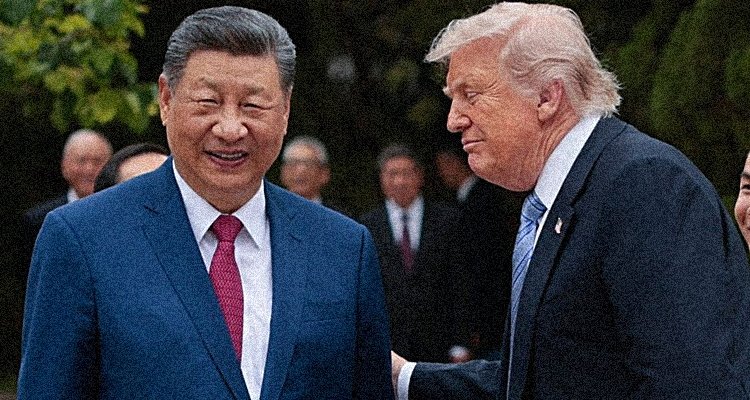
Miles Yu suggests that at least ten myths were promulgated and/or accepted during the mid-May summit in Beijing, which “revealed a dangerous temptation in American foreign policy: the desire to substitute comforting illusions for strategic clarity” (Washington Times, May 25, 2026).
Xi Jinping spoke of the “Thucydides Trap,” about how a rising power, China, is supposedly “displacing a declining America,” tending to lead to conflict that Xi counsels should be avoided. (This is true in a way: Xi would like all persons and countries targeted by the CCP to simply give up without offering any resistance.) Yu points out that in the Peloponnesian War the history of which is recounted by Thucydides, the rising power was defeated. So the analogy does not quite imply the lesson that Xi Jinping probably intends.
The more important point is that Xi himself is trapped not by geopolitics but by the dogmas of Marxism-Leninism, “which insists capitalism is collapsing and communist victory triumphantly inexorable.”
Moreover, “The real divide is not ‘China versus America,’ but communist China versus the entire free world.”
Taiwan
Three of the myths have to do with Taiwan, which is not “the most important issue” in U.S.-China relations. “The central issue is the irreconcilable conflict between the CCP’s authoritarian ideology and the democratic principles of the free world. Taiwan merely exposes and amplifies that contradiction.”
Second, Taiwan (or the Republic of China) does not need to become independent of the People’s Republic of China; it is already independent.
Third, “Taiwan does not belong to communist China. History, law, and political reality say otherwise.” Even if the history had been different—that is, even if Taiwan had at one time been subject to governance by the CCP, for five years or whatever, before attaining its current independent status—this would not justify conquering and absorbing Taiwan. No tyrants have an inalienable right to oppress anybody. But as it is, the Kuomintang set up shop in Taiwan immediately after losing the civil war on the mainland.
Yu also batters the notions that Xi is a “master strategist,” that the PRC is “open for business,” that the PRC is “peace-loving,” and that “mutual respect” and “win-win cooperation” as understood by the CCP mean anything but appeasement and surrender. “Cooperation detached from moral reality becomes appeasement…. Respect cannot mean surrendering truth or abandoning democratic values.”
The Chinese people
“Perhaps the biggest falsehood of all is the claim that the CCP represents China and the Chinese people. It does not. The CCP is a Leninist ruling apparatus of European origin that maintains power through censorship, surveillance, coercion and fear.”
Also see:
Taipei Times: “China unleashes a war of words”
“Understanding the discourse around the Trump-Xi summit matters because Trump’s comments appeared to validate part of that narrative: not Beijing’s legal claim over Taiwan, but its preferred framing that Taiwan’s democratic self-defense is the source of instability….
“Beijing does not need Washington to formally abandon Taiwan to score a discourse-power victory. It only needs enough ambiguity to feed US skepticism inside Taiwan. The message is simple: Washington is unreliable, Taiwan is only a bargaining chip, and resistance to China is dangerous because the US might not show up in a crisis.”