Is it really just primarily tungsten among critical minerals that the U.S. military is running low on right now? That’s the impression given by an NBC News report, which does also eventually refer to all of the critical minerals and rare earths for which the U.S. is trying to find alternate sources so as to be less dependent on the People’s Republic of China.
But tungsten may be a special case (NBC News, May 25, 2026).
As the United States wages war on Iran, it is burning through stockpiles of advanced weapons and ammunition, including Tomahawk, Patriot and Precision Strike missiles. Replacing them will require a powerful metal, tungsten, whose production and refining are dominated by China—leading the U.S. to desperately search for it elsewhere.
Tungsten is used in fighter jets, bunker buster bombs, armor-piercing rounds and missile systems, making it indispensable for national defense. But the U.S. has had no active commercial tungsten mines since 2015, and the Trump administration has made it a mission to curb dependence on the Chinese supply.
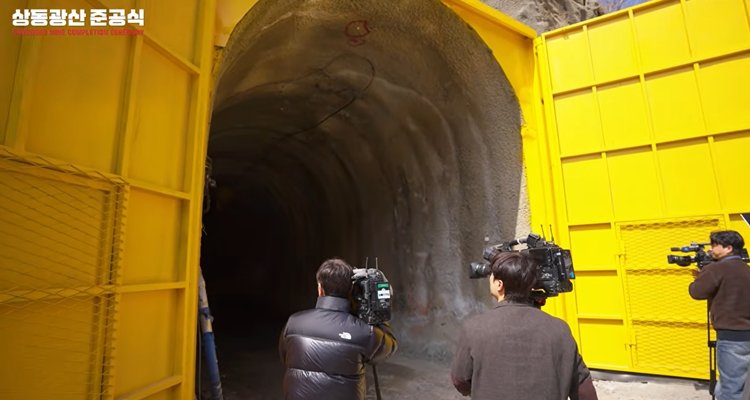
One place the metal can be found is in the mountains of eastern South Korea, at a mine owned by a U.S. company [Almonty Industries] that holds millions of tons of tungsten ore….
There is no substitute for tungsten, whose global supply has come under even more pressure since the U.S.-Israeli war with Iran began in February. It could take as long as four years to restore key munitions to prewar levels, which would be critical in the event of conflict with China, Mark Cancian, a senior adviser with the Center for Strategic and International Studies, said in a report last month….
Under President Donald Trump, the White House has taken steps to address the problem [of dependency on China for critical minerals], having launched a $12 billion stockpile of critical minerals in February. It has also provided financial support for domestic mining projects and sought to establish mineral partnerships with U.S. allies around the world, as well as a minerals trading bloc.
Well, there is a partial substitute for tungsten, says Discovery Alert. Sometimes. “Molybdenum can serve as a partial substitute in moderate-temperature applications, but once operating conditions exceed certain thermal and mechanical thresholds, tungsten becomes the only viable option.”
Restricted loosening
When the truce phase of the 2025 trade war arrived, the PRC reportedly suspended curbs on rare earths or critical minerals. The Rare Earth Exchanges site reports that tungsten was among the critical minerals benefiting from a one-year suspension on (some?) export controls. “Included minerals: rare earths, lithium battery materials, gallium, germanium, antimony, tungsten, and graphite.”
In April 2026, after China had reportedly loosened export controls on tungsten and other critical minerals, Reuters noted that the prices of tungsten, valued in aerospace and defense applications for its “extreme heat resistance and hardness,” had become record-high, “fuelled by China’s tightening export controls and surging military demand, with supplies stretched thin…. In December 2025, China said only 15 firms would be allowed to export tungsten in 2026–2027.”
So the PRC’s export controls on tungsten became looser than when they were at their tightest in early 2025 but are still way tighter than they were before 2025.
However short the supply and high the price of tungsten right now, the military’s difficulty replacing equipment which relies on tungsten could, maybe, have been even worse.
Also see:
Discovery Alert: “The Hidden Architecture of a Critical Minerals Crisis”
“For the highest-performance tier of each of these applications, substitution [for tungsten] is not a design choice that engineering teams can simply make.”
StoptheCCP.org: “The Mad, Mad, Mad, Mad World of Rare Earths”
“We do have some leverage, however. To get the full effect of farce, note that Red China buys our military-grade semiconductors in exchange for ‘these minerals for fighter jets and missile systems.’ We support their military, they support ours. It’s a comedian’s plan for world peace.”