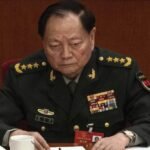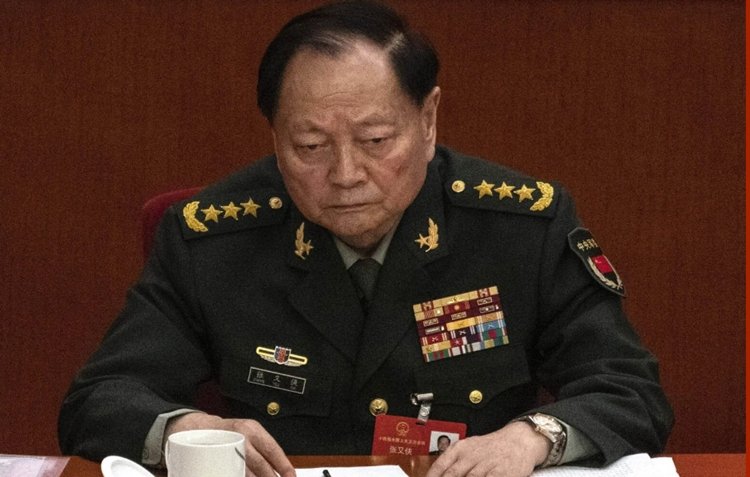
Zhang Youxia, former top PLA general and vice chairman of the Central Committee, was purged in January 2026 because of “disagreements with Xi Jinping over PLA development and training, and even instances of open resistance to his directives” (Jamestown Foundation, January 26, 2026).
Technically, not all of the purge happened when Zhang was arrested in January 2026. In August, the Standing Committee of the National People’s Congress removed him from the state Central Military Commission; a month later, from the Chinese Communist Party and the military. Some believe that the process was stretched out because of Zhang’s standing within the military. Xi Jinping needed to muster support for or at least acceptance of the ouster before it could be formalized in every respect.
Capable of invading
Observers disagree about whether dictator Xi Jinping really has imposed a 2027 deadline by which the People’s Liberation Army must be “capable of invading Taiwan” (not exactly the same thing as a deadline by which the PLA “must invade Taiwan”). But Jamestown author K. Tristan Tang accepts it as fact and contends that Zhang Youxia was purged because his “timeline for PLA joint operations did not align” with this deadline.
Tang compares official explanations of why Zhang was purged to official explanations of other purges, primarily that of He Weidong.
Zhang Youxia and Liu Zhenli most likely fell from power due to disagreements with Xi Jinping over PLA development, particularly the joint operations training timeline, and may have pursued policies or issued orders that ran counter to Xi’s directives. (The simultaneous announcement of investigations into Zhang Youxia and Liu Zhenli indicates the decision stemmed from the same underlying cause.)
Differences between official statements about He Weidong and about Zhang and Liu suggest that “personal corruption or private gain did not drive the purge of Zhang and Liu”; that Zhang was targeted in part because he “did not prioritize political loyalty as the guiding principle of military building”; that Zhang may well have directly defied or disregarded orders from Xi; and that “Zhang and Liu’s disagreements with Xi reached a visible and widely recognized level within the PLA.”
Divergence
Tang then elaborates reasons for concluding that “Zhang and Liu fell from power because their results in force building and war preparation failed to meet expectations and may have jeopardized Xi Jinping’s requirement that the PLA be capable of invading Taiwan by 2027.”
First, the official statement explicitly accused Zhang and Liu of causing “severe damage to combat capability development,” a charge absent from the case of He Weidong. This distinction indicates that the CCP leadership viewed Zhang and Liu’s actions as having a direct negative impact on PLA military capability.
Second, the language describing their relationship with the Party center differed in weight. Authorities said He Weidong and others “betrayed trust,” while they said Zhang and Liu “betrayed a trust and heavy responsibility.” At the 20th Party Congress in late 2022, Xi broke age norms by shifting Zhang from political oversight to operational command as CMC vice chairman. Xi likely sought to rely on Zhang’s combat experience and senior status to push forward the new military training system that Xi personally announced in 2020 to correct long-standing PLA training deficiencies. This role clearly carried a heavier level of trust than was granted to He Weidong and others.
Third, both cases cited negative effects on the Party and the military, but they differed in scope. He Weidong and others “caused severe damage to…national defense construction” while Zhang Youxia and Liu Zhenli “caused serious harm to…the state.” References to the “state” point to broader national development. In military terms, this concept centers on resisting external threats or, in the PRC’s specific context, achieving unification with Taiwan.
Tang then looks at the pace of joint military operations during early 2026 to discern the continuing consequences of “a divergence between Zhang and Xi over military development concepts. Xi’s preference has been to pursue speed and scale, while Zhang favored a more focused and deliberate approach….
“Taken together, political and military evidence points to disagreements between Zhang and Xi over the pace and method of joint training. Both officers [Zhang and Liu] possess real operational experience and likely held firm views on combat and training requirements. They may have judged some of Xi’s objectives, including the force-building timeline, as unrealistic, and resisted or declined to implement them on professional military grounds.”
To what degree is the author right? Tang infers more explicit reasons for purging Zhang and Liu than those provided by the elliptical official texts and also assumes the existence of the disputed 2027 deadline. We may learn more during 2027, which arrives in two months.