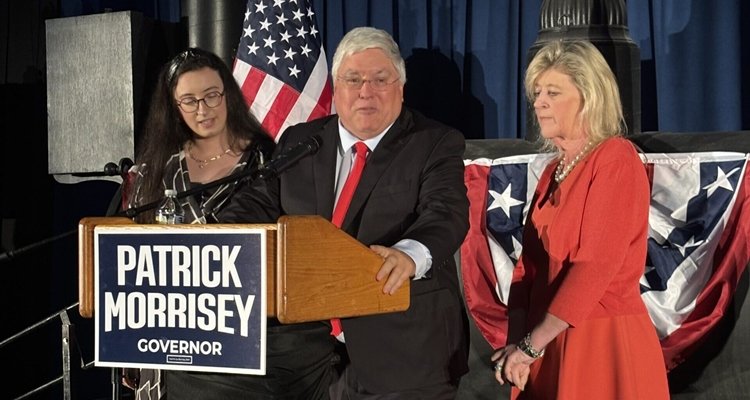
The state’s new governor, Patrick Morrissey, says: “The Chinese Communist Party poses a threat to our national security, dodges transparency and legal oversight, and represents a financial risk that we cannot take. With the passage of this resolution, the West Virginia Investment Management Board will not invest in CCP-owned or -controlled companies.”
West Virginia will also “prudently divest” from such companies in which it is currently invested.
The Investment Management Board’s resolution had been proposed by Morrisey (WVVA, May 29, 2025).
The state treasurer, Larry Pack, says that the new policy “will ensure that we do not put American dollars at risk and that state tax dollars are not used to bankroll a nation that is completely against our way of life. We must do everything in our power to hold bad foreign actors accountable.”
Other states
In November 2024, Fox News reported that financial officers in 15 states had submitted a letter urging the managers of their states’ public pension funds to discontinue investment in Chinese companies.
“ ‘Trustees of state funds have a duty to investigate investments and a duty to monitor investments and divest from imprudent investments, in order to ensure that those funds grow and are protected for future beneficiaries,’ the letter from 18 state treasurers stated to public pension fund fiduciaries, who include anyone managing a public pension fund. ‘The time has come to divest from China.’ ”
Fox News said that the signatories hailed from “Alabama, Arkansas, Alaska, Arizona, Indiana, Kansas, Louisiana, Mississippi, Missouri, Nebraska, North Carolina, Oklahoma, Pennsylvania, South Carolina and Wyoming.”
No signer from West Virginia. Well, it’s the deed that counts.
The lists
The Fox report also noted that although U.S. agencies maintain various blacklists and “red-flag lists” in order to prohibit exports to specific foreign firms, prohibit imports of goods associated with slave labor, and prevent purchases of equipment deemed a national security risk, “Most of these lists do not restrict U.S. asset managers or investors from investing in listed companies. One list that does restrict U.S. investment in listed firms, the Treasury Department’s NS-CMIC list, blocks investment only in listed firms but excludes those companies’ subsidiaries, allowing them to receive U.S. capital.”
This last detail seems incredible. However, Treasury’s own Q&A on the subject, dated June 3, 2021, says that subsidiaries are subject to the same ban as the parent company “only if such subsidiary itself is publicly listed on the NS-CMIC List…”
857. Do the prohibitions in Executive Order (E.O.) 13959, as amended, apply to purchases or sales of publicly traded securities of subsidiaries of entities listed on the Non-SDN Chinese Military-Industrial Complex Companies List (the “NS-CMIC List”)
[Answer:] The prohibitions in E.O. 13959, as amended, apply to a subsidiary of a Chinese Military-Industrial Complex Company (CMIC) listed on the NS-CMIC List only if such subsidiary itself is publicly listed on the NS-CMIC List by Treasury pursuant to E.O. 13959, as amended, or identified in the Annex of E.O. 13959, as amended. OFAC’s 50 percent rule does not apply to entities listed solely pursuant to E.O. 13959, as amended. Accordingly, the prohibitions on any subsidiaries listed on the NS-CMIC List would go into effect beginning 12:01 a.m. eastern time on the date that is 60 days after such subsidiary is added to the NS-CMIC List.
The question, then, is whether subsidiaries of Chinese Military-Industrial Complex Companies are also routinely added to the NS-CMIC List along with the parent company. But if they are, which is doubtful, why the bifurcation? Why not just prohibit investment in the whole entity all at once, including any future subdivisions or additions?
And how hard would it be for a CCP-linked company to keep creating new subsidiaries in order to evade a ban that does not apply to subsidiaries automatically?
It seems that states need to do more (be more like West Viriginia and Texas) and that the federal government needs to do more.
Also see:
StoptheCCP.org: “Don’t Mess With Texas, Beijing”