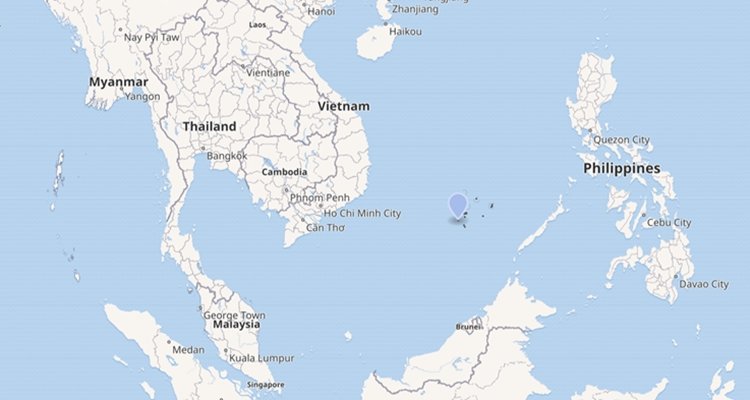
A Spratly island called Taiping Island by its claimant the Republic of China was 1.4 kilometers long in 2016 when the good folks at the United Nations Convention on the Law of the Sea (UNCLOS) announced that Taiping was a rock. This ruling covers all the other islands of the chain as well.
Taiping Island seems large for a rock, and Taipei rejected the decision. The decision still stands as far as we can tell.
Reporting on the UNCLOS decision, Voice of America declared (joked?) that there are “no islands in the Spratly Islands. Only rocks.” Rocks don’t get you much these days, just 20 nautical kilometers of surrounding territorial waters.
What would an island get you? Islands come with a “370-nautical kilometer exclusive economic zone (EEZ), and an EEZ gives the rights holder access to fish, oil, natural gas and whatever else may be present.”
One suspects that such a ruling would encourage any state with claims and holdings to make their Spratly bits more island-like and less rock-like. And so they would, if such states paid attention to such rulings, which they do not.
Let’s call these states the Spratly states. Right now, they are busy land-forming. In the future, they seem unlikely to appeal to UNCLOS to promote their rocks to islands. They also seem likely to claim as many EEZ rights as they like.
Following a lead
All this seems less about rights to fish or explore for oil than about militaries and geopolitics. Incited by Red China’s pioneering efforts, everyone in the Spratlys game has entered a competitive island-building race.
Beijing has reached beyond the Spratlys to engage in reef building. The CSIS Asia Maritime Transparency Initiative (AMTI), which tracks these developments, reported in March 2026 that Beijing’s work on Antelope Reef will make it the biggest in the Paracel Islands. The Reds have reclaimed 1,490 acres on Antelope, and the building here will eventually overtake that of Mischief Reef, which is also in the Paracel chain and was expanded to 1,504 acres in the 2010s.
The report says that Antelope Reef “could now accommodate a 9,000-foot runway of the type China has already constructed at Woody Island, Mischief Reef, Subi Reef, and Fiery Cross Reef…. Antelope’s size would also enable it to accommodate the robust infrastructure seen at Woody and China’s ‘big three’ outposts (Mischief, Subi, and Fiery Cross) in the Spratlys, including diesel power plants, underground storage facilities, coastal defense emplacements, and surface-to-air and anti-ship missile facilities, as well as numerous surveillance and electronic warfare installations.”
AMTI notes that last year Hanoi gave Beijing a run for its money in island building but will fall behind this year. “Hanoi already hosted a total of twelve harbors across its outposts in 2025. Satellite imagery shows that an additional three harbors are taking shape at Grierson Reef, Petley Reef, and South Reef.” Vietnam entered the race only as recently as 2021.
Real Clear Defense reports that “Malaysia claims at least 12 features in the Spratlys, but it has a physical presence on only five: Swallow, Ardasier, Erica, Mariveles, and Investigator reefs.” Malaysia’s criticism of Vietnamese expansion while continuing to improve its own occupied features “demonstrates how regional states increasingly distinguish between their rival’s reclamation and legitimizing their own.”
At least Malaysia is taking a dual-use tack in occupying Swallow Reef in the Spratlys. In addition to its “naval station with an air-defense system, an airport with two aircraft hangers and a paved runway, [and] a marine research facility,” it also features a diving resort.
High-end opponent
Red China has its own South China Sea–watching group, the South China Sea Strategic Situation Probing Initiative, which this month released a report on “U.S. Military Base Expansion and Force Posture Enhancement in the Philippines.” The Global Times tells us that it focuses on how the United States “uses Manila to destabilize region” and “offers a detailed account of US base expansion activities in the Philippines.”
Since the Spratlys lie between Vietnam and the Philippines in the South China Sea, this is relevant. The report contains some good news for the communists.
The expansion of bases “has fallen short of expectations, and U.S. efforts to strengthen its military presence in the Philippines continue to face constraints from multiple factors. First, the Philippines’ own capabilities are limited, providing little assistance to the U.S. in wartime; second, while the U.S. needs the Philippines’ strategic geographic location, it would require significant investment to fully enable [its] sites for wartime readiness; third, the political uncertainty within the Philippines and rising nationalism have added to U.S. hesitations.”
Thus, ”Although U.S. forces have sharply increased their presence and deployments in the Philippines, these assets possess limited wartime utility, especially against a high-end opponent such as China.”
Speaking of limited wartime utility, it is hard to believe that even the largest of Beijing’s bases on built-up landforms could survive even a single U.S. bunker-busting bomb.
Which suggests that the point of all this island building is just to jockey for position in regional disputes. □
James Roth works for a major defense contractor in Virginia.
Also see:
StoptheCCP.org: The Spratly Agenda