Unalienable rights
“On June 4, the world marks 37 years since the Chinese Communist Party ordered its troops to attack thousands of peaceful demonstrators in and around Tiananmen Square…. No amount of censorship can erase the past. Those who sacrificed to uphold their unalienable rights of free expression and peaceful assembly will be vindicated someday.”
—Marco Rubio, U.S. State Department, June 3, 2026
Choosing not to kill
“What gives a soldier the courage to refuse an order that endangers the very people his uniform is meant to protect?….[A six-hour recording of a 1990 military trial that surfaced in 2025] shows the court-martial of General Xu Qinxian, commander of the elite 38th Group Army of the People’s Liberation Army, who in May 1989 rejected the directive to lead heavily armed troops into Beijing to enforce martial law and suppress the massive Tiananmen pro-democracy movement. For that refusal, General Xu was imprisoned for five years and lived the remainder of his life under strict surveillance until his death in 2021….
“But General Xu’s story is not solely about one man. It is also about the unknown soldier who drove the lead tank during the iconic standoff on June 5, 1989, when a lone man carrying shopping bags, Tank Man, stood before a column of armored vehicles. Countless observers have asked why the first tank did not fire on the Tank Man or simply crush him. General Xu’s refusal offers the most credible answer: that driver, too, chose not to kill. In that instant, he became a ‘Tank Man’ in uniform.”
—“Decades After Tiananmen, General Xu Qinxian’s Quiet Defiance Still Echoes,” Jianli Yang, National Review, June 3, 2026
Police versus humanity
“Chinese authorities snuffed out efforts to mark Thursday’s anniversary of the deadly 1989 military crackdown on student-led pro-democracy protests in Tiananmen Square, in a further tightening of a yearslong campaign to erase what happened from public memory.
“Police told relatives of the victims they would not be allowed to visit a cemetery in Beijing on the anniversary of the crackdown 37 years ago, a person with knowledge of the matter said. The person spoke on condition of anonymity because of fear of retribution….
“In Hong Kong, police stepped up security Thursday at or near a park where a massive candlelight vigil lit up the night every year until a clampdown following major anti-government protests in 2019. A handful of people showed up in the evening, and officers allowed some to go freely.
“Police said in a statement that seven people were stopped and searched on suspicion of being disorderly in public as of 11:30 p.m. They were taken away for further investigation before being allowed to leave, police said.”
—“Tiananmen’s anniversary limited,” Ken Moritsugu and Kanis Leung, The Associated Press, June 5, 2026
A continuing struggle
“Today, we commemorate the Tiananmen Square Massacre, a defining moment in history that the Chinese government has spent decades trying to erase. It stands as a stark reminder of Beijing’s long-standing repression of dissent and its refusal to tolerate calls for freedom and justice. Since the massacre, the machinery of repression has only expanded, increasingly targeting Uyghurs as well as other ethnic and religious groups. As we honor the courage of those who stood for freedom in 1989, we must also stand with those who continue that struggle today.”
—Rushan Abbas, executive director, Campaign for Uyghurs, June 4, 2026
More than a performance
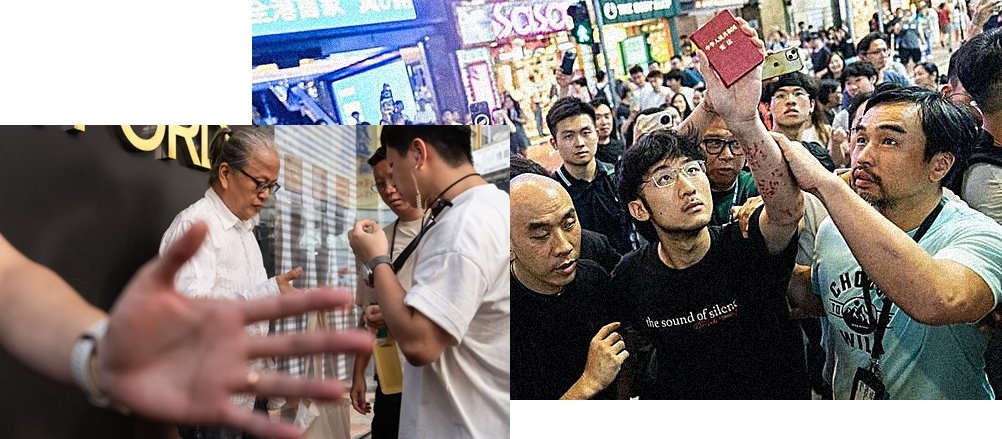
“A performance artist in Hong Kong who tried on Wednesday to honour the victims of Beijing’s 1989 Tiananmen Square crackdown was quickly stopped by plainclothes police, the latest sign of the city’s shrinking freedom of expression.
“Sanmu Chen tried to tie a symbolic red thread to a street signpost in Causeway Bay, a shopping district close to a park that previously hosted an annual candlelight vigil on 4 June to commemorate those who died in the 1989 student-led protests….
“Chen said his thread was 6.4 metres long—an apparent reference to 4 June….
“In 2024, Chen was briefly detained on 3 June after appearing to write the Chinese characters of ‘eight nine six four’—a set of numbers referencing the date of the crackdown—with his hand in the air.
“The year before, he was detained on the same date in the same neighbourhood, after chanting: ‘Hong Kongers, do not be afraid. Don’t forget, tomorrow is June 4.’ ”
—“Hong Kong artist who tried to mark Tiananmen massacre intercepted by police,” The Guardian, June 3, 2026
Collapse of a worldview
“Given the censors’ success at burying the history, those people who uncover it themselves are often horrified.
“A teenage student in Zhejiang province was watching Li Jiaqi live-stream on June 3, 2022, when the influencer showed off an ice-cream cake in the shape of a tank. The show was abruptly cut off.
“The student, now 18, was bewildered. She worked her way around the firewall to figure out what had happened.
“ ‘When I tore open the truth, what I saw was not only the blood and tears of history, but also the collapse of the worldview I had held for more than a decade,’ she told The Washington Post. She spoke on the condition of anonymity for fear of retribution.
“She now wants to leave China.”
—“Despite censorship, young Chinese are learning the truth about Tiananmen Square,” Huiyee Chiew, The Washington Post, June 4, 2026
Also see:
Frontline by ITN: Video: “After the Tiananmen Square Massacre (1989) | Secretly Filmed News Rushes Days after Mass Deaths”
Archive.org: Video: ABC News Special Report 6/4/1989
The Guardian: “ ‘Every year I get new pictures’: the fight to preserve the memory of Tiananmen”
China Unofficial Archives: Remembering Tiananmen Square