This is odd wording in a recent installment of the White House’s weekly briefing (June 7, 2026): “In a landmark move to keep America at the cutting edge, President Trump signed a directive integrating artificial intelligence into the national security enterprise—ensuring the United States maintains its technological lead over China and adversarial nations.”
The White House can afford copy editors and proofreaders and probably uses them. The omission of the word “other” is almost certainly intentional. I would agree that the U.S. government should do what it reasonably can to maintain (or gain or reacquire) sundry technological and military edges over the People’s Republic of China and other adversarial nations (the main method being getting out of the way of American producers and innovators). But whom would I be agreeing with? Is there any reason to especially try to thwart the PRC if it is not an adversary—an enemy—in fact, the most powerful enemy—of the United States?
Compare “we should not be prejudiced against short people and tall people” to “we should not be prejudiced against short people and other tall people.” Here the omission of the word “other” is mandatory precisely because we have two different classes. If Joe is short, one might say that “we should not be prejudiced against Joe and other short people.” If you didn’t already happen to know about Joe and his height, the wording and structure would tell you that Joe is one of the short people. But “we should not be prejudiced against Joe and short people”—a condensation of “we should not be prejudiced against Joe, and we should not be prejudiced against short people”—does not give you this information.
Accommodations
The nit I’m picking is not isolated, and other examples cannot be dismissed as inadvertent or marginal. In many of its public pronouncements, the Trump administration has slipped or slumped into a mode of destructively accommodating the ideological themes of the Xi Jinping and the Chinese Communist Party. But at least in policy pertaining to export controls and the like, the administration continues to act as if the PRC is an adversary that the U.S. needs to defend itself against. Right?
Well, that glass is only half-full. For example, the administration has been working to find alternative sources of rare earths and critical minerals so that the U.S. is not so dangerously dependent on China for supplies of components of military and other tech. Good. Meanwhile, though, the Trump administration has also been making it easier for the Chinese military to use high-end microchips in the computers and weapons that it has been using against us or may one day use against us. By July 2025, The New York Times was reporting: “Officials throughout the government say the Trump administration is putting more aggressive actions on China on hold, while pushing forward with moves that the Chinese will perceive positively. That includes the reversal on the H20 chip.”
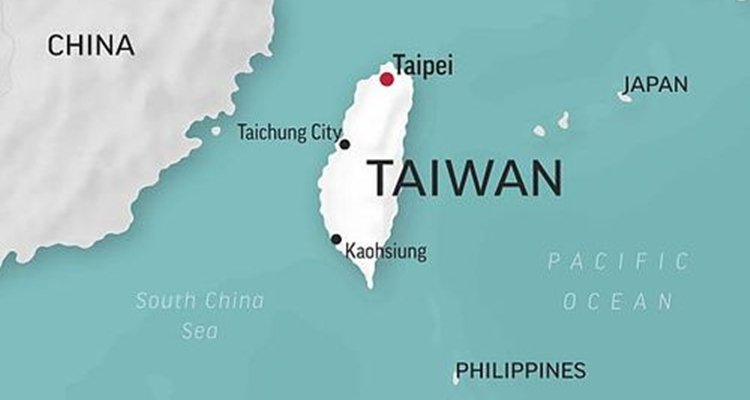
For another example, the U.S. has agreed to multi-billion-dollar sales of arms to Taipei, which the Republic of China needs to have in order to mount the most robust possible defense against CCP aggression. Good. But before and after his May trip to Beijing to meet with PRC dictator Xi Jinping, Trump deferred completion of the agreed-upon deals, and he has talked about using the possibility of further deferment as a “negotiating chip” with the CCP.
Cool it
President Trump has also urged both the People’s Republic of China and the Republic of China to “cool it a little bit,” as if the ROC has been doing anything wrong by acting to defend itself from the mainland’s constant threats. And he has repeated the CCP propaganda-babble about how the ROC should avoid moving toward or declaring independence. “I’m not looking to have somebody go independent,” Trump says. Although the CCP has reasons for pretending otherwise, the ROC is already independent, as President Lai Ching-te has often observed.
The bad U.S. rhetoric is part of the bad U.S. policy, and it helps the PRC and hurts the ROC and the United States.