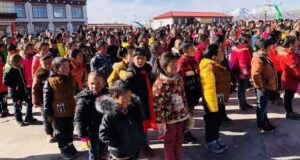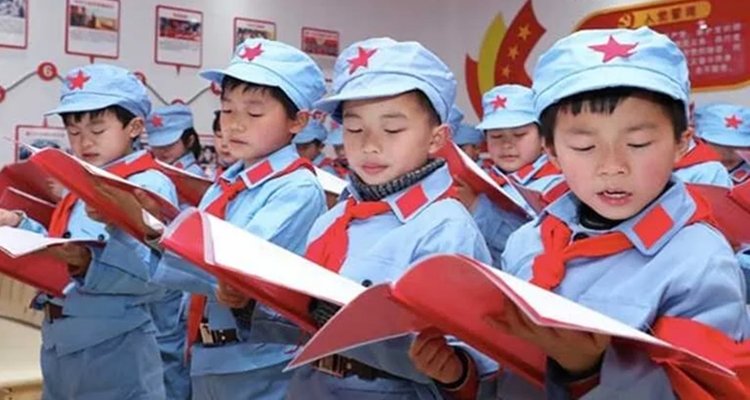
Weren’t the kids already getting plenty of lessons about the importance of loving Big Brother? But in the view of at least one of China’s secondary schools, there’s always room for more. The Haikou Number 4 Secondary School in Hainan now requires its charges to watch state news every day (Organiser, September 7, 2026).
The mandatory political content is reportedly scheduled every day at 7 p.m., before students begin two 70-minute evening study sessions.
The reported school routine begins at 6:20 a.m. and includes nine classes during the day. Students living in dormitories are scheduled to turn off their lights at 11 p.m. The placement of state-run news within this tightly controlled timetable has prompted criticism that political teaching and Chinese Communist Party messaging are being incorporated into students’ everyday education rather than being confined to conventional classroom subjects.
Critics have compared the schedule to a highly regimented institutional routine, while questioning whether compulsory viewing of Chinese state media amounts to political indoctrination of school students. The controversy has also renewed scrutiny of the role of CCP ideology in China’s education system and the extent to which students are exposed to information outside officially approved narratives….
Political messaging also reportedly begins at an early age. Children in kindergarten are exposed to so-called red songs carrying revolutionary communist themes, while concepts of loyalty to the Party and the country are introduced through educational activities. Critics argue that this creates a continuous process of Chinese Communist Party indoctrination that begins in early childhood and continues through successive stages of schooling.
A central concern is the limited access students may have to alternative sources of information. The state-run evening news… functions as a major platform for the Chinese Communist Party to communicate its political positions, promote its leadership and reinforce official narratives.
The objection to incorporating more CCP propaganda into what should be normal classroom fare is valid. But this is like objecting to the latest bucket of rain in a deluge. As the report indicates, the CCP brainwashing in China’s classrooms is already at saturation levels, and not only in the most regimented schools.
As provoked by this particular development, concerns that students are being deprived of “alternative sources of information” seem both duplicative and incomplete. The Chinese Communist Party works continuously to deprive everyone in the country of alternative sources of information, whether the subject is Winnie the Pooh, the politics of Zhongnanhai, the Tiananmen Square massacre, a plane crashing into a building, or the flooding in Nepal and Tibet.
Now that Number 4’s addition to students’ schedules is being publicized, other schools may follow suit; perhaps some already are. And various apparatchiks and even Xi Jinping may get the idea of foisting the same daily dose of state-filtered, state-interpreted news on all students throughout the land.