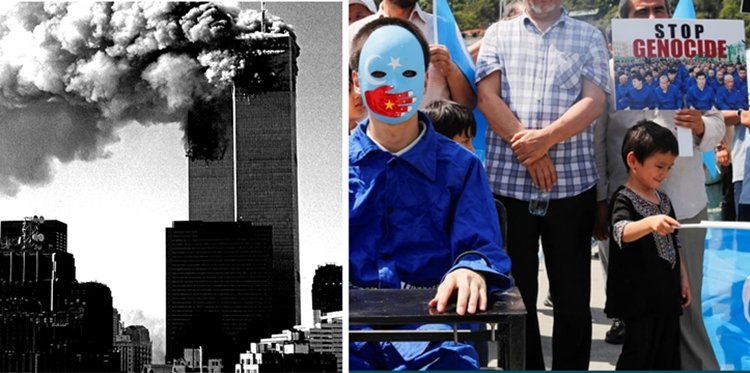
In addition to pursuing legitimate targets of the so-called War on Terror precipitated by the September 11, 2001 attacks on the United States, governments have also invoked that broadly defined and probably poorly named War to target people much more indiscriminately.
These are people who may be “threats” to a state by some description, but who are not terrorists or even criminals by any reasonable understanding of the terms. Rather, they are ideological, religious-cultural, or ethnic “threats.” They fail to fit into some government-preferred mold. That they are terrorists or terrorists-in-the-making is asserted, not proved. They may be among the millions who have the same culture or faith as persons who did commit an act of terrorism. But there is no such thing as collective guilt.
The Uyghurs
The CCP has targeted the Uyghurs and other Muslims in the Xinjiang region of China simply for being Muslims. Possessing a Koran or reading it in public is not an act of terrorism. But such acts, and simply being a Uyghur, have led to incarceration in reeducation camps or prisons for hundreds of thousands born in the wrong place and time.
A few years ago, Politico published a piece arguing that the 9/11 attacks “provided the pretext for China’s ongoing crackdown on Muslim Uyghurs in Xinjiang” (“How China hijacked the war on terror,” September 9, 2021).
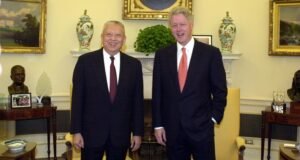
After Bush’s first face-to-face meeting with Jiang…Bush praised the two countries’ new joint anti-terrorism focus and said he had “no doubt that [China] would stand with the United States and our people during this terrible time.”
While the U.S. poured its attention and troops into Central Asia and the Middle East as part of its anti-terrorism campaign, China pursued the objective of stamping central government authority—with a distinctive identity of the majority Han population—across a restive region dominated by ethnic and religious minorities. “U.S. paranoia [?] about Islamic terrorism was only matched by Chinese paranoia about any challenge to the Communist Party,” said Richard Boucher, a former assistant secretary of State for Central Asia and State Department spokesperson from 2000 to 2005.
Within months, China’s Xinjiang narrative lurched from that of a stable region with scattered elements of “separatists’’ to that of a battleground beset by al-Qaeda-funded terror groups. The U.S. government endorsed that rebranding by designating a then little-known entity, the East Turkistan Islamic Movement (ETIM), as an international terror group.
That helped boost Xinjiang’s two-decade transformation into a militarized open-air prison for its ethnic Muslim populations, where security forces routinely conflate legitimate expressions of religious and cultural identity with terrorism….
Prior to 9/11, Chinese authorities had depicted Xinjiang as prey to only sporadic separatist violence…. An official Chinese government White Paper published in January 2002 upended that narrative by alleging that Xinjiang was beset by al-Qaeda-linked terror groups. Their intent, they argued, was the violent transformation of Xinjiang into an independent “East Turkistan.”
President Bush and members of his administration may deserve censure for going along with China’s rhetoric and even contributing to it. But the People’s Republic of China has never had a problem with repressing peoples within its borders; no inadvertent assists from the boneheaded diplomacy of other powers needed. Neither the Chinese state’s evil conduct nor its mangling of language to rationalize the conduct is a post-9/11 innovation.
For all its self-proclaimed opposition to what it calls terrorism, aka cultural differences, the PRC has no problem directly and indirectly abetting actual terrorists when the havoc that they wreak serves its ends.
Many of the Chinese government’s own assaults on persons and peoples are acts of terrorism by the most general dictionary definition: “the systematic use of terror especially as a means of coercion”; “terror” being defined in turn as “violence or the threat of violence used as a weapon of intimidation or coercion….” Sometimes the violence serves a different kind of purpose, as in the murdering of Uyghurs to harvest their organs.