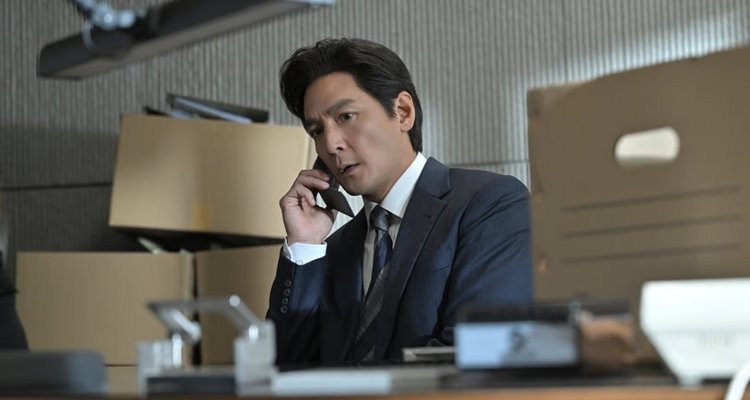
The South China Morning Post speaks of “invisible red lines” that makers of Hong Kong crime thrillers may not cross these days. The lines are not hard to detect.
For example, here’s a line dangerous to cross when scripting your film: if there’s rot in the system with which noble cops must contend, this rot has nothing to do with the Chinese Communist Party. As a rule of thumb, CCP authority good, British colonial-era authority bad.
1997 Minus Three
“Cold War 1994,” a 2026 prequel to the 2012 film “Cold War,” avoids pitfalls “by rewinding to the pre-handover era and pinpointing Britain as the ultimate source of trouble.” The Post calls these and other obvious accommodations of CCP censors “ingenious” (April 28, 2026).
The British colonial era has become a vital cinematic safe haven. To explore systemic corruption, police brutality and triad collusion without running afoul of censorship, filmmakers are displacing controversial narratives into history, yielding some of the most visually arresting and politically insulated films in recent years.
Wong Jing’s “Once Upon a Time in Hong Kong” (2021) and Philip Yung Tsz-kwong’s “Where the Wind Blows” (2022) both chronicle the rampant police-triad alliances of the 1960s and 70s, framing institutional rot as a bygone relic to satisfy the audience’s craving for gritty underworld politics.
Similarly, Felix Chong Man-keung’s “The Goldfinger” (2023) delves safely into the unabashed corporate greed and corruption of 80s Hong Kong, while Soi Cheang Pou-soi’s martial arts epic “Twilight of the Warriors: Walled In” (2024) uses the lawless, claustrophobic enclave of the Kowloon Walled City as its battlefield.
In these settings, villains can wear uniforms and institutions can be inherently flawed….
For directors helming big-budget crime thrillers set in the present day, the trope of the internal mole has been largely sanitised to maintain the moral purity of the police. Instead, filmmakers have turned to scaling up the villains.
Fantasy and absurdism are other “disguises” of themes that might otherwise arouse the censors. “In these films, the madness, the unseasonal snowstorms and the feverish pacing are not merely stylistic flourishes. They are the new vocabulary of the Hong Kong crime thriller, ensuring the genre remains a vital, beating heart of local cinema.”
So the post-2020 censorship in Hong Kong is not really so very bad, at least not for cinema, or at least not for crime thrillers. It just gives the creators a new hoop to jump through. Even if they can’t say what they want, they can say something sort of related somehow to what they would have said if they could, ensuring that crime thrillers remain “a vital, beating heart of local cinema.” And the camera work in some of these movies is wowzo!
Not noted in the Post’s piece is what happens to Hong Kong filmmakers who lack the ingenuity or willingness to knuckle under that is required to get their films shown in Hong Kong.
Kiwi Chow Kwun-wai
One consequence is that they can no longer show their films in Hong Kong. Last December, the Post talked about how Hong Kong authorities had “banned director Kiwi Chow Kwun-wai’s latest film, the campus thriller ‘Deadline,’ citing national security concerns, according to the award-winning filmmaker, whose previous documentary on the 2019 social unrest was also barred from cinemas….
“He said he had considered filing a judicial review, but received legal advice suggesting it could be pointless to sue the government in what he called an era of ‘judicial collapse’.”
Chow: “My response to this blow is that I will keep filming…. May justice come to Hong Kong.”
Also see:
Formosa News: “New film shot in Taiwan by ‘Our Times’ director blocked by HK film board” (video)