Things started well. Or did they?
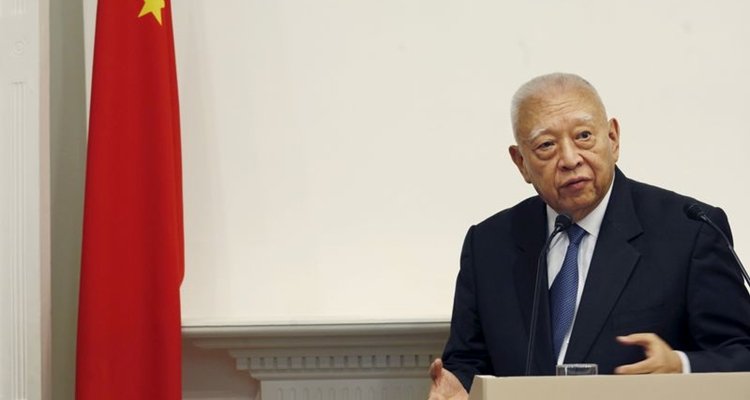
One of the pioneers of the Chinese Communist Party’s betrayal of Hong Kong, Tung Chee-hwa, has died. He was 89. He was a bad man (Reuters, September 8, 2026).
His obituary underscores the fact that there was never a time after Great Britain turned the city over to the People’s Republic of China when the new rulers planned to leave the two-system system intact.
The Party’s track record throughout the century had provided clues of what was to come. Its crude denunciations of the last British governor of Hong Kong, Chris Patten, for working to strengthen Hong Kong’s democracy was another indication.
From Patten to Tung
Tung was the first chief executive of the PRC’s new special administrative region.
“For the first time in history, we, the people of Hong Kong, will be master of our own destiny,” he said on July 1,1997, in his first speech in that capacity.
This innocuous-seeming assertion is already a dark and rumbling cloud on the horizon.
Considering the much greater freedom that Hongkongers had been enjoying under British rule than the people of the mainland had been enjoying under Red rule, the claim is dubious in the extreme. Also fatuous.
What did Tung regard as “our” destiny? Were individual destinies something that would now be even more freely chosen by Hongkongers themselves, with the mainland eager to cooperate in the further expansion of their rights and liberties? Were freedom and individualism now to be cherished? Or was “our destiny” to be a local version of the usual “happy future together” type CCP destiny according to which all persons in the world become numb, obedient serfs of the Party and its collectivist slogans and program?
Fully committed
One or more parts of what he said next would have been better, even corrective, if those next words could have been credited.
“The Special Administrative Region Government is fully committed to preserving the Hong Kong way of life, maintaining Hong Kong’s free and open economic system, upholding the rule of law, and building a more democratic society.”
Hooray. Way of life to be preserved. Free, open system maintained. Rule of law upheld. Plus: an even more democratic society. What Patten had tried to establish wasn’t democratic enough, that was the problem.
Except…first of all, whenever the party-state talks about acting in accordance with “the rule of law,” the meaning turns out to be acting in accordance with the state’s exercise of untrammeled arbitrary power over the individual, who is to have no recourse against it. The party-state is the law, and when the party-state obeys itself, this, in its view, is as fidelitous to the rule of law as you can get.
But maybe that’s not what Tung meant. And maybe he was also using the other words in their valid meanings and not their CCP meanings. At least, this is the kind of thing that people back then could have tried to tell themselves.
Article 23
However:
Six years later, Tung sought to push through Article 23. The proposed security law, covering offences like treason and sedition while expanding police powers, was widely seen as Chinese encroachment on Hong Kongers’ freedoms.
It triggered a half-million-strong protest, with many demonstrators wearing black as a sign of mourning.
Tung backed down. But the events of 2003 set the stage for increased tensions between opposition democrats and Beijing over the city’s future. These eventually boiled over with major, months-long pro-democracy movements in 2014 and 2019.
Tung’s ill-fated Article 23 bill was eventually approved in March 2024 by a predominantly pro-Beijing legislature….
After the blunt 2003 push to enact Article 23 by Tung and his security chief, Regina Ip, the chief executive’s popularity ratings plunged.
The national security bill was shelved. He resigned two years later, halfway through his second term, citing ill health.
The deposed Tung managed to snag an elder-statesman gig and “was considered influential behind the scenes.” Later, he set up a China-U.S. Exchange Foundation that the U.S. government report would accuse of “involvement in influence operations.”
In response to the prodemocracy protests of 2019, Tung chastised “anti-China disruptors” for endangering national security.
In a 2021 interview for People’s Daily, he expressed his support for excluding opposition candidates from Hong Kong’s elections. Elections are okay, he said, as long as they come out the right way.
Now he’s gone. Bye.