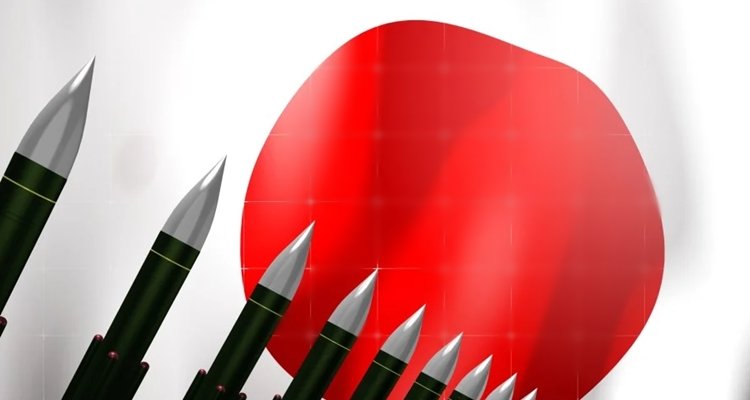
In July, Japanese Defense Minister Shinjiro Koizumi called for discussions “without taboos” on whether Japan might possess nuclear weapons. He repeated this call in late September, telling a TV interviewer, “The idea that we aren’t even allowed to have a discussion on this matter [of possessing nuclear weapons] is a bit at odds with my sense of crisis.”
The CCP was quick to respond, with Foreign Ministry spokesman Guo Jiakun saying that “whether Japan possesses nuclear weapons is not a matter for the Japanese side to discuss as it wishes.”
He warned Tokyo, as the Global Times summarized, that “as a non-nuclear-weapon state party to the Treaty on the Non-Proliferation of Nuclear Weapons, [Japan] has non-negotiable international legal obligations not to accept, manufacture, possess or proliferate nuclear weapons.”
As far back as 2016, former Japanese Prime Minister Shinzo Abe had said that “Japan is a signatory to the Nuclear Non-Proliferation Treaty and has its three nonnuclear principles, but it should not treat as a taboo discussion on the reality of how the world is kept safe.”
Three principles
Current Prime Minister Sanae Takaichi has urged review of the “three principles” that came into law in 1967: the principles of not possessing, not producing and not hosting.
Three principles for Japan, just one for Red China: “nuclear weapons for me but not for thee.”
In 2024 Takaichi opened the nuclear door, writing that “Even if we continue to adhere to ‘not possessing’ and ‘not producing’ [nuclear weapons], the ‘not permitting the introduction’ principle is not realistic if we expect the United States to provide extended deterrence. I was concerned that in an ultimate crisis, the wording ‘adhere to the three non-nuclear principles’ would become an obstacle.”
Now her defense minister, Shinjiro Koizumi, has taken the question beyond the hosting principle to possession.
What might be this “ultimate crisis” Takaichi refers to?
Well, in November of last year, she said that a communist naval blockade (never mind an invasion) of the Republic of China would trigger a “survival-threatening situation” for Japan.
Consider that there are reports of Japan’s being a “latent nuclear power” with 1.2 tons of enriched uranium and (as of 2014) nine tons of plutonium on hand (byproducts of its energy production). This means that according to experts, “Japan could develop its own nuclear weapons within three years if it wanted to.”
The question is why should Red China care? It has 600 nuclear weapons. It would take Japan three years from the start of a crisis to develop its very first handful of nukes. With respect to warheads, China remains mighty.
Furthermore, recall that the U.S. removed its nuclear weapons from Taiwan in 1972. Taipei then suspended its own nuclear weapons research in the late 1980s. And nowadays there are no U.S. nuclear weapons in neighboring Japan.
Why Beijing must worry
The communists hold almost all of the nuclear cards. Why should they worry?
For Beijing, the immediate problem is that if Japanese wrangling over building nuclear weapons leads to the conclusion that the third principle, that of not hosting, can be set aside if need be, hosting nukes could become a reasonable backup plan in case of a “survival-threatening situation.” If Japanese legislators are arguing over the farther, more controversial goal of producing atomic weapons, the hosting of U.S. weapons may become an easier question to settle, a palatable political compromise.
Red China worries that despite Japan’s current lukewarm self-defense posture, it might, by a sudden Diet vote, be transformed into a land bristling with tactical U.S. nukes in easy range of both Communist China and the waters around the Republic of China. And that can happen even if the other two principles are not repealed.
We can broaden this prospect to include nonnuclear scenarios. Japan’s current near-neutral defense posture requires PLA planning to cope with contingencies that include just a U.S. enemy and an ROC enemy. This assumption has led to certain force structures, a certain organization of forces, certain military expenditures, certain contingency plans.
Though it might begin slowly, the nuclearization of the Japanese military would likely be part of a larger military expansion and a hardening of Japanese foreign policy.
Japan’s entering the picture as a potential belligerent delivers major headaches: the need to reset Beijing’s force structures, organization of forces, military expenditures, contingency plans. A buildup is required. Everything becomes more expensive and harder.
And then there is the question of a new nuclear rival, however weak initially, and a cold war, an arms race, and the related stress accruing to the communist economy and political structure.
Article 9
But first Japan has to amend its constitution, particularly Article 9, which imposes restrictions on its military generally.
The Reds are not letting the grass grow under their feet. A new report from the Jamestown think tank shows that Beijing is launching “cross-domain operations…to fracture Japan’s domestic political consensus on security normalization. Beijing seeks to obstruct the political conditions that Tokyo’s constitutional amendments require through actions below the threshold of direct kinetic confrontation.
“The latest polling by Kyodo News shows public opinion on Article 9 revision evenly split with 50 percent in favor and 48 percent opposed. This suggests that even marginal [communist] influence could be sufficient to sway the outcome.”
It is sad to think that Japan’s nuclear and conventional defenses are at the mercy of Beijing’s influence campaign. But we shall see what Prime Minister Takaichi can do to get her way. □
James Roth works for a major defense contractor in Virginia.