The term “de facto” is used a lot to describe the diplomatic relations that the U.S. and other countries almost or somewhat have with the Republic of China. Taipei has formal diplomatic relations with just a dozen or so countries; with most countries, it has neither formal nor “de facto” diplomatic relations; with perhaps 59 countries, it has de facto or unofficial diplomatic relations.
The United States, unfortunately, accepts diplomatic relations with the ROC that are no more honest and supportive than “de facto.” The reason is that the U.S. wants to appease the People’s Republic of China. So although willing (mostly) to sell arms to Taipei, the U.S. government pretends to accept some version of the view that the Republic of China is not an independent country. The smog of Nixon-Kissinger-Carter China policy has been fixed in amber. Thus it is somehow possible for the current U.S. president to say, alluding to the Republic of China, that he is not “looking to have somebody go independent.”
De facto in Phoenix
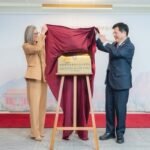
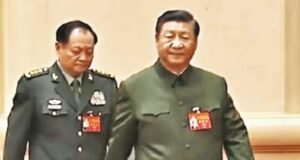
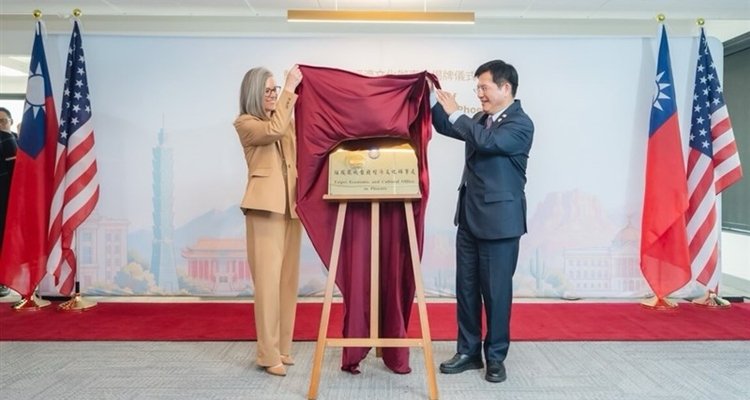
Into this confused matrix comes the news that ROC Foreign Minister Lin Chia-Lung (above right) “is visiting the US state of Arizona for the opening of a new de facto consulate in Phoenix,” the 14th in the United States (Reuters, October 5, 2026).
That the office was coming had been announced in July, when the ROC Ministry of Foreign Affairs said that the decision was motivated by “the new Taiwan-US high-tech industrial cooperation landscape, the increasing number of Taiwan enterprises and overseas compatriots in Arizona and surrounding areas, and the ever-closer interactions between Taiwan and various US state and municipal governments.”
South China Morning Post adds that Lin Chia-Lung will be touring the state’s semiconductor corridor “just days after US President Donald Trump wrapped up the pageantry of a state visit for President Xi Jinping.”
His visit will not include stops in Washington or meetings with anyone at the State Department, according to two sources familiar with the matter.
A trip to Washington just days after Xi’s visit could have risked a blow-up with Beijing, which used the September 23-25 summit to press the US to harden its line on Taiwan.
Beijing sees Taiwan as part of China and has never ruled out the use of force to reunite it with the mainland.
SCMP is also trading in ambiguity here. After having been a Japanese colony since 1895, Taiwan was turned over to Kuomintang (Nationalist) Chinese control at the end of World War II. The KMT ruled the Republic of China on the mainland for about 21 years, from 1928 to 1949. In 1949, the ROC government and Nationalist forces fled to Taiwan after losing the civil war with Mao’s communists—who established the People’s Republic of China on the mainland while the Republic of China established a contracted form of itself on Taiwan (and some much smaller islands).
Taiwan has never been governed by the PRC. And if the People’s Republic should ever conquer and absorb Taiwan, the two would not be “re‑”uniting with each other.