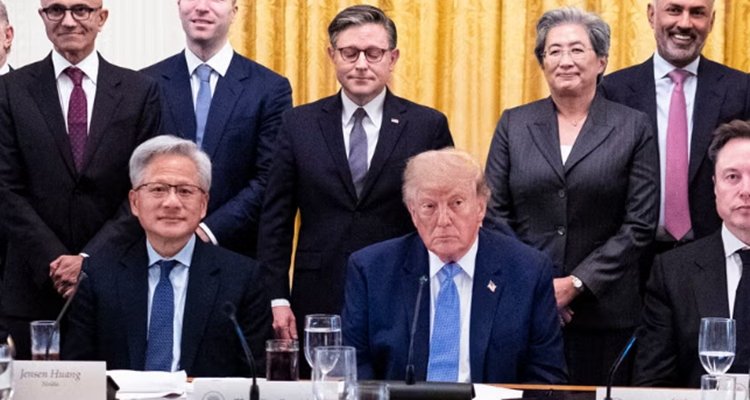
Nvidia’s Jensen Huang has been eager to sell microchips as advanced as U.S. policy will allow to firms in the People’s Republic of China. How advanced the exportable-to-PRC microchips can be has been affected by Jensen Huang’s lobbying of the U.S. President. Enter Alice Huang, a top executive at a Singapore company called Megaspeed who has been surveilled by U.S. spy agencies “for possibly steering advanced Nvidia A.I. chips to China” (The New York Times, October 29, 2026).
And now American officials had concluded that she was a Chinese intelligence asset, funneling information to Beijing.
But what came next was even more alarming. Surveillance of the executive, Alice Huang or Huang Le, a Chinese citizen, revealed that she had developed a close relationship with Jensen Huang, Nvidia’s chief executive.
For years, Washington has worked to deny China the technology needed to match or surpass the United States in the intense global competition for superiority in artificial intelligence. The discovery that Beijing was getting reports from someone with direct access to Mr. Huang, one of the most powerful figures in the A.I. revolution as well as an influential ally of President Trump’s, set off alarms at the White House.
Roughly a year ago, Mr. Trump was briefed about the intelligence findings, which have not been previously reported, and chose not to do anything with the information. Mr. Trump has been wary of disrupting Nvidia’s chip sales, which are helping to drive the economy and the stock market, and of further complicating the trading relationship with China….
The surveillance of Ms. Huang continues, they said, and companies that have been affiliated with her continued this year to purchase Nvidia chips. [Let’s hope Ms. Huang doesn’t read the Times.]…
Nvidia said the company that employed Ms. Huang, Megaspeed, was like any other regional customer and that it had previously investigated and debunked claims the Singaporean company was smuggling chips to China.
Compare the third paragraph of the excerpt above to the fourth paragraph.
Good, understandable: “Washington has worked to deny China the technology needed to match or surpass the United States in the intense global competition for superiority in artificial intelligence.”
Bad, not understandable: President Trump “chose not to do anything with the information [because he] has been wary of disrupting Nvidia’s chip sales [to the People’s Republic of China]…and of further complicating….”
These paragraphs contradict each other, at least if we take “Washington” to mean “everybody in Washington with influence on the relevant policies” and “worked to deny” to mean “worked consistently to deny.”
The White House, the FBI, and the NSA declined to give the Times any comment on this story. But people “briefed on the surveillance” gave interviews supplying the story “on the condition of anonymity because the findings are drawn from classified intelligence, as well as other officials and industry executives and analysts.” Which makes it sound as if one or more interviewees knowingly divulged classified intelligence to the Times.
Pre–AI model cyberattacks
The competition over artificial intelligence between the United States and the People’s Republic of China (or North Korea or Russia) is not like a badminton game that if you lose, oh well. AI models can be and have been used by bad actors to hack into systems more efficiently than hackers not using AI can. And the People’s Republic of China has a history of launching already pretty effective massive cyberattacks on the U.S. and world in the service of various nefarious ends.
Silk Typhoon. In 2021, CCP-backed hackers cyberattacked Microsoft Exchange Server in order to steal email and install backdoors, compromising “no fewer than tens of thousands of email servers.”
Volt Typhoon. From 2021 to the present, CCP-sponsored hackers have gained access to “the IT environments of multiple critical infrastructure providers in the U.S.” According to one U.S. cybersecurity official, the evidence “strongly suggests that the PRC actors are prepositioning to launch future disruptive or destructive cyberattacks that could cause impact to national security, economic security or public health and safety.” When might they want to launch these attacks? Maybe during an invasion of Taiwan by the People’s Liberation Army.
Salt Typhoon. Starting in 2023 and perhaps earlier, CCP-sponsored hackers targeted “more than 80 countries and may have stolen information from nearly every American” in a “years-long, coordinated assault that infiltrated major telecommunications companies and others…. Security officials warned that the stolen data could allow Chinese intelligence services to exploit global communication networks to track targets including politicians, spies and activists.”
Silk Typhoon. In 2024, CCP-sponsored hackers burrowed into systems of the U.S. Treasury Department. Associated Press reported: “The incident comes as U.S. officials are continuing to grapple with the fallout of a massive Chinese cyberespionage campaign known as Salt Typhoon that gave officials in Beijing access to private texts and phone conversations of an unknown number of Americans.”
QTFY. From 2018 to 2026 and especially 2024 to 2026, CCP-sponsored hackers breached various federal networks and attempted but failed to hack into systems of the U.S. Senate and “unnamed U.S. election systems.”
In the cyber wars, it would be better if the United States, not Red China, had the very most capable AI on its side. One thing this means is preventing powerful U.S.-crafted chips from getting to firms, i.e., to hackers, in the PRC. Let them work with vacuum tubes instead. Why assist in our own destruction?